I was reading the book 007: GoldenEye and noticed that Xenia Onatopp's description doesn't match Famke Janssen's looks; oh, and also this:
At first glance, the book appears to be playing fast and loose with orbits; after all, the ISS, which orbits around 400 km, is also on a roughly 90-minute orbit. So, let us check the numbers.
The first step is computing the acceleration of gravity $g_{100}$ at 100 km altitude. Using Newton's formula we can compute it from first principles (radius and mass of the Earth, gravitational constant... too many things to look up), or we can use the precomputed $g=$ 9.8 m/s$^2$ and solve for the altitude using a ratio of two Newton's formulas at different radii (using 6370 km as the radius of the Earth):
This acceleration has to match the centripetal acceleration of a circle with radius 6470 km, $a = v^2/r = g_{100}$, yielding a orbital speed of 7.84 km/s.
The circumference of a great circle at 100 km altitude is $2 \times \pi \times 6470$ km = 40,652 km, giving a total orbit time of 5180 s, or 1 hour, 26 minutes, and 19 seconds. So close enough to ninety minutes for a general.
So, yes, GoldenEye's orbit makes sense (-ish). Even though it's much lower than that of the ISS, which also has around 90 minute orbital period (92 minutes, and it's on a very mildly elliptical orbit).
On the other hand, a 100 km orbit would graze the atmosphere (it's inside the thermosphere layer, near the bottom) and therefore lose energy over time, so not a great orbit to place an orbital weapon masquerading as a piece of space debris, because you can't boost up "space debris."
Here are the circular orbital times for different altitudes; because of the approximation of $g=9.8$ m/s$^2$ and radius of the Earth as 6370 km, there are increasing errors with altitude, which are obvious for the GEO orbit (in yellow), still not bad since GEO shows that errors will be less than 2 minutes 38 seconds on all the other orbits:
There's no True(x) function for the internet (or anywhere else)
(Ignore the bad grammar, it was a long day.)
What happens if we feed the [putative social media lie-detector] function $\mathrm{TRUE}(x)$ the statement $x=$"the set of all sets that don't contain themselves contains itself"?
Let's take a short detour to the beginning of the last century...
Most sets one encounters in everyday math don't contain themselves: the set of real numbers $\mathbb{R}$ doesn't contain itself, neither does the set $\{$chocolate, Graham cracker, marshmallow$\}$, for example. So one could collect all these sets that don't contain themselves into a set $S$, the set of all sets that don't contain themselves. So far so good, until we ask whether $S$ contains itself.
Well, one would reason, let's say $S$ doesn't contain itself; then $S$ is a set that doesn't contain itself, which means it's one of the sets in $S$. Oops.
Maybe if we start from the other side: say $S$ contains itself; but in that case $S$ is a set that contains itself, and doesn't belong in $S$.
This is Russell's set paradox and it shows that there are propositions for which there is no possible truth value.
On the price of micro-SD cards
Browsing Amazon for Black Friday deals (I saved 100% on Black Friday with coupon code #DontBuyUnnecessaryStuff and you can too), I saw these micro-SD cards:
Instead of buying them, I decided to analyze their prices, first computing the average cost per GB (as seen above) and then realizing that there's a fixed component to the price apart from the cost per GB, which a simple linear model captures:
All the electricity California needs is about 6 kilos of antimatter
I was reading a report on how much it costs to decommission (properly) a wind farm and realized that if we just had some antimatter lying around (!), California energy needs would be met with small quantities.
Okay, antimatter is a bit dangerous, so how about we develop that cold fusion people keep talking about? Here:
(Divide that by an efficiency factor if you feel like it.)
Relativity misconceptions and the reason I restarted blogging
I was listening to a podcast with Hans G Schantz, author of the The Hidden Truth trilogy (so far… fans eagerly await the fourth installment; highly recommended) and he had to correct the podcast host on what I've noticed is a very common misconception: that "near" the speed of light relativistic effects are very large.
Which is true, for an appropriate understanding of "near."
Time dilation, space contraction, and mass increase are all regulated by a function $\gamma(v) = (1 -(v/c)^2)^{-1/2}$, a very non-linear function. For the type of effects that people typically think about, like tenfold increases, we're talking about speeds near $0.995 c$; for the type of effect that would be noticeable in small objects or short durations, one needs to go significantly above that:
Interestingly, the decision to restart blogging (first under the new name "Fun with numbers," then back to the admonition to keep one's thoughts to oneself by Boetius) was due to a number of calculations I had been tweeting regarding relativistic effects in theTorchship trilogy by Karl K Gallagher (highly recommended as well). Here are some examples, from Twitter:
And it's always heartwarming to see an author who keeps the science fiction human: that in a universe with mass-to-energy converters, wormhole travel, rampaging artificial intelligences, and AI-made trans-Oganesson-118 elements, there's a place for the problem-solving power of a wrench:
Computerphile has a simple data analysis course on YouTube using R
Strictly speaking, what the paper describes is a successful laboratory test rig, but let's be generous and consider it a successful tech demo, also known in the low-tech world as a proof-of-concept. Note that though not all successful lab test rigs become successful tech demos, the ratio is much higher than the number of lab rigs (successful and otherwise) that become tech demos, so it's not that big a leap in the technology development process.
Science illustrations made by people without quantitative sensibility
From a tweet I saw retweeted by someone I follow (lost the reference), this is supposed to be a depiction of the Chicxulub impact:
My first impression (soon confirmed by minor geometry) was that that impact was too big; yes, the meteor was big for a meteor (ask the dinosaurs…), but the Earth is really really big compared to meteors. Something that created such a large explosion on impact wouldn't just kill 75% of the species on Earth, it would probably kill everything on the planet down to the last replicating protein structure, boil the oceans, and poison the atmosphere for millions of years.
Think Vorlon planet-killer, not Centauri mass driver. 🤓
Using a graphical estimation method (fit a circle over that segment of the Earth to get the radius in pixels, so that we can translate pixels into kilometers), we can see that this is an overestimation of at least 6-fold in linear dimensions (the actual crater diameter is ~150km):
6-fold increase in linear dimensions implies 216-fold increase in volume (and therefore mass); using the estimated energy of the actual impact from the Wikipedia, the energy of the impact above would be between $2.81 \times 10^{26}$ and $1.25 \times 10^{28}$ J or up to around 22 billion times the explosive power of the largest H-bomb ever detonated, the Tsar Bomba.
The area of the Earth is 510.1 million square kilometers, so that's 43 Tsar Bombas per square kilometer --- which is a lot, considering that the one Tsar Bomba that was detonated had a complete destruction radius in excess of 60 km (or an area of 11,310 square kilometers) and partial destruction (of weaker structures) at distances beyond 100 km (or an area of 31,416 square kilometers). And, again, that's 43 of those per square kilometer; so, yeah, that would probably have been the end of all life as we know it on Earth, and I wouldn't be here blogging about it.
A more accurate measurement, using a bit of trigonometry (though still using Eye 1.0 for the tangents):
Because of the eye-based estimation, it's a good idea to do some sensitivity analysis:
(Results are slightly different for the measured case because of full-precision calculation as opposed to dropped digits in the original, hand-calculator and sticky notes-based calculation.)
It gets worse. In some depictions we see the meteor, and it's rendered at the size of a planetoid (using the graphical method here too, because it's quick and accurate enough):
To be clear on the scale, that image is 442 pixels wide, the actual Chicxulub meteor at the same scale as the Earth would be 1-7 pixels wide, which is smaller than the dots in the dotted lines.
For additional context, the diameter of the Moon is 3,474 km, so the meteor in the image above is almost 1/3 the diameter of the Moon (28% to be more accurate) and that impact crater is over 1/2 the diameter of the Moon (60% to be more accurate).
Solar energy density in context
2 square kilometers for 100 MW nameplate capacity… and they're in the shade in that photo, so not producing anything at the moment.
Capacity factor for solar is [for obvious reasons] hard bound at 50%. For California, our solar CF is 26%; let's give Peter Mayle's Provence slightly better CF at 30%, and those 2 square km of non-dispatchable capacity become about 1/20 of a single Siemens SGT-9000H (fits in 1200 square meters with a lot of space to spare for admin offices and break room, works 24/7).
Nano-review of R Programming Compiler for the iPad
Basics: Available on the iOS app store; uses a remote server to run the code, so must have a net connection. Free for the baseline but seven dollars for plots and to use packages, which I paid. The extended keyboard is very helpful considering the limitations of the iPad keyboard. (Also runs on the iPhone and the iPod touch, though I haven't used it on them yet.)
I wouldn't use it to develop code or even to run serious models, but if there's a need to do a quick simulation or analysis (or even as a matrix calculator), it's better than Numbers. Can also be used offline to browse (and edit) code, though not to run it.
The programmer-joke code snippet in the above screen capture run instantly over a free lobby internet in a hotel conference center, so the service is pretty efficient for these small tasks, which are the things I'd be using this for.
Some retailers plan to eat the losses from tariffs
My comment (on twitter): Yeah, these are well-behaved cost and demand functions so when a tariff is added to the cost, typically the quantity drops and the price rises, unless there's some specific strategic reason to incur short-term opportunity costs.
Rationale (from any Econ 101 course, but I felt like drawing my own, just for fun):
Note that Bain's breakpoint at 50% of the tariff is the solution to the problem under linear demand with constant marginal cost, but other shapes of demand can make that number much bigger, for example, this exponential leads to 74% (numbers rounded in the diagram but not in the computation):
The demand function is nothing awkward or surprising, just a nice decreasing exponential:
On the other hand, if the marginal cost decreases with quantity, particularly if marginal cost is strongly convex, there's a chance the actual price increase from a tariff is higher than the tariff, even with linear demand:
Note that this is different from lazy markup pricing. Lazy markup pricing always raises the price by more than the tariff, so in places where such outdated pricing practices [cough Portugal /cough] are common, tariffs have a disproportionate negative impact on the economy and general welfare.
Late non-numerical entry: Another news item based on not understanding the life cycle of technologies
From Bloomberg (among many others) we learn that there's a new solar energy accumulator technology, and as usual the news write it up as if product deployment at scale is right around the corner, whereas what we have here is a lab testing rig… that's a lot of steps before there's a product at scale. And many of those steps are covered with oubliettes.
Literally; and I use "literally" literally, not figuratively.
Most of the time we have an implicit linear worldview: if $x$ effort gives you $y$ result, then $(1+\epsilon)x$ effort should give you $(1+\epsilon)y$ result, approximately. And in many cases, where the $\epsilon$ is very small, this tends to be the case.
But the world isn't linear, especially in the gym. Especially in conditioning. (Editor note: conditioning is like cardio, except it actually works because it's high-intensity, short, and paused; that makes it very painful. This is why most people who are happy with no results prefer cardio, which delivers no results with only mild discomfort.)
Along with the basic, more functional conditioning movements (hill sprints, farmer's walks, stair sprints, sandbags), I've been doing medicine ball Atlas stones. Basically, one lifts a medicine ball from between one's feet to a platform above shoulder height (like an Atlas stone), then brings it back to the floor. Like any other conditioning exercise, this needs to be done correctly to avoid injury and not the CrossFit way of "fake it until you break it."
(The real Atlas Stone exercise. Those are not medicine balls.)
Medicine ball Atlas stone lifts have one of the most nonlinear pain response functions in the gym. Basically, for the first 5-10 reps, it feels like nothing is happening; the heart rate raises slowly and the muscles get a little hot. Then, at about 15, you discover muscles that never hurt before; discover them as they start hurting hard and fast. I discovered several new muscles in my neck --- and I regularly train neck as part of the posterior chain. At 20-25, the ball has become pure neutronium, the platform has relativistically moved up several parsecs, and your blood pressure could drive a nuclear power plant turbine. So you rest 90 seconds, then restart; that's conditioning.
That's non-linearity.
In fact the response function is highly non-linear, not something that could easily be approximated with a low-degree polynomial, so I propose the following model:
Plot of $\mathsf{Pain} \doteq \exp(\exp(\exp( 0.035 \times \mathsf{Reps})))$
One of these days I'll write something serious about the misuse of linearity in everyday thinking; possibly also comment on the use of "exponential" to describe all convex functions and the unprofessionalism of drawing said "exponentials" on slides using the 'draw ellipse segment' tool in PowerPoint instead of plotting the actual function. But that's for another day.
Added Nov 16, 2016: while we wait for that "another day," here's a visual comment on convex functions:
Stephen Wolfram helps popularize science. Real science.
When I watch science fiction movies I have to say I quite often cringe, thinking, “someone’s spent $100 million on this movie—and yet they’ve made some gratuitous science mistake that could have been fixed in an instant if they’d just asked the right person”.
Occasionally one can see code. Like there’s a nice shot of rearranging alien “handwriting”, in which one sees a Wolfram Language notebook with rather elegant Wolfram Language code in it. And, yes, those lines of code actually do the transformation that’s in the notebook. It’s real stuff, with real computations being done. (Emphasis added.)
Here's Dr. Wolfram (whose alter ego is Mr. Tungsten --- couldn't resist 😀) talking about serious things:
Living in the future is great, never mind those who long for the "good" old times.
I have two words for these who long for the good bad old times: modern dentistry. (Not my original thought, but I've heard it from many sources; don't know original attribution. Still effective at capturing the power of technological change at an emotional level.)
Ai Build's system uses video cameras outfitted with machine learning algorithms to allow robots to learn from their mistakes—meaning they can operate more quickly, correcting for errors on the fly instead of moving slowly to prevent them. According to Cam, Ai Build's arms can print in half the time it would take using standard techniques. (Via Singularity Hub.)
In one of the first medical applications of this concept, Synlogic has patented a version of E. coli engineered to develop “an unquenchable appetite for ammonia” and turn it into the amino acid arginine, which, unlike ammonia, is harmless to the human body. (Via Singularity Hub.)
Media Briefed on New NASA Hurricane Mission
As you can see, NASA is causing all these hurricanes to create a New World Order where scientists will rule and… huh, no. It's just that hurricanes are kind of easier to spot from high above the atmosphere than from the basements where the people who come up with these NASA conspiracies spend their lives.
That's it for this geek-out. Live long and prosper. --JCS
There are growing complaints that Silicon Valley companies discriminate against middle-aged engineers. But it might not be just ageism, it might just be aggregation error.
Engineering comprises mainly two things: a body of knowledge and a problem-solving mindset. To be a good engineer one needs an up-to-date body of knowledge in the relevant field and a facility with different problem-solving approaches used in the field (and possibly outside it as well).
(For the moment let's leave aside the problem-solving mindset; its dynamics are complicated and very situation-dependent: while some engineers acquire and develop problem-solving skills with experience, other fossilize their thinking, for example due to organizational practices.)
As part of what I do is continuing education, I have observed the dynamics of the body of knowledge as engineers' careers progress.
The largest group by far (sadly), makes little attempt to keep up-to-date with their field after formal education ends. In conversation, after a corporate training event, a member of this group told me that keeping up-to-date was "very nice in theory, but we don't have the time." All of us would like more time; but this person spent tens of hours per week watching TV. One of those hours per week spent updating their skill set would mean 52 hours per year, which would be more than enough (most of the participants in that event had fewer than 20h/year of training or study, and self-paced learning can be much more effective than group events.)
Most of the remaining engineers realized their technical obsolescence would become a problem and were retooling themselves for a management job. The main problem with this attitude is that there will always be fewer management jobs than engineers who plan to go into management. Secondarily, firms have both partially replaced management jobs with consultancy engagements and started prioritizing management-trained applicants over engineers.
A few engineers fell into a third category: those who keep up-to-date either because they realize the job implications of doing so or because they really love their engineering field. The problem, for those in this group, is that their small number makes them liable to be categorized into one of the other groups.
Placing ourselves in the position of Google, for example, the decision to consider a candidate who's been out of formal education for several years versus considering one that's just graduated --- even if Google believes that the energy of youth can be balanced by the temper of experience --- comes down to which of the three groups above the older candidate will fall into.
In the absence of good information, statistically the older candidate will be in the first group, in other words, aged, not experienced, a distinction that most of the engineers can but will not make (as it defeats their case).
(The younger candidate's type is irrelevant, because being fresh from school means an up-to-date skill set, at least for the near future.)
There are obviously many confounds: consider a choice between a newly minted computer engineer from Idaho State - Tubertown with no code to show (not even from school projects) versus a 45-year-old Caltech graduate class of '95 who has code on GitHub that is particularly relevant to the job, for example.
For the other engineers, who have been lax in their updating of skills, there's a solution: it's never too late to learn. And then: show, don't tell.
Production note: Some credit to Thunderf00t, for had he not made such a complete pig's breakfast of his analysis of Hyperloop, this "why scientists are bad at engineering" post wouldn't have been written. *
There are significant differences between an idea ("it would be great to fly from London to New York in four hours, let's use fighter jet technologies to make an airliner") and a marketable product (the Concorde). That's just on the engineering side, without the additional complexity of the business side.
Ideas to technology
An idea is just an organization of thoughts, for example: "if we got a train riding on magnets instead of wheels, we could get rid of friction, wear, and fatigue; then if we put the train in a low pressure tube we could go really fast."
This idea becomes a technology when you get something actually working; this something is called, for obvious reasons, a technology demonstrator. It's used to show that the technology has some potential, and it used to be a minimum requirement for getting funding. (More on that below.)
Linear motor Maglev technology is already available, though maybe not quite up-to-spec, but there are some technological barriers to overcome regarding the tubes and the pods.
Here it's worth noting a common error of reasoning, which is to assume that just because something hasn't been done, it can't be done.
For example, TF's use of a video excerpt showing Brian Cox inside "the largest vacuum chamber in existence." It's the largest because there was never a need for a larger one. It doesn't represent a technology limit. It's not that difficult to make a long tube that can take a big pressure differential (= pipeline), though we currently design this kind of tube for over-pressure because that's what its currentuse requires.
Many of the "the largest X in existence" limits are determined by economic necessity, not laws of physics. Think about the largest pizza ever made; was its size determined by some limit of the laws of physics?
Sometimes the technology is based on existing science, or co-developed with it, like some of the current work in biotech. Sometimes the technology precedes the science needed to explain it (or at least the attention of the scientists whose expertise is necessary to build the explanation), as was the case of most of the mechanical innovations in the first industrial revolution.
Part of the funding of Hyperloop is an investment in technology development that will have applications beyond the Hyperloop itself ("spillovers"). There's this thingamabob called a "laser" that was imagined as a pew-pew death-ray in sciFi, became reality as a pure Physics experiment, and mostly is used to checkout groceries, read data off of polycarbonate discs, pump bits down fiberoptics, and annoy cats. Oh, some pew-pew, too.
Sometimes licensing or developing the technology in directions other than the originally intended ends up being the most important part of the business.
It's probably worth noting two things at this point:
Hyperloop projects haven't finished the technology development phase; that would be indicated by a technology demonstration. Assertions about the final product at this stage are futile.
Getting funded by professional investment organizations (with their due diligence and fiduciary obligations) requires passing much stricter scrutiny than that given to crowdsourced projects (like Solar Roadways, the Fontus water bottle, or Triton artificial gills).
Technology to prototype
Once the technologies necessary for implementing the idea exist, they have to be put together and made to work under laboratory conditions or at test-scale, in the form of prototypes.
Here's where the "scientists are bad at engineering" point becomes most pointy.
Prototypes will obey the laws of Physics (and other sciences), since they operate in reality. It may be the case that the laws aren't known yet (as with the first industrial revolution) or that they are being simultaneously developed, but no prototype can violate the laws of Physics.
The problem is that there's a lot of specialized knowledge that goes into engineering. Each small piece of knowledge obeys the laws of Physics, but deriving them from first principles isn't practical. (And real scientists don't dirty their hands with engineering.)
For example, a physicist friend of mine didn't know why the suspenders of a suspension bridge (the vertical cables from the big catenary cable to the bridge deck) sometimes have a thin metal helix around them. When pressed on it he said "it's probably a reinforcement of some kind." I knew that the helix is there to limit aerodynamic flutter, and told him. He said, "oh, of course" and mentioned some interesting facts of turbulent flow.
That's what I mean by "science is the foundation of engineering, but scientists don't learn the body of knowledge of engineering." Most scientists are humble enough to understand that there are things they don't know. My physicist friend didn't assert that the helix was for reinforcement; he actually said, "I don't know," a sentence more people would be wise to use.
For illustration, here's a series of videos about metal shop work (the presenter is a professor, I believe, since he keeps talking about research prototypes, but he's seriously shop-savvy):
Instructive and entertaining videos. A big hat tip to Star Simpson for the link, via Casey Handmer. Such is the serendipitous nature of internet knowledge discovery.
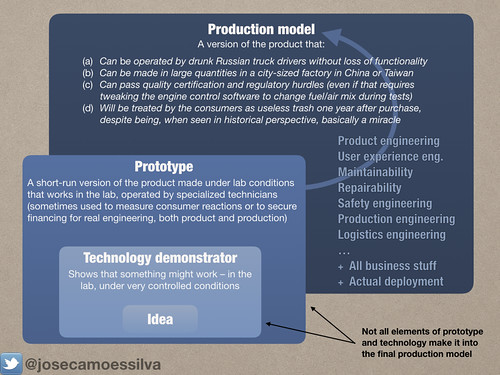
A prototype is a one-off, possibly scaled-down, version of the product reduced to its core elements. It's designed to be operated by specialists under controlled circumstances. It requires constant attention during performance and, conversely, is usually over-instrumented for its final purpose (as a product, that is), since part of its purpose as a prototype is to see which parts of the engineering body of knowledge need to be applied to the technology itself.
Sometimes that extensive instrumenting of prototypes helps discover hitherto unknown issues or phenomena and leads to rethinking of extant technologies and redesign or retrofit of existing products. Historically a good part of the body of knowledge of engineering has evolved by this process.
For example, vortex shedding in aircraft wings was not identified for the first several decades of aviation, even though the physics necessary for it was developed in the late 19th Century. Once the engineering idea of vortex shedding wingtips (or, for older airframes being retrofitted, winglets) entered the body of knowledge, it became universal for new airframe design.
The gulf between a prototype, typically a one-off object made to laboratory-grade specifications that requires an expert to operate, and a final product is almost as big as that between idea and prototype, and a lot of other specialized skills are necessary to bridge that gulf.
Prototype to product
Any engineering product development textbook will identify a lot of things that separate a prototype from a product, but here are a few off the top of my head (and the figure above):
Products have to be mass-produced by production facilities, not prototyping shops or laboratories. Figuring out how to mass-produce a product and organizing that production is what's called production engineering. Sometimes that involves the development of specialized production technology, and its prototyping and production, which might involve production engineering of its own, which might require... etc.
Products are to be operated by normal people, not expert operators (the drunk Russian truck drivers in the figure were motivated by the Only In Russia twitter account, a terrible sink of productivity). Though it's not entirely accurate, many people believe that Apple's success stems from its ability to deploy technology into final products by making it accessible to average users. That is the field of user experience design.
Products also need to be much more resilient, safe, repairable, and maintainable than prototypes. Though, sadly for the practice of engineering ---and the environment --- the "discard don't repair" mentality has taken hold, so maintainability and repairability aren't priorities in much product design. It being a railway, Hyperloop would have to be designed for both, of course.
There are a lot more. Engineering textbooks exist for a reason, they're not just collections of photos of pretty machines. A lot of knowlege goes into actually making things.
In the case of Hyperloop the product is passenger rail transportation, so there's yet another body of knowledge involved, that of managing railroad operations.
The whole "how hyperloop will kill you" schtick is nonsensical, since there's no final design to evaluate; but it becomes hilarious when almost all the ways to "kill" the passengers have well-established railroad solutions, namely sectioning (you can isolate sections of a line, and you can have isolation joints in the tube), shunt lines and spurs (to remove a pod from the main tube and access the outside world), instrumentation and control system with appropriate redundancies, and a wealth of other factors that any railroad engineer would be aware of.
I'm not a railroad engineer; these are basic Industrial Management observations.
And then there's deployment…
Anyone with a passing knowledge of operations management or project management could find some possible issues with the infrastructure of Hyperloop, even without knowing the details of the technology. Not impossibilities, issues that might cost money and time.
For example, a number of logistics complications come to mind regarding the construction of the Hyperloop along Route 5, namely: the movement of large-sized tube elements; the use of the Route 5 lanes as part of the construction area (even if most of the staging is done off of the road itself) while it's in use as a public roadway; and let's not forget that California municipalities are among the most anti-change in the world: NIMBY was invented here. Unless you know someone who knows someone who knows…
To have an idea of the scale of the problem created by moving the many elements of the tube, consider what happens when just one large assembly has to move on public roadways:
Building the Hyperloop infrastructure is essentially a large-scale project management problem, and specialists would be involved; I added the example above to show that there are more obvious difficulties than the risk of depressurization; in fact, depressurization isn't much of an issue under good operations management and a well thought-out track.
But pointing out commonsensical logistical difficulties doesn't help with the whole "I am a great scientist, hear me snark" persona.
- - - - - - - - - - Footnote - - - - - - - - - -
* My current view of transportation is that trains and ships are better for freight and cars and airplanes are better for people. By cars I mean autonomous individual vehicles, not necessarily individually owned, chaining for inter-city travel at 200-300 km/h (individual pods self-organizing into convoys), and swarming for autonomous intra-city travel. Most of the current problems with air travel are economic, regulatory, cultural, and managerial, not technological, though I'd like to see supersonic aircraft further along the product development process.
Maybe the Acela corridor would make sense for Hyperloop, though. Particularly since weather in the frozen Winter wasteland and broiling Summer Inferno of the Northeast is more volatile than in California, and the Hyperloop tube would be more resilient than the air shuttles, particularly the small planes. (Boston to NYC late December in a small plane… the horror, the horror.)
But as mentioned above, I believe there are some potential high-value spillovers from the technological developments necessary for Hyperloop, including advances in materials science and production engineering, even if it isn't ever actually built.
A couple of acquaintances asked me why I don't address TF's video (or its follow-up and comments on both YouTube and Reddit) directly. Giving it minimal thought,
Second, TF's not interested in the truth: he made his second video, which is based on the Hyperloop Alpha paper, after being told by Casey Handmer that the paper doesn't reflect current thinking on Hyperloop; and,
But the main reason not to get into online arguments with strangers is basically the same as for not wrestling with a pig: you both get dirty but the pig enjoys it.
Online learning is teaching us a lot. Mostly about reasoning fallacies: of those who like it and of those who don't.
Let us first dispose of what is clearly a strawman argument: no reasonable person believes that watching Stanford computer science lectures on YouTube is the same as being a Stanford CS student. The experience might be similar to watching those lectures in the classroom, especially in large classes with limited interaction, but lectures are a small part of the educational experience.
A rule of thumb for learning technical subjects: it's 1% lecture (if that); 9% studying on your own, which includes reading the textbook, working through the exercises therein, and researching background materials; and 90% solving the problem sets. Yes, studying makes a small contribution to learning compared to applying the material.
Good online course materials help because they select and organize topics for the students. By checking what they teach at Stanford CS, a student in Lagutrop (a fictional country) can bypass his country's terrible education system and figure out what to study by himself.
Textbooks may be expensive, but that's changing too: some authors are posting comprehensive notes and even their textbooks. Also, Lagutropian students may access certain libraries in other countries, which accidentally on purpose make their online textbooks freely accessible. And there's something called, I think, deluge? Barrage? Outpouring? Apparently you can find textbooks in there. Kids these days!
CS has a vibrant online community of practitioners and hackers willing to help you realize the errors of your "problem sets," which are in fact parts of open software development. So, for a student who wants to learn programming in Python there's a repository of broad and deep knowledge, guidance from universities, discussion forums and support groups, plenty of exercises to be done. All for free. (These things exist in varying degrees depending on the person's chosen field -- at least for now.)
And, by working hard and creating things, a Lagutropian student shows his ability to prospective employers, clients, and post-graduate institutions in a better country, hence bypassing the certification step of going to a good school. As long as the student has motivation and ability, the online learning environment presents many opportunities.
But herein lies the problem! Our hypothetical Lagutropian student is highly self-motivated, with a desire to learn and a love of the field. This does not describe the totality of college students. (On an related statistical note, Mickey D's has served more than 50 hamburgers.)
The Dean of Old Mizzou's journalism school noticed that students who downloaded (and presumably listened to) podcasts of lectures retained almost twice as much as students in the same classes who did not download the lectures. As a result, he decreed that henceforth all journalism students at Old Mizzou would be required to get an iPod, iPhone, or similar device for school use.
Can you say "ignoring the selection effect"?
Students who download lectures are different from those who don't: they choose to listen to the lectures on their iPod. Choose. A verb that indicates motivation to do something. No technology can make up for unmotivated students. (Motivating students is part of education, and academics disagree over how said motivation should arise. N.B.: "education" is not just educators.)
Certainly a few students who didn't download lectures wanted to but didn't own iPods; those will benefit from the policy. (Making an iPod required means that cash-strapped students may use financial aid monies to buy it.) The others chose not to download the lectures; requiring they have an iPod (which most own anyway) is unlikely to change their lecture retention.
This iPod case scales to most new technology initiatives in education: administrators see some people using a technology to enhance learning, attribute that enhanced learning to the technology, and make policies to generalize its use. All the while failing to consider that the learning enhancement resulted from the interaction between the technology and the self-selected people.
This is not to say that there aren't significant gains to be made with judicious use of information technologies in education. But in the end learning doesn't happen on the iPod, on YouTube, on Twitter, on Internet forums, or even in the classroom.
Learning happens inside the learner's head; technology may add opportunities, but, by itself, doesn't change abilities or motivations.