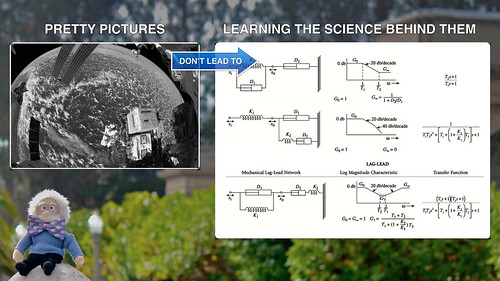
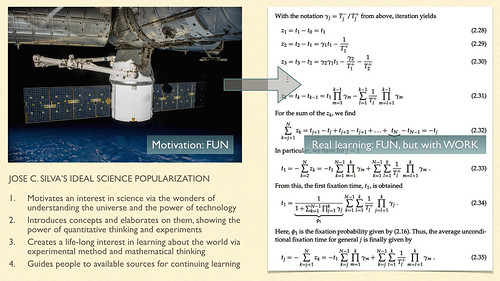
But there's a disturbing trend in education (brought in from non-technical fields) and in the reporting of technical fields (done by people with minimal-to-none interest in the technical matters, and yes, that includes those with putative training in the technical fields whose work is now in the infotainment business) of moving away from technical knowledge even in those technical fields:
The answers to the type 2 questions, real technical questions, from the top:
First question: The combustion equation would be
CH$_4$ + 2 O$_2$ $\rightarrow$ CO$_2$ + 2 H$_2$O
but it's unnecessary; since each methane molecule will yield a CO$_2$ molecule we can simply calculate the ratio of the masses: m(CO$_2$)/m(CH$_4$) = (12+2*16)/(12+4) = 44/16 = 2.75, so a metric ton of methane will yield 2.75 metric tons of carbon dioxide.
Second question: The density of air at one standard atmosphere and 19°C is 1.225 kg/m$^3$, so a 25 m$^3$ room contains 30.625 kg of air. A 1000 W heating element releases 3.6 MJ of energy in one hour. The increase in temperature is therefore (3600 kJ)/(30.625 kg x 0.72 kJ/(kg °K)) = 163 °K, for a final temperature of 182°C.
(Assuming no losses to the outside and using a constant value for the isochoric specific heat for air throughout the temperature range 0-200°C to avoid computing an integral, a reasonable approximation given it varies between 0.70 and 0.74 in that range.)
Third question: At resonance frequency $wL = 1/(wC)$ so $w^2 = 1/(LC)$, $w = 57,735$ radian/s or f = 9189 Hz. At that frequency the capacitor and inductor cancel each other out (impedance is zero and power factor is 1), so peak power is $5^2/100 = 250$ mW and RMS power is $250/\sqrt{2}$ = 177 mW.
These are not "gotcha" questions: I learned to solve the second in 11th grade; I learned electronics and chemistry by myself as a kid, but the material to solve the first was taught in 9th grade and the third in 11th grade, for students taking a chemical or electronics track in high-school (9th-12th grades). All of this was assumed known for incoming EECS students in the early 80s in Portugal.
Tempora mutantur, nos et mutamur in illis
From a video of an event in 2016. Most of the weight loss happened in the last 12 months as the result of intermittent fasting and a focus on high-protein, low-energy foods.
Another growth industry in San Francisco
When authors want to be science-y, but don't want to do the science…
From a mil-fic book that we'll keep unnamed.
At 18 km altitude, the gravity is 99.4% of the gravity at sea level ($6378^2/(6378+18)^2$), so Colonel Z would need super-human perception to be able to separate that $0.006 g$ from the turbulence and change in aircraft acceleration due to atmospheric changes.
(The story itself makes little sense, it's a remake semi-update of Tom Clancy's "Red Storm Rising," but with several errors of logic and biased by the need to make Russians super-hyper-badissimo-evil idiots.)
Chocolate milk, the high Protein-to-Energy version
Geeky linkage
(Because work has gotten into the way of blogging, social media, and other things. Book is 90-95% complete.)
Claustrophobia-inducing video by Smarter Every Day crawling inside a torpedo tube in a submarine while it's under the Arctic Ice Cap.
Nasa makes Einstein-Bose condensates aboard the ISS.
Scott Manley showcases the ideal villain lair, complete with a rocket to take the villain to a secret space base. Or a smart way to use the oceans to position a launch pad precisely where one wants (on the Equator, for example, to minimize the energy necessary to change the inclination of the orbit for a GEO satellite).
Because a real geek needs some sci- fi in their life.
Recycling some tweets on the third day of California shelter-in-place. Weather is nice:
I really don't like these "flatten the curve" diagrams posing as science
Maybe it’s just me, but this diagram strikes me as a number of unsupported unquantified statements presented as if it’s some sort of quantitative model based on real data
Axes have labels but no scales… so all we can measure is the relative magnitudes. Is that high peak at (D,A) 1%, 10%, 25%, or 90% of the population? Does it happen in a week, a month, or a year?
A/B = 415/110 so this undefined intervention lowers the peak by 73.5%. How many patients is that? Do these measures really slow down infection rates this much? Assuming that there’s no change to recovery speed, that’s a 4-fold reduction from an unidentified intervention.
E/D = 475/280 so this undefined intervention delays the peak by 70%. So if D is a month, this delays the peak a further three weeks, not long enough for a vaccine; if D is a year, that’s another 8 months, presumably enough.
B is still greater than C, so what happens when the slowed-down process crosses over the health system capacity? Rationing/triage or does this mean bodies littering the streets? That depends on that (B-C)/C = (110-83)/83 or 33% over capacity, but what happens needs absolute numbers, not relative; since there are no numbers, there’s no real meaning.
All the calculations above are just to show that if we’re to take a chart seriously we need to have real numbers and real details, and the above figure is just a qualitative “let’s hope this works to convince people to wash hands and stay away from others” masquerading as a technical models.
BY ALL MEANS, WASH YOUR HANDS, DON’T TOUCH YOUR FACE, AND STAY AWAY FROM OTHERS, because that makes sense. I've been doing it for as far as I can remember.
The information we're getting is preliminary and we're treating it as dogma
The internal consistency of this test is 75% (25% of the time the test doesn’t agree with itself in retesting); this doesn’t mean that the test is 75% accurate, because that’s measured relative to the underlying condition. This is an upper bound on the accuracy of the test, since we know that at least 25% of the time it's inaccurate for sure. (Sample size appears small, but for Medicine this is almost their version of "big data.")
It's easy to show that missing covariates leads to panic-inducing overestimates. The following numbers are not COVID19 data, just an illustration
Sometimes I despair of what people try to do with small amounts of data, and then the sarcasm comes out:
How can anyone deny this calamity?! In less than two months the entire population of the Earth will test positive.
In 100 days, over 8 trillion people will test positive. That's 5 times the total number of humans who've ever lived!!!!
TSLA twitter, always good for a laugh
No matter what the stock does or at what price it's trading, Ross always says "buy." One wonders how he charges 2-and-20 to his clients to give advice of this quality.
Richard "Hamster" Hammond drives a Tesla Model X
And gets very excited at adding one mile every few seconds at a Tesla Supercharger. (We can see in the touchscreen that the Supercharger is delivering 65 kW and Tesla claims 310 Wh/mi,* so that would average out at about 16 seconds per mile of range.) Not to be a spoilsport, but a gas pump adds about 26 miles of range per second (3 l/s in a 35 MPG car).
Then there's a small blur fail that reveals Hammond isn't really driving under the speed limit:
That's okay, Mr. Hammond, no one else is either.
- - - - -
* If you believe that number, you're exactly the kind of investor I'm targeting with a new product structured mostly with 2020 pandemic cat bonds; act now, supplies are limited.**
** CYA statement: this is a facetious offer, expressing derision for Tesla's number, not a proffer of a tradable security structured from out-of-the-money cat bonds.
Some videos to watch while the economy tanks around us
Grant Sanderson of 3blue1brown gave a talk at Berkeley about having people engage with math. The gist is that people want relevance and/or a story. That's good advice, but I think 3B1B's problem is that his audience is self-selected. In other words, that's how you engage an audience that's predisposed to look for and watch math videos. Still, good points.
Experimentboy is back, with thermal cameras. Very fun stuff.
PhysicsGirl suggests fun experiments to keep us from losing our minds while we wait to be moved to FEMA camps or be turned into Soylent Green.
YouTube affords the überdorks amongst us the opportunity to watch talks waaaaay above our expertise, something that in real life would be embarrassing, not to mention logistically difficult. So here are some links to:
Caltech. MIT-West, as some people who went to a technical school in Massachusetts call it.
Obviously it's very important that the product is 3D-printed, rather than CNC-machined or heat-molded. 3D-printers, like the Internet Of Things, are magical incantations that can get around the laws of Physics. Or so one would think, given how credulous people become at the sound of these incantations.
Alas, as is usual with engineering, ugly numbers murder beautiful illusions:
Since the battery voltage is 12V, a 12kW Peltier effect cooler will require a 1000A current, which is likely to make Li-ion battery a bit... well, just watch what happens:
Engineering rule: when an electronic device starts outgassing, that's generally not a good thing.
I often say that a mathematician thinks in numbers, a lawyer in laws, and an idiot thinks in words. These words don’t amount to anything.
A little unfair, though I've often cringed at the use of technical words by people who don't seem to know the meaning of those words. This sometimes leads to never-ending words-only arguments about things that can be determined in minutes with basic arithmetic or with a spreadsheet.
To not rehash the Heisenberg traffic stop example, here's one from a recent discussion of the putative California secession from the US (and already mentioned in this blog): people discussed California's need for electricity, with the pro-Calexit people assuming that appropriate capacity could be added in a jiffy, while the con-Calexit people assumed the state would instantly be blacked out.
No one thought of actually looking up the numbers and checking out the needs. Using 2015 numbers, California would need to add about 15GW of new dispatchable generation for energy independence, assuming no demand growth. (Computations in this post.) So, that's a lot, but not unsurmountable in, say, a decade with no regulatory interference. Maybe even less time, with newer technologies (yes, all nuclear; call it a French connection).
There was no advanced math in that calculation: literally add and divide. And the data was available online. But the "word thinkers" didn't think about their words as having meaning.
And that's it: the problem is not so much that they think in words, but rather that they don't associate any meaning to the words. They are just words, and all that matters is their aesthetic and signaling value.
Few things exemplify the problem of these words-without-meaning as well as The Igon Value Problem.
An eclectic essayist is necessarily a dilettante, which is not in itself a bad thing. But Gladwell frequently holds forth about statistics and psychology, and his lack of technical grounding in these subjects can be jarring. He provides misleading definitions of “homology,” “sagittal plane” and “power law” and quotes an expert speaking about an “igon value” (that’s eigenvalue, a basic concept in linear algebra). In the spirit of Gladwell, who likes to give portentous names to his aperçus, I will call this the Igon Value Problem: when a writer’s education on a topic consists in interviewing an expert, he is apt to offer generalizations that are banal, obtuse or flat wrong. [Emphasis added]
Educational interlude:
Eigenvalues of a square $[n\times n]$ matrix $M$ are the constants $\lambda_i$ associated with vectors $x_i$ such that $M \, x_i = \lambda_i \, x_i$. In other words, these vectors, called eigenvectors, are along the directions in $n$-dimensional space that are unchanged when operated upon by $M$; the $\lambda_i$ are proportionality constants that show how the vectors stretch in that direction. Because of this $n$-dimensional geometric interpretation, the $x_i$ are the matrix's "own vectors" (in German, eigenvectors) and by association the $\lambda_i$ are the "own values" (in German, you guessed it, eigenvalues).
Eigenvectors and eigenvalues reveal the deep structure of the information content of whatever the matrix represents. For example: if $M$ is a matrix of covariances among statistical variables, the eigenvectors represent the underlying principal components of the variables; if $M$ is an incidence matrix representing network connections, the eigenvector with the highest eigenvalue ranks the centrality of the nodes in the network.
This educational interlude is a demonstration of the use of words (note that there's no actual derivation or computation in it) with deep meaning, in this case mathematical.
Being a purveyor of "generalizations that are banal, obtuse or flat wrong" hasn't harmed Gladwell; in fact, his success has spawned a cottage industry of what Taleb is calling word-thinkers, which apparently are now facing an impending rebellion.
Taleb talks about 'skin in the game,' which is a way to say, having an outside validator: not popularity, not social signaling; money, physical results, a verifiable mathematical proof. All of these come with the one thing word-thinkers avoid:
A clear succeed/fail criterion.
- - - - - - - - - -
Added 2/16/2017: An example of word-thinking over quantitative matters.
From a discussion about Twitter, motivated by their filtering policies:
Person A: "I wonder how long Twitter can burn money, billions/yr. Who is funding this nonsense?"
My response: "Actually, from latest available financials, TWTR had a $\$ 77$ million positive cash flow last year. Even if its revenue were to dry up, the operational cash outflow is only $\$ 220$ million/year; with a $\$ 3.8$ billion cash-in-hand reserve, it can last around 17 years at zero inflow."
Numbers are easy to obtain and the only necessary computation is a division. But Person A didn't bother to (a) look up the TWTR financials, (b) search for the appropriate entries, and (c) do a simple computation.
That's the problem with word thinking about quantitative matters: those who take the extra quant step will always have the advantage. As far as truth and logic are concerned, of course.
"Quantum mechanics means that affirmations change the reality of the universe."
Really, there are people who believe in that nonsense. I don't know whether affirmations work as a psychological tool (ex: to deal with depression or addiction), though I've been told that they might have a placebo effect. But I do know that quantum mechanics has nothing to do with this New Age nonsense.
The most misunderstood example: Schrödinger's cat
A common thread of the nonsense uses Schrödinger's cat example and goes something like this:
"There's a cat in a box and it might be alive or dead due to a machine that depends on a radioactive decay. Because of quantum mechanics, the cat is really alive and dead at the same time; it's the observer looking at the cat that makes the cat become dead or alive. The observer creates the reality."
No, really, this is a pretty good summary of how the argument goes in most discussions. It's also complete nonsense. The real Schrödinger's cat example is quite the opposite (note the highlighted parts):
As the excerpt shows, Schrödinger himself described applying quantum uncertainty to macroscopic objects as "ridiculous." In fact, in the original paper, Schrödinger calls it burlesque:
In other words, this New Age nonsense takes Schrödinger's example of misuse of a quantum concept and uses it as the foundation for some complete nonsense, doing precisely the opposite of the point of that example.
Sometimes "nonsense" isn't strong enough a descriptor, and references to bovine effluvium would be more appropriate. In honor of the hypothetical cat, I'll refer to this as Schrödinger's cat litter.
Say his name: Heisenberg (physics, not crystal meth)
Schrödinger isn't the only victim of these cat litter purveyors: the Heisenberg Uncertainty Principle also gets distorted into nonsense like:
"You can't observe the position and the momentum of an object at the same time. If you're observing momentum, you're in the flow. If you're observing position, you're no longer in the flow."
As I've mentioned before, when over-analyzing a Heisenberg joke, the uncertainty created by Heisenberg's inequality ($\Delta p \times \Delta x \ge h$) for macroscopic objects is many orders of magnitude smaller than the instruments available to measure it. TL;DR:
Police officer: "Sir, do you realize you were going 67.58 MPH? Werner Heisenberg: "Oh great. Now I'm lost."
Heisenberg's uncertainty re: his position is of the order of $10^{-38}$ meters, or about 1,000,000,000,000,000,000,000,000,000,000,000,000 times smaller than an inch.
And yet, these New Age cat litter purveyors use the Heisenberg uncertainty principle to talk about human actions and decisions, as if it was applicable to that domain.
What are the "defenders of science" doing while this goes on?
Ignorance, masquerading as erudition, sold to rubes who believe they're enlightened. Hey, I'm sure many of the rubes "love science" (as long as they don't have to learn any).
Meanwhile, "science popularizers" spend their time arguing politics. Because that's what science is now, apparently...
Yes, the first observation is that I am a science geek. Some people binge-watch Kim Cardassian, some people binge-watch Netflix, some people binge-watch sports; I binge-watch college lectures on subjects that excite me.
(This material has no applicability to my work. Learning this material is just a hobby, like hiking, but with expensive books instead of physical activity.)
To be fair, this course isn't a MOOC; these are lectures for a live audience, recorded for students who missed class or want to go over the material again.
The following is the first lecture of the course, and to complicate things, there are several different courses from UC-Stalingrad with the same exact name, which are different years of this course, taught by different people. So kudos for the laziness of not even using a playlist for each course. At least IHTFP does that.
(It starts with a bunch of class administrivia; skip to 7:20.)
Production values in 2013, University of California, Berkeley
To be fair: for this course. There are plenty of other UC-Leningrad courses online with pretty good production values. But they're usually on subjects I already know or have no interest in.
Powerpoint projections of scans of handwritten notes; maybe even acetate transparencies. In 2013, in a STEM department of a major research university. Because teaching is, er…, an annoyance?
The professor points out that there's an error in the slide, that the half-life of $^{232}\mathrm{Th}$ is actually $1.141 \times 10^{10}$ years, something that he could have corrected before the class (by editing the slide) but decided to say it in class instead, for reasons...?
The real problem with these slides isn't that handwriting is hard to read or that use of color can clarify things; it's the clear message to the students that preparing the class is a very low priority activity for the instructor.
A second irritating problem is that the video stream is a recording of the projection system, so when something is happening in the classroom there's no visual record.
As a former and sometimes educator, I don't believe in the power of lectures without practice, so when the instructor says something like "check at home to make sure that X," I stop the video and check the X.
For example, production of a radioactive species at a production rate $R$ and with radioactive decay with constant $\lambda$ is described by the equation at the top of the highlighted area in the slide above and the instructor presents the solution on the bottom "to be checked at home." So, I did:
Simple calculus, but makes for a better learning experience. (On a side note, using that envelope for calculations is the best value I've received from the United frequent flyer program in years.)
This, doing the work, is the defining difference between being a passive recipient of entertainment and an active participant in an educational experience.
Two tidbits from the early lectures (using materials from the web):
Binding energy per nucleon explains why heavy atoms can be fissioned and light atoms can be fused but not the opposite (because the move is towards higher binding energy per nucleon):
The decay chains of Uranium $^{235}\mathrm{U}$ and Thorium $^{232}\mathrm{Th}$:
(Vertical arrows are $\alpha$ decay, diagonals are $\beta$ decay.)
Unfair comparison: The Brachistochrone video
It's an unfair comparison because the level of detail is much smaller and the audience is much larger; but the production values are very high.
Or maybe not so unfair: before his shameful (for MIT) retconning out of the MIT MOOC universe, Walter Lewin had entire courses on the basics of Physics with high production values:
(I had the foresight to download all Lewin's courses well before the shameful retconning. Others have posted them to YouTube.)
Speaking of production values in education (particularly in Participant-Centered Learning), the use of physical props and audience movement brings a physicality that most instruction lacks and creates both more immersive experience and longer term retention of the material. From Lewin's lecture above:
Yes, yet another rant against the "I Effing Love Science" crowd.
Midway through a MOOC lecture on nuclear decay I decided to write a post about production values in MOOCs (in my case not really a MOOC, just University lectures made available online). Then, midway through that post, I started to refine my usual "people who love science" vs "people who learn science" taxonomy; this post, preempting the MOOC post, is the result. Apparently my blogging brain is a LIFO queue (a stack).
Nerd, who, me?
I've posted several criticisms of people who "love science" but never learn any (for example here, here, here, and here; there are many more); but there are several people who do love science and therefore learn it. So here's a diagram of several possibilities, including a few descriptors for the "love science but doesn't learn science" crowd:
The interesting parts are the areas designated by the letters A, B, and C. There's a sliver of area where people who really love science don't learn science to capture the fact that some people don't have the time, resources, or access necessary to learn science, even these days. (In the US and EU, I mean; for the rest of the world that sliver would be the majority of the diagram, as many people who would love science have no access to water, electricity, food, let alone libraries and the internet.)
Area A is that of people who love science and learn it but don't make that a big part of their identity. That would have been the vast majority of people with an interest in science in the past; with the rise of social media, some of us decided to share our excitement with science and technology with the rest of the world, leading to area B.
People in area B aren't the usual "I effing love science" crowd. First, they actually learn science; second, their sharing of the excitement of science is geared towards getting other people to learn science, while the IFLS crowd is virtue signaling.
People in area C are those who learn science for goal-oriented reasons. They want to have a productive education and career, so they choose science (and engineering) in order to have marketable skills. They might have preferred to study art or practice sports, but they pragmatically de-prioritize these true loves in favor of market-valued skills.
As for the rest, the big blob of IFLS people, I've given them enough posts (for now).
- - - - -
Note 1: the reason to follow real scientists and research labs on Twitter and Facebook is that they post about ongoing research (theirs and others'), unlike professional popularizers who post "memes" and self-promotion. Or complete nonsense --- only to be corrected by much smarter and incredibly nice Destin "Smarter Every Day" Sandlin:
Note 2: For people who still think that if one of two children is a boy, then the probability of two boys is 1/3 (it's not, it's 1/2):
and the frequentist answer is in this post. Remember: if you think a math result is incorrect, you need to point out the error in the derivation. (There are no errors.)
This particular math problem is one favorite of the IFLS crowd, as it makes them feel superior to the "rubes" who say 1/2, whereas in fact that is the right answer. The IFLS crowd, in general, cannot follow the rationales above, though some may slog through the frequentist computation.
Early on in the movie Interstellar there are two important lessons about what makes a society fail (or succeed), both delivered in the parent-teacher conference that Cooper attends.
Lesson one: don't underestimate the power of engineering (and science)
Lesson two: beware of those who would rewrite the truth
(Excerpts from the novelization of the movie by Greg Keyes. No, I'm not a nerd. Ok, I am.)
Andrew Rader points out some problems with the movie:
The main problem was also pointed out by Kip Thorne in The Science of Interstellar: that fighting the blight on Earth would make a lot more sense than going to a different planet.
Thorne also raises the problem of orbital mechanics in chapter 7 of the book:
and proposes a few speculative mechanisms to get the necessary changes in velocity from gravity assists. Note that there are two decelerations one of $c/3$ and one of $c/4$ for a total speed change of $7c/12$ or $1.75\times 10^{8}$ m/s. Returning to the Endurance requires an increase in speed of $1.75\times 10^{8}$ m/s as well.
To see the size of the problem, let's say they take 500 seconds (8 minutes and 20 seconds) to do each maneuver (while the rest of the Universe ages significantly) and the Ranger's mass is 2 metric tons (for simplicity, we'll assume that the water taken in on the planet makes up for the loss of Dr. Doyle to stupidity, indiscipline, and lack of planning). If we assume constant thrust for simplicity, assume away all friction and ignore the propellant mass loss (yay, infinite specific impulse!), the thrust needed for each maneuver is $7 \times 10^8$ Newton or about the same as 1077 SpaceX Merlin engines (averaging their atmosphere and vacuum thrust to 650 kN). Since there's propellant mass loss, let's say we "only" need the equivalent of 900 Merlin engines. So, yes, only a gravity assist would do.
Yes, it's an oversimplification, but didn't feel like solving the Tsiolkovsky equation. Hence the drop from 1077 to 900 engines. (That's still equivalent to 100 Falcon 9 rockets.) By the way, Thorne appears unconvinced of the feasibility of those gravity assists and hence of the feasibility of whole expedition to Miller's planet. But at least they tried to be accurate with some science in the movie.
The problem with science communication is the science communicators who aren't interested in communicating science.
Take, for example, this tweet:
Yes, it's quite obvious that the Science Channel twitterer is referring to the solar system, not the galaxy.
No. That's not true.
The announced television show itself, I'm sure will get that right. But the twitterer? I literally can't even, as the kids say. And I literally can't even... bet a cup of coffee that the twitterer understands the difference between the solar system and the galaxy --- because I have an MBA.
Yes, a Master's degree in Business Administration, and that's what tells me that it's quite likely that the twitterer has no clue about the science. First, because it was posted at midnight on Friday; second, because it's television; and third because it's on twitter.
It's not even a case of people who "love" science (as long as they don't have to learn any). It's more a case of 'we need a "communications/social media team" for this property.' (Property here refers to the Science Channel.) That's the twitter part: the team is grown as an appendage to the marketing group because that's how people in media tend to see twitter, just another channel to add to the communications mix.
And these "communication/social media team" members are recruited from communication programs and from people who are part of the influence network of those in charge of recruiting, because that's how things are done in mass media conglomerates. So that's the television part.
At midnight on a Friday, the most junior or least competent members of the team will be the ones operating the account. And those are likely to be the ones who are least likely to know the difference between galaxies and solar systems.
But the recruitment of people who know nothing about science to positions of science communication isn't the worst problem.
The worst problem is that there's no problem, not really, because:
Since the audience doesn't care, the advertisers don't care either. After all, it's not like they really want a critical thinking audience for their commercials. (Remember, I have an MBA. Only few products and companies want a critical thinking audience.)
Since the advertisers don't care, the channel management doesn't care. And most in management have no interest in science; it's a product to be sold, just like potato chips and time-share vacations.
And the science-educated audience, the ones who notice these things? Well, everyone hates a know-it-all tattle-tale nerd. Until the technological society that was built by engineers on the foundations of science collapses.
Then, well, then that was a totally unpredictable act of God Nature.
Basically, because I'm not allowed to write or talk about work-related matters.
So I apply my considerable intelligence, broad knowledge, and unbeatable modesty to things like the differences between powerlifting and bodybuilding (and the superiority of the former over the latter), using the standard B-school two-by-two matrix format (click for bigger):
I also take to task people who think that knowledge is superfluous as long as their intentions are good (or at least consistent the the current "virtuous" narrative). For example, I did congratulate TIME for not using a photo of cooling towers for this article (unlike almost everyone else who uses images of cooling towers' steam to write about pollution),
but I do have to point out that most of what's seen coming out of those stacks is also steam. First, the color and the shape of the expansion give that away, but even if they didn't, gaseous $\mathrm{CO}_{2}$ is transparent, as is water vapor. (Steam is liquid water suspended in water vapor.) And soot and other common pollutants have distinctive colors; that white means water.
If you're surprised that combustion would generate water vapor, which condenses when it expands at the top of the stack, remember that hydrocarbon-based fuel combustion is mostly
and most of the rest (nitrous and sulfurous compounds, metals, soot and ash, the souls of the damned) are removed from the smoke before it's allowed to leave through the stacks (because of laws against pollution):
About a year ago, when I temporarily changed the name of this blog to Project 2016, the idea was to track non-work related learning, which is one of my hobbies; but time constraints made me choose between actually learning stuff and blogging about it, and I chose the learning.
So, expect some more carefully thought-out nonsense. Careful thinking is another one of my hobbies, so I practice it even on nonsensical topics. I have very strange hobbies: another one is moving heavy objects for no immediate purpose, like this gentleman
Literally; and I use "literally" literally, not figuratively.
Most of the time we have an implicit linear worldview: if $x$ effort gives you $y$ result, then $(1+\epsilon)x$ effort should give you $(1+\epsilon)y$ result, approximately. And in many cases, where the $\epsilon$ is very small, this tends to be the case.
But the world isn't linear, especially in the gym. Especially in conditioning. (Editor note: conditioning is like cardio, except it actually works because it's high-intensity, short, and paused; that makes it very painful. This is why most people who are happy with no results prefer cardio, which delivers no results with only mild discomfort.)
Along with the basic, more functional conditioning movements (hill sprints, farmer's walks, stair sprints, sandbags), I've been doing medicine ball Atlas stones. Basically, one lifts a medicine ball from between one's feet to a platform above shoulder height (like an Atlas stone), then brings it back to the floor. Like any other conditioning exercise, this needs to be done correctly to avoid injury and not the CrossFit way of "fake it until you break it."
(The real Atlas Stone exercise. Those are not medicine balls.)
Medicine ball Atlas stone lifts have one of the most nonlinear pain response functions in the gym. Basically, for the first 5-10 reps, it feels like nothing is happening; the heart rate raises slowly and the muscles get a little hot. Then, at about 15, you discover muscles that never hurt before; discover them as they start hurting hard and fast. I discovered several new muscles in my neck --- and I regularly train neck as part of the posterior chain. At 20-25, the ball has become pure neutronium, the platform has relativistically moved up several parsecs, and your blood pressure could drive a nuclear power plant turbine. So you rest 90 seconds, then restart; that's conditioning.
That's non-linearity.
In fact the response function is highly non-linear, not something that could easily be approximated with a low-degree polynomial, so I propose the following model:
Plot of $\mathsf{Pain} \doteq \exp(\exp(\exp( 0.035 \times \mathsf{Reps})))$
One of these days I'll write something serious about the misuse of linearity in everyday thinking; possibly also comment on the use of "exponential" to describe all convex functions and the unprofessionalism of drawing said "exponentials" on slides using the 'draw ellipse segment' tool in PowerPoint instead of plotting the actual function. But that's for another day.
Added Nov 16, 2016: while we wait for that "another day," here's a visual comment on convex functions:
Stephen Wolfram helps popularize science. Real science.
When I watch science fiction movies I have to say I quite often cringe, thinking, “someone’s spent $100 million on this movie—and yet they’ve made some gratuitous science mistake that could have been fixed in an instant if they’d just asked the right person”.
Occasionally one can see code. Like there’s a nice shot of rearranging alien “handwriting”, in which one sees a Wolfram Language notebook with rather elegant Wolfram Language code in it. And, yes, those lines of code actually do the transformation that’s in the notebook. It’s real stuff, with real computations being done. (Emphasis added.)
Here's Dr. Wolfram (whose alter ego is Mr. Tungsten --- couldn't resist 😀) talking about serious things:
Living in the future is great, never mind those who long for the "good" old times.
I have two words for these who long for the good bad old times: modern dentistry. (Not my original thought, but I've heard it from many sources; don't know original attribution. Still effective at capturing the power of technological change at an emotional level.)
Ai Build's system uses video cameras outfitted with machine learning algorithms to allow robots to learn from their mistakes—meaning they can operate more quickly, correcting for errors on the fly instead of moving slowly to prevent them. According to Cam, Ai Build's arms can print in half the time it would take using standard techniques. (Via Singularity Hub.)
In one of the first medical applications of this concept, Synlogic has patented a version of E. coli engineered to develop “an unquenchable appetite for ammonia” and turn it into the amino acid arginine, which, unlike ammonia, is harmless to the human body. (Via Singularity Hub.)
Media Briefed on New NASA Hurricane Mission
As you can see, NASA is causing all these hurricanes to create a New World Order where scientists will rule and… huh, no. It's just that hurricanes are kind of easier to spot from high above the atmosphere than from the basements where the people who come up with these NASA conspiracies spend their lives.
That's it for this geek-out. Live long and prosper. --JCS
Now for some science. Let's assume that the stolen vial contained 1 gram of antimatter. Then, the explosion would release $E = mc^2 = (0.002) \times (3 \times 10^8)^2 = 1.8 \times 10^{14}$ Joule. At 4.184 petajoule per megaton of TNT equivalent, that is an explosion of roughly 43 kiloton.
(The more observant readers will notice that there's two grams in the energy computation. That's one gram each matter and antimatter.)
The operational ceiling of helicopters is around 25,000 ft, but the helicopter piloted by Ewan McObi-Wan Kenobi is nowhere close to that altitude when he jumps. An air burst of 43 kiloton even at say 10,000 ft would create a lot more damage than shown in the movie. (For comparison, Hiroshima's burst was at the yield-optimized height of 2,000 ft and with a yield of about 15 kt.)
So Ewan McThe Ghost Writer would probably be a carbonized carmelengo rather than a usurper to the Vatican throne. And probably so would the faithful in St. Peter's square and the Cardinals in Busch Stadium The Sistine Chapel.
Nikolaj Lie Kaas, who plays the assassin, plays the corrupt CEO of the energy company in the recent Danish series "Follow The Money." I guess he's typecast as the sociopathic type now.
I claim extra nerd points for using RStudio to do the computations (was already open; it's pretty much always open these days):
When there's too little demand for electricity, certain grid operators (like the Portuguese one) use excess capacity to pump water from downstream of dams to the dam reservoir. This is a way to store energy for peak demand.
I understand that some mountainous region is studying the possibility of replicating this with a funicular that would operate as the water in the dam. The losses involved in moving the funicular imply low roundtrip efficiency (the ratio of the energy recovered to the energy entered into the "battery"). And, of course, the funicular can't be used for passengers, unless there's some special discount for unpredictable schedules.
At least two people have told me about a start-up (I forgot its name) that wants to solve the battery problem by using the same approach, only with dedicated masses on vertical tracks.
The tragedy of engineering is the murder of beautiful illusions by ugly numbers.
Let's say this company can use $100\%$ roundtrip-efficient motor/generators, that is, all the electrical energy that is converted into potential energy of the moved mass can be recovered as electrical energy with zero losses in the whole process. (Yes, this is a ridiculously generous assumption, but it won't matter.)
Say this company has a 1000 metric ton mass that can be raised up to 10 meters. It can therefore accumulate $98$ megajoule (MJ) or $27.44$ kWh. Sounds ok-ish for a battery, except:
1. If that mass is made of lead (density = $11.34$ kg/l), a cheap-ish dense material, its volume is 88.2 cubic meters. That's large for a battery: it's a cube almost 4.5 meters on the side. Remember that this assumes $100\%$ roundtrip efficiency motor/generators.
2. Gasoline has an energy density of $32$ MJ/l and jet fuel has an energy density of around $30$ MJ/l; using a readily available commercial-grade combined-cycle generator with around $65\%$ total efficiency, 98 MJ can be generated with less than 4 liters of jet fuel or gasoline.
Okay, the combined cycle generator takes some space, but so do the motor/generators and the support frame for the 1000 ton mass. And the space for the vertical track, of course.
Numbers. Killing illusions. No wonder so many people avoid them.
- - - -
To make up for the bursted bubble of delusion, here's the feel-good video of this week:
Science identity products like t-shirts, mugs, posters, and computer wallpapers are used to signal that the owner has an interest in science; unfortunately, because this interest in science has become fashionable -- at least in some segments of the population -- poseurs also buy these objects, lowering the quality of the signal.
I've written often (one, two, three, four, five times at least) about the problems with using science as an identity product, as with the people who "love science" as long as they don't have to learn any.
These products aren't necessarily only appealing to poseurs, though. People with a real interest in science and in science education also like them for, among other reasons,
1. Identity signaling. Like the poseurs, except it this case it's a real signal. People want to communicate their interest in science and the beauty of some scientific results and natural phenomena. (I own quite a few science identity products myself.)
2. Recruitment. These products can be useful motivators for bringing newcomers into an appreciation of science. By showing that there are other nerdsgeeks people interested in science, they create social conditions for others to come out as nerdsgeeks people interested in science.
3. Mere exposure. People like or at least feel more comfortable with things that appear familiar. The more exposure people have to scientific concepts and images, even if as part of jokes or background material in sitcoms like The Big Bang Theory, the less aversion they may feel when science content is presented to them.
There's one possible disconnect undermining these three points, though: that people who are influenced by exposure to the science identity products only like the aesthetics:
The big problem with the poseurs, which is a real problem not just my "I liked that band before it was cool" complaint, is not that they use the products to pretend to like science, though that would be bad enough. The real problem is that poseurs know that they don't actually like (or know) real science, so they feel threatened by those who do and take action to counter that threat, usually distracting from the science.
As my previous post showed, many poseurs in the media try to be "sciencey" but they fail miserably because in the end they don't understand that science is not like literature or art where the judgment of some other people is what matters. In science, reality is what matters. Poseurs don't get that, because to them reality is whether others buy into their pose.
Popular science content
Making science accessible to the general public is one of the most effective ways to improve society: it allows more people to partake of the benefits of knowledge (for example, avoiding junk science and quackery), it helps garner support for scientific enterprises that require public funding, and it creates the foundations for new generations with more and better scientists.
The problem is that popularizers can be real science popularizers or they too can be poseurs. And the poseur popularizers tend to be more popular. The glaring exception is Carl Sagan, but that's because he was both a pioneer in popularization and a real research scientist prior to that.
The most obvious difference is that Carl Sagan's Cosmos was designed to impress people with the power of science, while many current popularizers design their programs to impress upon the audience (a) how special they, the audience, are; and (b) how smart, knowledgeable, and suave the popularizer is. There are some exceptions, but they aren't the most successful popularizers, at least not on TV.
A rule-of-thumb that works for me is to ask whether the popularizer is an active researcher (or was until recently active) in the field. People whose job is some variation of "science popularizer" tout-court, even if they have some scientific training (which many of them don't), tend to focus on people and events rather than concepts and principles. In other words, they popularize the story of science rather than the actual science. (In many cases they either avoid the science completely, or they get most of it wrong.)
This rule works for two reasons:
First, an active researcher will know the science better than a non-researcher popularizer. This IMNSHO more than balances any communication advantages the non-researcher might have. One of the hilarious examples of this advantage is The Igon Value Problem, where active researcher Steven Pinker takes on the intellectual lightweight Malcolm Gladwell. (But supporting my observation above, Gladwell is more popular than Pinker.)
Second, an active researcher has to protect his/her reputation in the field. This adds motivation to get things right to the knowledge (the ability to do things right). When no one in Astrophysics takes you seriously (because you call yourself a scientist but your career total citations of 150 mark you as a museum manager), you can say ignorant things on twitter about planes and helicopters. An engineer who wrote nonsense like this would be mocked at any future technical conferences he/she attended:
Personally I decided to read textbooks in lieu of popularization books,* but there are some popular books I've read that I found worthy of recommendation, so here are two for now:
Deep science (or other technical) content
Leaning technical material is something that requires audience (perhaps in this case "student" would be the better term) participation.
Lectures can motivate study and are a good introduction to the material, but only self-paced study and practice exercises can make technical material stick.
There's a qualitative difference between (to quote again from my old post about Heisenberg) understanding that this is a joke, i.e. popularizer-level understanding:
Police officer: "Sir, do you realize you were going 67.58 MPH?
Werner Heisenberg: "Oh great. Now I'm lost."
and being able to completely spoil the joke by computing the actual uncertainty (deep understanding):
A simplified form of Heisenberg's inequality, good enough for our purposes, is
$\qquad \Delta p \, \Delta x \ge h $
Going by orders of magnitude alone, assuming that the mass of Heisenberg plus car is in the order of 1000 kg, and noting that the speed is given to a precision of 0.01 mi/h, an order of magnitude of 10 m/s, with $h \approx 10^{-34}$ Js, we get a $\Delta x$ of the order of
$\qquad \Delta x \approx \frac{ 10^{-34} }{10 000} = 10^{-38}$ m.
Only practice and study can create the kind of deep understanding that allows you to spoil people's fun at parties with numerical sidebars like this. Certainly something to aspire to...
That's not to say that lectures don't have value; I think of them as the warm-up sets you do before actually exercising. In that sense, they are very important, since they provide a passive experience that gets the material into context, setting up the active experiences of self-paced study and practice exercises.
Walter Lewin, shamefully retconned out of OCW and their official YouTube channels by MIT for undisclosed non-scientific transgressions, was one of the best Physics instructors online; even better than Feynman, since Lewin used actual in-class demonstrations and calculations matched to the examples. Here's a great class on standing waves:
1. MOOCs have economies of scale in production and diffusion, but the difficult parts of education, personalized attention, for example, don't scale.
2. MOOCs can derive brand equity from the institutions associated with the teaching, but whether that brand equity is deserved is an open question: there are many components to education beyond what most MOOCs offer. I made some observations about that regarding the Kenan-Flagler Online MBA.
3. MOOCs built out of classroom teaching and associated materials are audience-targeted; a course like Lewin's works well at MIT and possibly CalTech, but the speed of exposition and the amount of off-classroom work that Lewin expected from his students will not work for most other universities. Other materials, like textbooks, may partially make up for this, but even so most students would probably prefer better match between materials and audiences.
4. The major weakness of MOOCs as they exist now is the lack of evaluation and, in many cases, of ways to check your exercises. Since audiences (students) learn from these exercises, done individually and then corrected by a knowledgeable instructor, this is actually a much bigger weakness than I noted on the "MOOC-rize this" post.
In conclusion
There's nothing wrong about being out and proud as a nerdgeek someone who likes science; take care to avoid poseurs, both individuals and media darlings who don't have a track record of research; and if you want to learn more (kudos to you), there are plenty of MOOCs and other free resources to help you. One of those resources is called a Public Library and for the effort of getting a library card you can get a good education because in the end what matters is that you want to learn.
In the end what matters is that you want to learn. Poseurs don't want to.
-- -- -- -- -- -- FOOTNOTE -- -- -- -- -- --
* I find textbooks to do a better job than popularization books since I want to learn things at a more proficient level than a passing understanding. This requires time and effort, but I like it. (Hey, I lift heavy weights for no reason other than I like lifting heavy weights, so this isn't that different.)
The one enormous barrier to this approach is the ridiculous cost of textbooks in the US. I was interested in molecular biology, so I got Molecular Biology of the Gene, I believe for its weight in gold. There's now a new edition which costs its weight in diamonds, so I won't get that. Note that this is a personal interest in molecular biology; this is not work-related or anything monetizable, so the $\$200$ are a hobby expenditure. Which is fine, but still could discourage others from buying such an expensive book for a hobby.
I rationalize the cost by reminding myself of an old business associate who spent $\$150$ on a date with someone who, according to his later report, made Lady Macbeth sound warm and cuddly. So, that's about 3/4 of a textbook he could have bought there...


 Binding energy per nucleon explains why heavy atoms can be fissioned and light atoms can be fused but not the opposite (because the move is towards higher binding energy per nucleon):