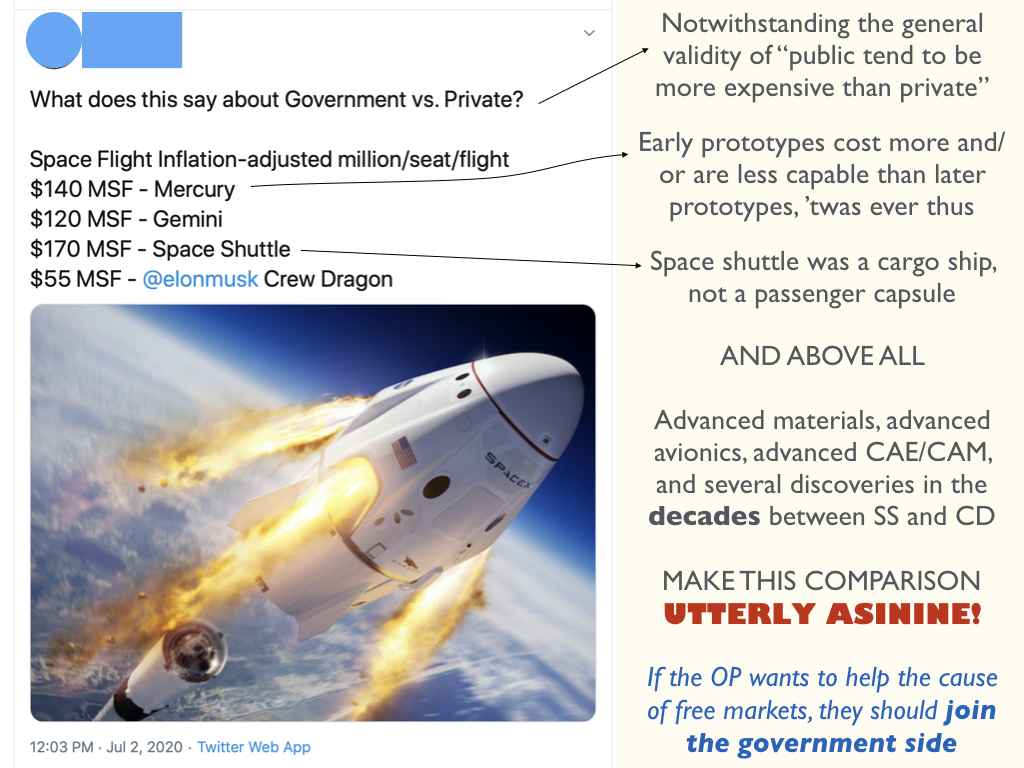
Been busy with book writing (another short book in the works while I wait for advance readers feedback on the numbers book; less math more management), so no time to blog. Some images from my Twitter for now.
When someone putatively supports one side (free markets) but uses such a flawed and weak argument, I recommend they wholeheartedly join the other side. This level of fail almost suggests it's a false flag.
While getting some of YV's books in audible form for travel and rowing, I realized that maybe Audible's search engine has some pathologies...
Trying a new yogurt I found at Whole Paycheck, ahem, Foods. Those live cultures help with 'le transit intestinal' as the French say. Obs: 1. very pricey; 2. P:E ratio 2/3 (low for yogurt); and 3. Inconsistent message. Taste: 7/10, will buy again.
From a site that has "engineering" in its title. Apparently not engineering enough for its writers to do basic (middle-school) physics. Relying on the NYT for physics is like using a chocolate frying pan. Behold:
Note that at Mach 15, around 5 km/s the energy density of a projectile is 12.5 MJ/kg (~ 3 times that of TNT), so the first sentence only makes sense for a impactor of around 1 to 3 tons. (More feasible that 100 tons, at least.)
Audiophiles aren't, in general, audiophools. There's some foolishness in the wings, but mostly what people who criticize us don't like is that we have taste and discernment.
More collected tweeterage and other social media detritus.
MSNBC doesn't care about getting numbers right
And water is wet and fire burns... Okay, this one is particularly egregious. It starts on twitter, with a person who doesn't understand the difference between millions and trillions:
But then, Brian Williams and NYT Editorial Board member Mara Gay put it up in a discussion of Bloomberg's failed presidential bid, and agree with it (video here):
The problem here isn't so much that anchors and producers at MSNBC can't do this basic math, it's that they don't care enough about getting the numbers right to ask a fact-checker to check them. Note that they had the graphic made in advance, and this was a scripted segment, so they didn't just extemporize and made an error. They didn't care enough about the numbers to check them.
And, given their response, they still don't care. This is sad.
A puzzle that's going around, solved correctly
Saw this on Twitter, and a lot of snark with it:
Apparently some people have difficulty with this puzzle, drawing a line in B that's parallel to the bottom of the bottle (perhaps they think the water is frozen?). But many of the people who mock those who draw that parallel line draw a horizontal line that is too low, creating a triangle.
Here's the correct solution:
As with all math problems, even very simple ones like this, the right approach is to do the math, not to try to guess and hand-wave your way to a probably-wrong solution.
In their haste to badmouth Millennials, finance researchers misstate their results
I saw this "Millennials are bad with money" article on Yahoo Finance, got the original report (PDF), and found a glaring problem with their data. (The table notes make it clear they're saying a conjunction, 'AND,' not a 'GIVEN THAT' conditional.)
My guess is that despite the table notes and the 'AND,' what they're measuring is the proportion of people who answered the three questions correctly GIVEN THAT they self-described as having high finance literacy, I.O.W. that's 19% of the 62%, not 19% of the 9041 Millennials. That would make the population in the conjunction 1065, whereas the number of people who got the three right answers is 1447; so about 4% of Millennials are money-smart[ish] but think they aren't.
But if you're going to get snarky about other people's issues with money, maybe write your tables and table notes a bit more carefully…
About the financial literacy of Millennials, these were the three multiple-choice questions:
Suppose you had $\$100$ in a savings account, and the interest rate was 2% per year. After 5 years, how much do you think you would have in the account if you left the money to grow? Answers: a) More than $\$102$; b) Exactly $\$102$; c) Less than $\$102$; d) Do not know; e) Refuse to answer.
Imagine that the interest rate on your savings account was 1% per year and inflation was 2% per year. After 1 year, how much would you be able to buy with the money in this account? Answers: a) More than today; b) Exactly the same; c) Less than today; d) Do not know; e) Refuse to answer.
Please tell me whether this statement is true or false. “Buying a single company’s stock usually provides a safer return than a stock mutual fund.” Answers: a) True; b) False; c) Do not know; d) Refuse to answer.
These questions are extremely simple, which makes the low incidence of correct answers troubling.
Science illustration lie factor: 71 million
How bad can science illustrations get? Let's ask the Daily Express from the UK:
We don't need to calculate to see that that meteor is much larger than 4.1 km, but if we do calculate (I did), we realize they exaggerated the volume of that meteor by just a hair under SEVENTY-ONE MILLION-FOLD:
To put that lie factor into perspective, here's the Harvester Mothership from Independence Day: Resurgence, which has only a lie factor of 50 (linear, because that's the dimensionality of the problem here):
Fun with our brains: the Stroop interference test
From a paper on the effect of HIIT and keto on BDNF production and cognitive performance that intermittent fasting and low carb advocate (and responsible for at least 50% of my fat loss) P.D. Mangan shared on twitter, we learn that people with metabolic syndrome show improvement on their cognitive executive function when on a ketogenic diet and even more if interval training is used.
To measure cognitive executive function they use a Stroop interference test, which is a fun example of our brains' limitations, so here's an example:
The test compares the speed with which participants can state the colors of the words in the columns inside the box: on the left the color and the word are congruent (the word is the name of the color of the text for that word), on the right the color and the word are incongruent (the word is the name of a color, but not the color of the text for that word).
Other than color-blind people, almost everyone takes less time and makes fewer mistakes with the congruent than the incongruent column. That's because the brain CEO (executive function) has to stop the reading and process color in the case of incongruent. This is easy to see if one compares the test with the two extras: speed of the incongruent is about the same as that of reading the words in Extra 1 column, while the speed of stating the colors of the Extra 2 column is much faster (and less error-prone) than that of the incongruent column.
(The paper also measures BDNF, the chemical usually associated with better executive function, directly, by drawing blood and doing an ELISA test; but it's interesting to know that diet and exercise may make you a more disciplined thinker and to see that in the numbers for an actual executive function test, not just the serum levels.)
Technically, Target isn't lying, it's 4 dollars off
But I've never seen that $\$$11.99 'regular' price for this coffee, which would make it the only coffee in the entire aisle not to have a regular price of $\$$9.99. All the other sale signs say 'Save $\$$2,' for what it's worth…
Destin 'Smarter Every Day' Sandlin visits a ULA rocket factory
And, on twitter, ULA CEO Tory Bruno gets a dig into SpaceX's Texas operations:
From my YouTube subscriptions, the image that inspired all this:
Ah, MIT teaching, where professors get former students who they consult for/with to teach all their classes, while still getting their teaching requirement filled…
(For what it's worth, students probably get better teaching this way, given the average quality of MIT engineering professors' teaching.)
These are not the typical MIT/Stanford/Caltech post-docs or PhD students teaching the classes of their Principal Investigators or Doctoral Advisors. These are business associates of Tom Eagar, who get roped into teaching his class "as an honor." (In other words, for free.)
Note that there is such a thing in academia as "organizing a seminar series," which some professors do (for partial teaching credit), formally different from "teaching a class" (full teaching credit). Doing the former for the credit of the latter… questionable, but sadly common in certain parts of academe.
On the other hand, as most MIT faculty and students will confirm, technical learning is 0.1% lectures, 0.9% reading textbook/notes, 9% working through solved examples, 90% solving problem sets, so all this "who teaches what" is basically a non-issue. (These numbers aren't precise estimates, just an orders-of-magnitude reference used at MIT.)
That's probably the major difference between technical fields and non-technical fields, that all the learning (all the understanding, really) is in the problem-solving. Concepts, principles, and tools only matter inasmuch as they are understood to solve problems.
(Sports analogy: No matter how strong you are, no matter how many books you read and videos you watch about handstand walks, the only way to do handstand walks is to get into a handstand, then "walk" with your hands.)
Which brings us to the next section:
Understanding technical material
There are roughly five levels of understanding technical material, counting 'no knowledge or understanding at all' as a level; the other four are illustrated in the following picture:
The most basic knowledge is that the phenomenon exists, perhaps with some general idea of its application. We'll be using gravity as the example, so the lowest level of understanding is just knowing that things under gravity, well, fall.
This might seem prosaic, but in some technical fields one meets people whose knowledge of the technical material in the field is limited to knowing the words but not their meaning; sometimes these people can bluff their way into significant positions simply by using a barrage of jargon on unsuspecting victims, but generally can be discovered easily by anyone with deeper understanding of the material.
A second rough level of knowlege and understanding is a conceptual or qualitative understanding of a field; this is the type of understanding one gets from reading well-written and correct mass-market non-fiction. In other words, an amateur's level of understanding, which is fine for amateurs.
In the case of gravity this would include things like knowing that the gravity is different on different planets, that there's some relationship with the mass of the planet, and that on a given planet objects of different masses fall at the same rate (with some caveats regarding friction and fluid displacement forces).
The big divide is between this qualitative level of understanding (which in technical fields is for amateurs, though it's also the level some professionals decay to by not keeping up with the field and not keeping their learned skills sharp) and the level at which a person can operationalize the knowledge to solve problems.
Operational understanding means that we can solve problems using the material. For example, we can use the formula $d= 1/2 \, g \, t^2$ to determine that a ball bearing falling freely will drop 4.9 m in the first second. We can also compute the equivalent result for the Moon, using $g_{\mathrm{Moon}} = g/6$, so on the Moon the ball bearing would only fall 82 cm in the first second.
This level of understanding is what technical training (classes, textbooks, problem sets, etc) is for. It's possible to learn by self-study, of course, since that's a component of all learning (textbooks were the original MOOCs), but the only way to have real operational understanding is to solve problems.
There's a level of understanding beyond operational, typically reserved for people who work in research and development, or the people moving the concepts, principles, and tools of the field forward. Since that kind of research and development needs a good understanding of the foundations of (and causality within) the field, I chose to call it deep understanding, but one might also call it causal understanding. Such an understanding of gravity would come from doing research and reading and publishing research papers in Physics, rather than applying physics to solve, say, engineering problems.
An example: Sergei Krikalev, the time-traveling cosmonaut
The difference between qualitative understanding and operational understanding can be clarified with how each level processes the following tweet:
More precise data can be obtained from the linked article and that's what we'll use below.*
Qualitative understanding: Special Relativity says that when people are moving their time passes slower than that of people who are stationary; the 0.02 seconds in the tweet come from the ISS moving around the Earth very fast.
(There's a lot of issues with that explanation; for example: from the viewpoint of Krikalev the Earth was moving while he was stationary, so why is Krikalev, instead of the Earth, in the future? Viascience explains this apparent paradox here.)
Operational understanding: time dilation relative to a reference frame created by being in a moving frame with speed $v$ is given by $\gamma(v) = (1 - (v/c)^2)^{-1/2}$. The ISS moves at approximately 7700 m/s, so that dilation is $\gamma(7700) = 1.00000000032939$. When we apply this dilation to the total time spent by Krikalev at the ISS (803 days, 9 hours, and 39 minutes = 69,413,940 s) we get that an additional 0.0228642576966 seconds passed on Earth during that time.
Because we have operational understanding of time dilation, we could ask how much in the future Krikalev would have traveled at faster speeds (not on the ISS, since its orbit determines its speed). We can see that if Krikalev had moved at twice the ISS speed, he'd have been 0.0914570307864 seconds younger. At ten times the speed, 2.2864181341266 seconds younger. And at 10,000 times the speed – over 25% of the speed of light – almost 28 days younger.
As a curiosity, we can use that $\gamma(7700)$ to compute kinetic energy, $E_k(v) = (\gamma(v)-1) \, mc^2$, or more precisely, since we don't have the mass, the specific energy, $E_k(v)/m = (\gamma(v)-1) \, c^2$. At its speed of 7.7 km/s the ISS and its contents have the specific energy of ethanol (30 MJ/kg) or seven times that of an equivalent mass of TNT.
To say that one understands technical material without being able to solve problems with that same understanding is like saying one knows French without being able to speak, read, write, or understand French speech or text. Sacré Bleu!
The application is what counts.
- - - - -
* The article also refers to the effect of gravity, noting that it's too low to make any difference (Earth gravity at the ISS average altitude of ~400 km is 89% of surface gravity; both are too small for the General Relativity effect of gravity slowing down time to be of any impact on Krikalev, or for that matter anyone on Earth).
Some collected numerical fun I had on twitter since the last post.
Science illustration fail: meteor tails in outer space
Why oh why do these representations always put meteor tails on objects far off the exosphere? That tail extends past 3000 km altitude, with the fireball center at around 1400 km. Little atmosphere there, fellas…
Also, that meteor (assuming it's the darker circle inside the fireball) is well over 300 km in diameter; even losing a big chunk of its mass in the atmosphere, it would reach the ground much larger than the 7 km the article says.
Star Trek: Picard nonsense: solar panels on/over the Golden Gate Bridge
I got this image, from the new show Star Trek: Picard, requiring unattainable suspension of disbelief — as if there was ever fluid traffic, let alone no traffic, on the GGB.
Oh, and also, solar roadways?! Really?!
I assume the Picard writers are from Hell-A, since anyone from the Bay Area would know that the GGB is fogged-in most days, so putting solar panels on it would be even stupider than on other roads, and that's saying something...
Okay, some have suggested panels are above the road. At 100% efficiency, 4 kWh/(m$^2$ * day) San Francisco insolation, and 75,000 m$^2$ deck area for the GGB, that's a 12.5 MW (average power) generator, and for that we cover one of the best views of the city?! In the 24th Century?!
Anyone who drives East on the Bay Bridge gets the transition from claustrophobic (West of Yerba Buena Island) to open space (East of YBI). Covering the GGB, especially as a pedestrian park, would be a terrible decision, more so for a puny 12.5 MW power rating.
Corona virus causes an epidemic of bad economics
What is it about supply and demand that is difficult to understand for otherwise intelligent people?
Two of many reasons why raising prices in these circumstances is good:
Some of the people who are reminded of the need for N95 masks, hand sanitizer, and disposable gloves during an emergency might realize that they shouldn't be unprepared in the future; if there's no enforced rationing (terrible thing to do, rationing) and the prices don't rise, these people may buy more than they need now, to address their previous failure to prepare. Therefore, raising the price will deal with some of this behavior, making supplies available to more people.
Expedited delivery (to the retailer) costs more than regular delivery. Some of these deliveries were made with an assortment of goods, many of which were high-margin (say bottles of 30-year-old scotch) that absorbed most of the cost of the delivery. Delivering truckloads of low-margin items like sanitizer and N95 masks alone (no expensive items to share the cost of the delivery) means the cost per unit is much higher.
California electrical consumption in nuclear explosions per year
Impressing people who have trouble with division, for emotional responses. (Not me.)
There's a video circulating on Twitter (not linking to it, for reasons that will become obvious) that describes the effect of AGW in terms of nuclear explosions per day. This is an excerpt of a much longer Thunderf00t video, which includes his customary numerical errors and bombast, but more importantly, and worse for a purported scientist, uses the imagery of nuclear destruction to create emotional responses to serious issues that demand cold analysis.
To show how ridiculous the imagery is, I calculated the equivalent of California's 2018 electricity consumption* in nuclear (fission and fusion) explosion units:
The point, which might escape some of the audience for that video, is that energy is energy and power is power; 45 Hiroshima-like nuclear explosions per day is just another way of saying 33 GW. Using such imagery is an appeal to emotion, not something a scientist should do.
Some collected numerical fun from twitter to end the year.
As an amuse-bouche, if you're going to mock other people for their lack of intelligence, perhaps don't make trivial arithmetic errors…
(In accordance with my recent resolution to be more positive by not posting negative content, I didn't post this to twitter and I obscured the author.)
Trust but verify, as they said in the Soviet Union:
In case the trigonometry isn't obvious, the angle (call it $\alpha$) is important to translate the horizontal measurements (say $l_1$ measured at $h_1$) into vertical distance via the magic of tangents: $\tan(\alpha/2) = l_1/(2 h_1)$ from where we get $h_1 = l_1/(2 \tan(\alpha/2))$.
The calculation above is actually for a FoV of 60° (camera), not 120° (eyes) as said in the text, because I used a hand calculator and post-its and transcribed the result from the wrong post-it; this result is about twice the correct result; for more accuracy, here are the different altitudes calculated [using a spreadsheet, like a proper responsible adult] as a function of what the angle taken by the big ship (around 50 m linear dimension) is:
(There are many approximations and precision trade-offs in the measurement, but SM's point holds: these are clearly different orbits and no one in the production or writing team seems to have noticed.)
It's only the equivalent of one to five .50-cal bullets...
The Hacksmith made one of those "how much dangerous nonsense can we post before YouTube throttles our channel" videos:
and I checked their Physics:
They replied on twitter that the maximum speed was over 2000 RPM, at which point I calculated that the kinetic energy was close to that of five .50-cal bullets.
What could go wrong, amirite?
(I like how the producers of Nikita [with Maggie Q, not La Femme Nikita with Peta Wilson] thought that the Styer HS .50 was an appropriate rifle for a shot through a window across a city street. Spoiler alert: it isn't; it's too much gun, in the words of Mike Ermentraut. The rifle looks gigantic next to Maggie Q, which is probably why they chose that caliber instead of something in .223 or .308 either of which would be more appropriate --- he said with all his marksmanship expertise acquired on the training fields of the xbox.)
Et tu, Arthur C. Clarke?
Usually A.C. Clarke's science is spot-on (excerpt from The Songs of Distant Earth),
but in this case, no:
(We could say that it's the captain of the Magellan that's wrong, perhaps exaggerating for effect, not A.C. Clarke, but that's a cop-out.)
Here's an example of A.C. Clarke getting much harder science right, from Rendezvouz with Rama (an old tweet, from the era when I wasn't blogging):
(I mean, what kind of nerd does numerical integration to check on the feasibility of a scifi author's solution to a minor plot point just to post it on twitter? This guy! 🤓 [Pointing both thumbs at self.])
Tidal turbines and bad interpretation of statistics
Real Engineering had an interesting video about tidal turbines:
But I had an issue with the conclusions from the impact study, because they repeat a common error: mistaking statistical significance (or lack thereof) for effect size. This point deserves a better treatment, but for now here's a simple example:
The energy density of the ocean, like other renewables, is still a bit on the low side. Compared to Canadian actinides, it's certainly lacking:
Carbon capture wonky accounting
The XPrize has a video on "Everyday Products Made Out of Thin Air":
I like the Xprize and the ideas behind it, but most of these 'carbon capture products' are complete nonsense. The CO2 footprint for the processes that make and market the product is much larger than captured CO2. In other words, these products harm the environment by increasing the total CO2 output.
If you create say 1000 tonnes of CO2 building a factory to make a product that captures 100 g of carbon per unit, you need to make over 2.7 million units just to capture the CO2 created by building the factory alone! (If the product has 100 g of carbon, that came from 44/12*100 = 367 g of CO2.) Not counting the footprint of packaging, delivery, etc.
(This is the same accounting problem that people have comparing the CO2 footprints in production of wind turbines and gas turbines. If the gas turbines already exist and the wind turbines don't, the CO2 footprint of building them has to enter the calculation [but never does…].)
Note also that the products aren't made of 100% carbon, so the correct accounting for how much CO2 they capture would necessitate accounting for the CO2 footprint of the other components and their delivery — usually to a net creation of CO2 by these 'capture' products just in this manner.
Let us not forget delivery; even if we just consider local delivery with a city van (like those that are always blocking traffic in San Francisco by being double-parked in awkward places, not that traffic moves in San Francisco, vans or no vans), the numbers aren't encouraging:
A Ford Transit cargo van is rated for 25 MPG in the city. Assuming that gasoline is 100% trimethylpentane for simplicity, burning 1 kg of gasoline yields 3.1 kg of CO2. One gallon of gasoline is 2.86 kg (3.79 l * 0.755 kg/l) so 100 miles of delivery route has a 35.5 kg CO2 footprint. If each product unit has 100 g of carbon captured (367 g of CO2), it takes 97 units in that delivery route just to make up for the delivery itself.
Here are some real carbon capture products: first some really big ones a little bit south of the Bay Area
I was reading the book 007: GoldenEye and noticed that Xenia Onatopp's description doesn't match Famke Janssen's looks; oh, and also this:
At first glance, the book appears to be playing fast and loose with orbits; after all, the ISS, which orbits around 400 km, is also on a roughly 90-minute orbit. So, let us check the numbers.
The first step is computing the acceleration of gravity $g_{100}$ at 100 km altitude. Using Newton's formula we can compute it from first principles (radius and mass of the Earth, gravitational constant... too many things to look up), or we can use the precomputed $g=$ 9.8 m/s$^2$ and solve for the altitude using a ratio of two Newton's formulas at different radii (using 6370 km as the radius of the Earth):
This acceleration has to match the centripetal acceleration of a circle with radius 6470 km, $a = v^2/r = g_{100}$, yielding a orbital speed of 7.84 km/s.
The circumference of a great circle at 100 km altitude is $2 \times \pi \times 6470$ km = 40,652 km, giving a total orbit time of 5180 s, or 1 hour, 26 minutes, and 19 seconds. So close enough to ninety minutes for a general.
So, yes, GoldenEye's orbit makes sense (-ish). Even though it's much lower than that of the ISS, which also has around 90 minute orbital period (92 minutes, and it's on a very mildly elliptical orbit).
On the other hand, a 100 km orbit would graze the atmosphere (it's inside the thermosphere layer, near the bottom) and therefore lose energy over time, so not a great orbit to place an orbital weapon masquerading as a piece of space debris, because you can't boost up "space debris."
Here are the circular orbital times for different altitudes; because of the approximation of $g=9.8$ m/s$^2$ and radius of the Earth as 6370 km, there are increasing errors with altitude, which are obvious for the GEO orbit (in yellow), still not bad since GEO shows that errors will be less than 2 minutes 38 seconds on all the other orbits:
There's no True(x) function for the internet (or anywhere else)
(Ignore the bad grammar, it was a long day.)
What happens if we feed the [putative social media lie-detector] function $\mathrm{TRUE}(x)$ the statement $x=$"the set of all sets that don't contain themselves contains itself"?
Let's take a short detour to the beginning of the last century...
Most sets one encounters in everyday math don't contain themselves: the set of real numbers $\mathbb{R}$ doesn't contain itself, neither does the set $\{$chocolate, Graham cracker, marshmallow$\}$, for example. So one could collect all these sets that don't contain themselves into a set $S$, the set of all sets that don't contain themselves. So far so good, until we ask whether $S$ contains itself.
Well, one would reason, let's say $S$ doesn't contain itself; then $S$ is a set that doesn't contain itself, which means it's one of the sets in $S$. Oops.
Maybe if we start from the other side: say $S$ contains itself; but in that case $S$ is a set that contains itself, and doesn't belong in $S$.
This is Russell's set paradox and it shows that there are propositions for which there is no possible truth value.
On the price of micro-SD cards
Browsing Amazon for Black Friday deals (I saved 100% on Black Friday with coupon code #DontBuyUnnecessaryStuff and you can too), I saw these micro-SD cards:
Instead of buying them, I decided to analyze their prices, first computing the average cost per GB (as seen above) and then realizing that there's a fixed component to the price apart from the cost per GB, which a simple linear model captures:
All the electricity California needs is about 6 kilos of antimatter
I was reading a report on how much it costs to decommission (properly) a wind farm and realized that if we just had some antimatter lying around (!), California energy needs would be met with small quantities.
Okay, antimatter is a bit dangerous, so how about we develop that cold fusion people keep talking about? Here:
(Divide that by an efficiency factor if you feel like it.)
Relativity misconceptions and the reason I restarted blogging
I was listening to a podcast with Hans G Schantz, author of the The Hidden Truth trilogy (so far… fans eagerly await the fourth installment; highly recommended) and he had to correct the podcast host on what I've noticed is a very common misconception: that "near" the speed of light relativistic effects are very large.
Which is true, for an appropriate understanding of "near."
Time dilation, space contraction, and mass increase are all regulated by a function $\gamma(v) = (1 -(v/c)^2)^{-1/2}$, a very non-linear function. For the type of effects that people typically think about, like tenfold increases, we're talking about speeds near $0.995 c$; for the type of effect that would be noticeable in small objects or short durations, one needs to go significantly above that:
Interestingly, the decision to restart blogging (first under the new name "Fun with numbers," then back to the admonition to keep one's thoughts to oneself by Boetius) was due to a number of calculations I had been tweeting regarding relativistic effects in theTorchship trilogy by Karl K Gallagher (highly recommended as well). Here are some examples, from Twitter:
And it's always heartwarming to see an author who keeps the science fiction human: that in a universe with mass-to-energy converters, wormhole travel, rampaging artificial intelligences, and AI-made trans-Oganesson-118 elements, there's a place for the problem-solving power of a wrench:
Computerphile has a simple data analysis course on YouTube using R
Strictly speaking, what the paper describes is a successful laboratory test rig, but let's be generous and consider it a successful tech demo, also known in the low-tech world as a proof-of-concept. Note that though not all successful lab test rigs become successful tech demos, the ratio is much higher than the number of lab rigs (successful and otherwise) that become tech demos, so it's not that big a leap in the technology development process.