Showing posts with label learning. Show all posts

Thursday, February 27, 2020

Learning and understanding technical material – some thoughts

Learning technical material


From my YouTube subscriptions, the image that inspired all this:


Ah, MIT teaching, where professors get former students who they consult for/with to teach all their classes, while still getting their teaching requirement filled…

(For what it's worth, students probably get better teaching this way, given the average quality of MIT engineering professors' teaching.)

These are not the typical MIT/Stanford/Caltech post-docs or PhD students teaching the classes of their Principal Investigators or Doctoral Advisors. These are business associates of Tom Eagar, who get roped into teaching his class "as an honor." (In other words, for free.)

Note that there is such a thing in academia as "organizing a seminar series," which some professors do (for partial teaching credit), formally different from "teaching a class" (full teaching credit). Doing the former for the credit of the latter… questionable, but sadly common in certain parts of academe.

On the other hand, as most MIT faculty and students will confirm, technical learning is 0.1% lectures, 0.9% reading textbook/notes, 9% working through solved examples, 90% solving problem sets, so all this "who teaches what" is basically a non-issue. (These numbers aren't precise estimates, just an orders-of-magnitude reference used at MIT.)


That's probably the major difference between technical fields and non-technical fields, that all the learning (all the understanding, really) is in the problem-solving. Concepts, principles, and tools only matter inasmuch as they are understood to solve problems.

(Sports analogy: No matter how strong you are, no matter how many books you read and videos you watch about handstand walks, the only way to do handstand walks is to get into a handstand, then "walk" with your hands.)

Which brings us to the next section:


Understanding technical material


There are roughly five levels of understanding technical material, counting 'no knowledge or understanding at all' as a level; the other four are illustrated in the following picture:


The most basic knowledge is that the phenomenon exists, perhaps with some general idea of its application. We'll be using gravity as the example, so the lowest level of understanding is just knowing that things under gravity, well, fall.

This might seem prosaic, but in some technical fields one meets people whose knowledge of the technical material in the field is limited to knowing the words but not their meaning; sometimes these people can bluff their way into significant positions simply by using a barrage of jargon on unsuspecting victims, but generally can be discovered easily by anyone with deeper understanding of the material.

A second rough level of knowlege and understanding is a conceptual or qualitative understanding of a field; this is the type of understanding one gets from reading well-written and correct mass-market non-fiction. In other words, an amateur's level of understanding, which is fine for amateurs.

In the case of gravity this would include things like knowing that the gravity is different on different planets, that there's some relationship with the mass of the planet, and that on a given planet objects of different masses fall at the same rate (with some caveats regarding friction and fluid displacement forces).

The big divide is between this qualitative level of understanding (which in technical fields is for amateurs, though it's also the level some professionals decay to by not keeping up with the field and not keeping their learned skills sharp) and the level at which a person can operationalize the knowledge to solve problems.

Operational understanding means that we can solve problems using the material. For example, we can use the formula $d= 1/2 \, g \, t^2$ to determine that a ball bearing falling freely will drop 4.9 m in the first second. We can also compute the equivalent result for the Moon, using $g_{\mathrm{Moon}} = g/6$, so on the Moon the ball bearing would only fall 82 cm in the first second.

This level of understanding is what technical training (classes, textbooks, problem sets, etc) is for. It's possible to learn by self-study, of course, since that's a component of all learning (textbooks were the original MOOCs), but the only way to have real operational understanding is to solve problems.

There's a level of understanding beyond operational, typically reserved for people who work in research and development, or the people moving the concepts, principles, and tools of the field forward. Since that kind of research and development needs a good understanding of the foundations of (and causality within) the field, I chose to call it deep understanding, but one might also call it causal understanding. Such an understanding of gravity would come from doing research and reading and publishing research papers in Physics, rather than applying physics to solve, say, engineering problems.


An example: Sergei Krikalev, the time-traveling cosmonaut


The difference between qualitative understanding and operational understanding can be clarified with how each level processes the following tweet:


More precise data can be obtained from the linked article and that's what we'll use below.*

Qualitative understanding: Special Relativity says that when people are moving their time passes slower than that of people who are stationary; the 0.02 seconds in the tweet come from the ISS moving around the Earth very fast.

(There's a lot of issues with that explanation; for example: from the viewpoint of Krikalev the Earth was moving while he was stationary, so why is Krikalev, instead of the Earth, in the future? Viascience explains this apparent paradox here.)

Operational understanding: time dilation relative to a reference frame created by being in a moving frame with speed $v$ is given by $\gamma(v) = (1 - (v/c)^2)^{-1/2}$. The ISS moves at approximately 7700 m/s, so that dilation is $\gamma(7700) = 1.00000000032939$. When we apply this dilation to the total time spent by Krikalev at the ISS (803 days, 9 hours, and 39 minutes = 69,413,940 s) we get that an additional 0.0228642576966 seconds passed on Earth during that time.

Because we have operational understanding of time dilation, we could ask how much in the future Krikalev would have traveled at faster speeds (not on the ISS, since its orbit determines its speed). We can see that if Krikalev had moved at twice the ISS speed, he'd have been 0.0914570307864 seconds younger. At ten times the speed, 2.2864181341266 seconds younger. And at 10,000 times the speed – over 25% of the speed of light – almost 28 days younger.

As a curiosity, we can use that $\gamma(7700)$ to compute kinetic energy, $E_k(v) = (\gamma(v)-1) \, mc^2$, or more precisely, since we don't have the mass, the specific energy, $E_k(v)/m = (\gamma(v)-1) \, c^2$. At its speed of 7.7 km/s the ISS and its contents have the specific energy of ethanol (30 MJ/kg) or seven times that of an equivalent mass of TNT.

To say that one understands technical material without being able to solve problems with that same understanding is like saying one knows French without being able to speak, read, write, or understand  French speech or text. Sacré Bleu!

The application is what counts.


- - - - -
* The article also refers to the effect of gravity, noting that it's too low to make any difference (Earth gravity at the ISS average altitude of ~400 km is 89% of surface gravity; both are too small for the General Relativity effect of gravity slowing down time to be of any impact on Krikalev, or for that matter anyone on Earth).

Sunday, February 26, 2017

Deepwater Horizon: Movie not-a-review


Even though this is not a review, but rather a description of how to enjoy a movie through advanced nerditude knowledge, there are some noteworthy points:

- The beginning gives an idea of how much infrastructure supports offshore exploration and the number of different companies and support industries involved. Maybe this will reduce the "nuclear energy needs a lot of additional infrastructure" comments; I'm not optimistic, though, because those comments are born of ignorance and fear.

- Casting is phenomenal and the actors portray accurately the type of worker one finds in dangerous, rough, hard jobs. Props to John Malkovich who plays the quintessential John Malkovich villain, with additional villainy and a southern accent.

- A scene I thought was "too Hollywood," when Wahlberg runs across a burning rig to start the emergency generators and save the day (well, within possible), is actually true. It actually happened, pretty much the way they showed in the movie.

- Kudos for the minimal "character development," a disease that has made many other movies unwatchable. There was some, obviously, but the movie kept to the story and focussed on the main action (first the decisions leading up to the accident, then the evacuation of the rig).

- Instead of "you should really care about this person because they have a family and lost their dog when they were little"-type "character development," we get credible interactions among human beings (which humanize them a lot more than that usual pap) and an accurate depiction of the culture in heavy industry, epitomized by: Wahlberg (about the skipped cement test): "Is that stupid?" Roughneck: "I don't know if that's stupid... but it ain't smart."

- The class demonstration that Wahlberg's daughter is preparing in the kitchen foreshadows the blowout, but it's a bit Hollywood: the complexity of what happened is beyond the movie and in fact the movie has a lot of situations where it's clear the writers decided to move forward without trying to explain what was happening (it's a movie, after all, not a training film for petroleum engineers).

- For all the entertainment value of the movie, and the educational points one may take away from it, there were 11 fatalities, a large number of injuries, and an ecological disaster involved. So, it was nice of the producers to include the final vignettes commemorating the losses.

Now, to the hard nerditude.

I heard of the incident at the Macondo well (that's the correct name for the location, the Deepwater Horizon is the drilling rig) when it happened and for a while the news were, as usual, full of uninformed speculation, name-calling, mentions of Halliburton (always a good villain for certain parts of the population) and greed, and attacks on fossil fuels.

Not being a petroleum engineer, I assumed that (a) everything the media said was either wrong or very wrong; (b) at some point there would be smart and knowledgeable people looking at this; and (c) reports from these smart and knowledgeable people would be put online, as a prelude to the many many many lawsuits to come.

So, when a friend bought the movie (friends with kids are great: they buy movies that I can borrow), I borrowed it and in a moment of extra nerdiness decided to learn something about the Macondo/Deepwater Horizon incident before watching the movie.

I struck gold with Stanford University:


I had a general idea about how drilling works, but the details are quite important. This video was very helpful:


Being an engineer, I went to the reports too. The easiest to read is the report to the President. Having read the report helped situate the movie, since a few of the important events are not in it (some are referred to in passing):

Halliburton simulated a specific cementing plan for the well, but the actual cementing did not follow that plan. In particular, because of the tight window of usable pressures for the cementing, the cementing pipe had to be centered accurately in the hole using more spacers than were actually used. Halliburton isn't mentioned in the movie because (a) they are scary and have lots of lawyers; or (b) they didn't do what they had simulated, on orders from BP, which makes it BP's responsibility.

Schlumberger (Sch-loom-bear-g-heh, which a roustabout calls Schlam-burger to mock Wahlberg's correct pronunciation) was on site to conduct a test of the cement and see if it had set, but as the action on the movie arrives on the rig, the testing team is leaving without running the test (what happened in reality). There's no doubt that the cementing failed, since that's where the oil and gas got into the pipe and eventually the riser to the surface, so in retrospect that test would have saved the rig and well.

Unmentioned in the movie is the large quantity of highly viscous plugging fluid used as a spacer between the cement and the drilling mud, which might have blocked the narrow pipes of the kill line and shown the zero pressure when there was in fact pressure. This is the part in the movie when the writers gave up, decided that giving an impromptu course in deep-water drilling to the audience was not their job, and moved forward into the actual action.

The most unbelievable scene in the movie, when Wahlberg runs across essentially a field of giant exploding flamethrowers (the burning rig) to start the backup diesel generators, is actually true. The rig was all electrically-operated, including the thrusters; without electricity they had no lights, no PA, and lost control of the rig (it moved off-station enough that it pulled the drill string through the blowout preventer and possibly disabled parts of the blowout preventer that would have cut the pipe and sealed the well).

Watching the movie, I found it difficult to believe that Transocean management, especially HR, was okay with 1 woman and 125 men on a 21-day rotation on a drilling rig, but that is apparently accurate (maybe a few more women, but overwhelming majority of people on the rig were men). The potential for lawsuit-inducing behavior just seemed too high.

All in all, I think that the movie was much more fun to watch having read the report and watched the videos beforehand than it would have been otherwise. I would have been thinking about the discrepancy between the drill pipe and kill line pressure and the blowout preventer failure till the end of the movie, so I would have missed the emotional and action-loaded last thirty minutes.

The Wahlberg/Rodriguez jump was all Hollywood, though.


Update April 5, 2017: the problems in the blowout preventer.


Thursday, September 8, 2016

Multitasking at the gym


Powerlifting and other training (including conditioning) are not multi-taskable. It's very important to keep one's concentration and focus on the exercise. I cringe when I see people talking with each other while moving metal. Even during warm-up sets; perhaps especially during warm-up sets, when the low weight allows one to do a preflighting of the movement, check for any anomalies in mobility or weak or sore prime movers or stabilizers.

When walking short distances, cooking, or doing housework, I tend to listen to podcasts or sometimes to the audiotrack of YouTube hangouts (basically the equivalent of radio's Morning Zoo). These are ways to get some low-density information into the brainpan without distracting too much from the errands. (I also listen to podcasts on shared transportation, like shuttles. Too much entropy for anything else.)

Some podcasts I listen to (there are more; I usually only listen to a few episodes a week):


(Yes, I have a significant déformation professionelle.)

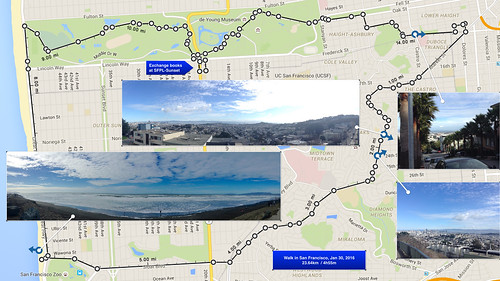
When I go for a real walk, what I call a walk-n-think, I typically listen to music, not any sources of information. The point is to think and clear the cobwebs of my mind. I find the Baroque a particularly good cobweb-solvent period. Here's a walk-n-think with a side-trip to exchange books at the SFPL:

Walk SF January 30, 2016

Once in a repetitive-motion machine in the gym, for oxygenation not conditioning purposes, the main determinant of the type of content is the movement of the head, in particular the eyes.

When walking on treadmills (my preferred cool-down approach) or rowing on a machine (which for me is real exercise, but of form and rhythm, not muscle), the head moves too much to fix the eyes on a screen; as the activity itself requires less attention than the errands, freeing attention for content, my choices of media are audio lectures and audio books.

(I only run on treadmills for High-Intensity Interval Training, which is conditioning, which means it cannot be multitasked. When doing anything that stresses the body, I always want 100% of the attention to be on the exercise. I have this strange desire to avoid injury, ridicule, and absence of gains; sort of the philosophical opposite of CrossFit.)

I should clarify that I'm using "lecture" to mean all sorts of purposeful speeches, not just university lectures. I do have a number of these speeches and lectures which work out well, many of them extracted from videos of talks where there were no significant visuals (or the visuals were the dreaded "power points," which are speaker's notes not audience-centered visuals).

As for audiobooks, I've been a Platinum member of Audible for fifteen years, which means I have two new books per month, which I complement by filling up on the seasonal sales and the occasional extra purchase.

Here are a few of my latest Audible purchases:


 On average I listen to around 30 audiobooks per year, some of which are re-listens.

(Yes, I re-read and re-listen to books. There are some books I read pretty much every year… Waugh, Wilde, and Wodehouse; certain Poirots and Maigrets; a few favorite Discworld pieces. There are 1000-page books I read every year, though that's just Anathem. And Cryptonomicon. And Reamde. And Seveneves, now on its second year. Guess who my favorite living author is.)

For other machines, like elliptical runners, stairclimbers, and exercise bicycles, the head doesn't move, so it's feasible to use the eyes. My old-but-trusted iPad 1.0 has seen this gym duty pretty much from the first day I bought it, which was the day it came out. (100% impulse purchase, as I was coming back from brunch and passed an Apple Store.)

Though in the past I've read books (paper books), journals (academic magazines), and magazines on paper on these machines, and have evolved to read electronic versions of these, I find that I prefer to give the eyes a break by letting them watch video instead of processing written words. I tend to watch lectures (again including speeches, but in this case a lot more real lectures) on the elliptical and the stairclimber, and to read books (ebooks with large type) only on the exercycle.

(Basically I use elliptical, exercycle, and stairclimbers in my building exercise room. It's not a "gym event," rather a "I need to take a break and instead of vegetating in front of the TV, which I no longer have service for, I can go do some movement while imbibing some basic knowledge.)

I keep a Rite-in-the-rain notebook and a Fisher space pen nearby in case I want to make notes, something that confuses other users of our exercise room. And that others have started to copy.

I hasten to point out that despite the déformation professionelle mentioned above, I tend to think of these books and lectures as leisure, so I keep them broadly within my areas of interest but not focussed on my actual area of work. For example, here are a few courses that I've enjoyed on the elliptical machines in the exercise room:


It's worth mentioning that real intellectual work cannot be multitasked, as indicated by the position of textbooks and research papers in the diagram. Anytime I'm looking to learn something, that requires dedicated attention, note-taking, and a block of dedicated time.

I don't mean work-related textbooks (though american textbook prices do their darndest to discourage the intellectually curious from serious study) or research papers (ditto with the gating, but public libraries and authors' own webpages are a good workaround), but even when I'm trying to learn something, say geology, our of pure curiosity, reading textbooks and research papers has been a much better experience than the materials that now pass for science popularization.

(My opinion on the decline of science popularization is well established in this blog.)

One thing I used to do at the gym (the real big gym, not the exercise room and not the powerlifting gym I occasionally go to instead of driving to the big gym) and eventually stopped due to social pressure, was to watch FoodTV network on the gym TV while cooling down on a treadmill or an elliptical, after 90-120 minutes of iron and conditioning. For some reason, those whose entire workout is 30 min of slow walking on the elliptical (what I call a Potemkin workout, still better than Planet Fatness or CrossFit) were not happy with my selection of programming.

Go figure.

Sunday, January 3, 2016

Recognizing, knowing, understanding.

The future needs people who really understand technical material, but I fear what now passes for technical education (including self-education) lacks depth.

Reusing my example of the Heisenberg (physics, not cristal meth) joke, namely,
Police officer: "Sir, do you realize you were going 67.58 MPH?
Werner Heisenberg: "Oh great. Now I'm lost."
there's a number of levels at which we can understand it.

At the recognition level, Alex associates "Heisenberg" with "science reference" and decides to laugh to appear educated. I find that most people who "love" science are like Alex. I also find people like this in my field of work, effectively LARPing at being experts.

At the knowing level, Blake has some idea that Heisenberg said that you can't measure speed and position together with arbitrary precision. Blake also knows that Heisenberg was talking about electrons or other particles, so applying his "rule" to a car must be hilarious.

At the understanding level, Chris can do what I did and spoil a joke by making calculations. From the linked post:
A simplified form of Heisenberg's inequality, good enough for our purposes, is 
$\qquad \Delta p \, \Delta x \ge h $ 
Going by orders of magnitude alone, assuming that the mass of Heisenberg plus car is in the order of 1000 kg, and noting that the speed is given to a precision of 0.01 mi/h, an order of magnitude of 10 m/s, with $h \approx 10^{-34}$ Js, we get a $\Delta x$ of the order of 
$\qquad \Delta x  \approx \frac{ 10^{-34} }{10 000} = 10^{-38}$ m.
There are degrees of understanding, from the ability to make use of the uncertainty principle, as above, to deeper understanding of what that means for what the universe is like. But at the most basic level of understanding, you should be able to operationalize knowledge into decision, calculation, program, etc.


I think that there's some merit in trying to improve from recognition to knowledge and from knowledge to understanting. So here are a couple of observations on that:


Recognition to knowledge


The main problem in most cases, as I see it, is not of ability or opportunity but rather of motivation: if Alex gets social cachet for "loving" science just by recognizing a "science situation," why put in the effort to learn some science (or other technical material)?

There's a trap, however, for people who decide that they want knowledge: because of the identity problem in science popularization, most of the more popular sources are designed for recognition only, not understanding.

I find that books, lectures, etc. from active researchers or practitioners in the technical field (say Leonard Susskind instead of Neil deGrasse Tyson) generally mean better chance of knowledge rather than recognition. Even when non-researchers and non-practitioners are better at showmanship (mistaken for communication skils), it's worth a little effort to get real knowledge from those who understand it and don't treat their readers or audiences as an echo chamber.

(As for television shows, except for a few that are based on books by active researchers, they are to be avoided: they are not reliable sources, not even for the recognition level.)


Knowledge to understanding


Problem sets. That's the solution.

Well, to be precise, the step from basic knowledge to understanding has two parts: first, learn the concepts, principles, and tools of the field; second, practice them with incrementally difficult problems.

For the Heisenberg example, some of the elements needed for understanding are:
Concepts: speed, mass, momentum;
Principles: uncertainty principle;
Tools: order-of-magnitude reasoning.
My rule-of-thumb for learning technical material is $1\%$ from being a passive member of an audience (to a lecture or a video) or a passive reader (reading but not thinking); $9\%$ from actively studying the material (say, working through solved problems, making sure you understand all the steps in an example); and $90\%$ is practicing, in the lingo of academe solving problem sets.

It then becomes a matter of how much practice and how much effort you're willing to put in: at this level, the difference between amateurs and professionals is that amateurs practice something until they get it right, professionals practice until they can't get it wrong.


Understanding something is so much better than just knowing it, and knowing it so much better than just recognizing it. It worth the effort and the change in attitude required. At least for me it is.