Showing posts with label economics. Show all posts

Saturday, July 4, 2020

Fun with geekage for July 4th, 2020

Been busy with book writing (another short book in the works while I wait for advance readers feedback on the numbers book; less math more management), so no time to blog. Some images from my Twitter for now.


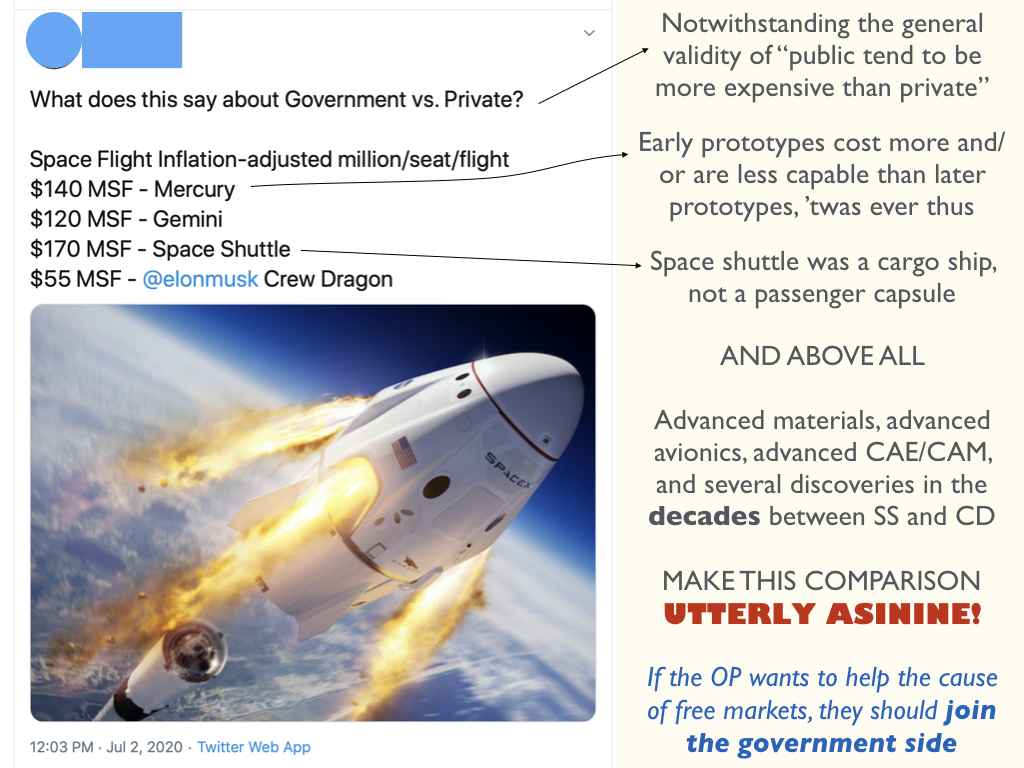
When someone putatively supports one side (free markets) but uses such a flawed and weak argument, I recommend they wholeheartedly join the other side. This level of fail almost suggests it's a false flag.


A bit steep for me.


I find myself agreeing with and extending Yanis Varoufakis.


While getting some of YV's books in audible form for travel and rowing, I realized that maybe Audible's search engine has some pathologies...


Trying a new yogurt I found at Whole Paycheck, ahem, Foods. Those live cultures help with 'le transit intestinal' as the French say. Obs: 1. very pricey; 2. P:E ratio 2/3 (low for yogurt); and 3. Inconsistent message. Taste: 7/10, will buy again.


From a site that has "engineering" in its title. Apparently not engineering enough for its writers to do basic (middle-school) physics. Relying on the NYT for physics is like using a chocolate frying pan. Behold:


Note that at Mach 15, around 5 km/s the energy density of a projectile is 12.5 MJ/kg (~ 3 times that of TNT), so the first sentence only makes sense for a impactor of around 1 to 3 tons. (More feasible that 100 tons, at least.)


Audiophiles aren't, in general, audiophools. There's some foolishness in the wings, but mostly what people who criticize us don't like is that we have taste and discernment. 

Thursday, January 30, 2020

Fun with numbers for January 30, 2020

Some collected numerical fun I had on twitter since the last post.

Science illustration fail: meteor tails in outer space


Why oh why do these representations always put meteor tails on objects far off the exosphere? That tail extends past 3000 km altitude, with the fireball center at around 1400 km. Little atmosphere there, fellas…

Also, that meteor (assuming it's the darker circle inside the fireball) is well over 300 km in diameter; even losing a big chunk of its mass in the atmosphere, it would reach the ground much larger than the 7 km the article says.

Source: https://www.cnet.com/g00/news/asteroid-that-smashed-earth-2-229-billion-years-ago-may-have-thawed-the-planet/


Star Trek: Picard nonsense: solar panels on/over the Golden Gate Bridge


I got this image, from the new show Star Trek: Picard, requiring unattainable suspension of disbelief — as if there was ever fluid traffic, let alone no traffic, on the GGB.

Oh, and also, solar roadways?! Really?!

I assume the Picard writers are from Hell-A, since anyone from the Bay Area would know that the GGB is fogged-in most days, so putting solar panels on it would be even stupider than on other roads, and that's saying something...

Okay, some have suggested panels are above the road. At 100% efficiency, 4 kWh/(m$^2$ * day) San Francisco insolation, and 75,000 m$^2$ deck area for the GGB, that's a 12.5 MW (average power) generator, and for that we cover one of the best views of the city?! In the 24th Century?!

Anyone who drives East on the Bay Bridge gets the transition from claustrophobic (West of Yerba Buena Island) to open space (East of YBI). Covering the GGB, especially as a pedestrian park, would be a terrible decision, more so for a puny 12.5 MW power rating.


Corona virus causes an epidemic of bad economics


What is it about supply and demand that is difficult to understand for otherwise intelligent people?


Two of many reasons why raising prices in these circumstances is good:

Some of the people who are reminded of the need for N95 masks, hand sanitizer, and disposable gloves during an emergency might realize that they shouldn't be unprepared in the future; if there's no enforced rationing (terrible thing to do, rationing) and the prices don't rise, these people may buy more than they need now, to address their previous failure to prepare. Therefore, raising the price will deal with some of this behavior, making supplies available to more people.

Expedited delivery (to the retailer) costs more than regular delivery. Some of these deliveries were made with an assortment of goods, many of which were high-margin (say bottles of 30-year-old scotch) that absorbed most of the cost of the delivery. Delivering truckloads of low-margin items like sanitizer and N95 masks alone (no expensive items to share the cost of the delivery) means the cost per unit is much higher.


California electrical consumption in nuclear explosions per year


Impressing people who have trouble with division, for emotional responses. (Not me.)

There's a video circulating on Twitter (not linking to it, for reasons that will become obvious) that describes the effect of AGW in terms of nuclear explosions per day. This is an excerpt of a much longer Thunderf00t video, which includes his customary numerical errors and bombast, but more importantly, and worse for a purported scientist, uses the imagery of nuclear destruction to create emotional responses to serious issues that demand cold analysis.

To show how ridiculous the imagery is, I calculated the equivalent of California's 2018 electricity consumption* in nuclear (fission and fusion) explosion units:


The point, which might escape some of the audience for that video, is that energy is energy and power is power; 45 Hiroshima-like nuclear explosions per day is just another way of saying 33 GW. Using such imagery is an appeal to emotion, not something a scientist should do.

Draw your own conclusions.

- - - -
* AEMO (Australian Energy Market Operator) has near real-time data, California, land of high-tech, releases information for a given year in late-June the following year.


Live long and prosper.

Friday, January 3, 2020

New Year resolutions: being sophisticated about one's own hyperbolic discounting


To understand New Year resolutions, we need to understand time-inconsistent decisions, commitment devices, and why those devices fail.

Let's think like quants and build a simple model: to diet or not to diet, that is the question.

To answer that question, people weigh the value of having a good lazy time (eating, not exercising), call it $v_0$, versus the value of being fit, call it $v_1$, with the understanding that you only get $v_1$ after a delay $t_1$ to get into shape, no matter when you start.

Resolutioners follow a variation of the Kate Moss rule: nothing tastes as good as being fit feels, in other words, $v_1 > v_0$. The problem is the $t_1$ delay, because people discount value when it's delayed. People like instant gratification and delayed sacrifice, whereas exercise and diet are instant sacrifice and delayed gratification.

In fact, we know from many experiments that people are willing to delay gratification later, say starting at $t_L$, just not now:

a) Given a choice between $\langle v_0$ now $\rangle$ and $\langle v_1$ with a delay $t_1 \rangle$, they choose $v_0$: they eat pizza and binge-watch 'Dracula' on Netflix instead of exercising and eating high-protein, low energy (carbs + fat) foods.

b) But, given a choice between $\langle v_0$ at time $t_L \rangle$ and $\langle v_1$ at time $t_L + t_1 \rangle $ (i.e. the same choice, but with a delay of $t_L$), they choose $v_1$: if asked on Nov 15 whether they're willing to join a gym and start eating more healthy food on New Year's day, rather than spend the next year binge-watching Netflix and eating pizza, they choose the gym and healthy food.

If we use the standard exponential discounting of economics and normative decision-making (also finance, where it actually comes from), with some rate $r$, this behavior can't happen:

$ v_0 > v_1 \exp(-r \, t_1)$    (the first choice)

implies

$ v_0 \exp(-r \, t_L) > v_1 \exp(-r \, (t_L + t_1))$    (the opposite of the second choice),

since the second inequality is just the first multiplied on both sides by $\exp(-r \, t_L)$, which is the discounting equivalent to a delay of $t_L$.

There's a different type of discounting, hyperbolic discounting, that captures these effects, but by its own nature leads to temporally inconsistent-decisions, so it's a bad guide for decision-making.*

So, people don't follow the rationality of economists; anyone surprised? No?! Right. What does that have to do with New Year Day, an arbitrary date? Simple: it's all about commitment: a tool to manage one's own irrationality. It's an arbitrary date from a sidereal point of view, but not from a social point of view.** People celebrate, there's some talk of renewal, and therefore it becomes a focal point for the decision. It acts as a commitment device, especially if the resolution is made public to one's friends.

Why does it fail?

I believe three main reasons, based on occasional observation of others:

1 - Bad information leads to bad outcomes early on. People get bad information and hurt themselves in the gym or eat food that leads to significant hunger so, rationally (ironic, isn't it?), they stop exercise and diet. Note that this really is rational in the strict sense, because what they realize is that $v_1 < v_0$.

The problem is that their $v_1$ is low due to bad information about diet and exercise, which unfortunately is rampant. If they had good information they would get a high $v_1$ and stick with the program, but alas where it comes to fitness and diet the worst disinformation around tends to have the best marketing.

2 - The arbitrariness of the date and the fact that it's a psychological or social trick is known to the resolutioners themselves, so they eventually de-commit by rationalizing away any value the arbitrary date might bring. This is why gym people tell friends talking about their upcoming resolutions to start immediately (basically this is pointing out the time-inconsistency illustrated by the choices above and the obvious solution of sticking with one of the decisions, preferably the second one.)

3 - People revert to type. Sometimes people realize that their expectation of the value of being fit (the $v_1$) was based on other people's preferences and media narratives; that they really don't value health and fitness as much as they thought they did and that life is too short to give up pizza and ice cream.

So, what is to be done if one has friends who make these resolutions? Based on my totally anecdotal unquantified analysis in the three preceding points, there are two main interventions:

First, get them good information. For exercise I recommend John Little and Dr. Doug McGuff's book Body By Science as the foundation for understanding exercise and Dr. Brett Osborn's book Get Serious as an important complement for people over 35.

Diet is a minefield, so I'll just say what worked for me: intermittent fasting on a high protein-to-energy ratio eating. It worked because it didn't rely on self-control or discipline; it relied on never being hungry. I find that Mangan150 and TedNaiman on Twitter are good sources of information.
(A side note here on diet advice from athletes and personal trainers: a lot of people who are very fit passing their physique off as knowledge and some people with actual formal education but who never struggled with weight issues behave as never-smokers telling smokers who want to quit smoking to "just don't smoke!" 
 If only dealing with one's temporal inconsistencies were that simple... usually it's easy to identify these unhelpful people, because they focus on counting calories and "energy deficit." Getting an energy deficit is like not-smoking, an outcome, advice no more practical than "just don't smoke"; counting calories is terrible advice as I've shown before.)
Second, encourage them by managing expectations. I agree with the human fountain of expletives, Alan Roberts: people out of shape are trying to improve themselves, they're often ill-at-ease in a gym, and they don't need fitter people making them feel bad about themselves. Also, make sure they moderate their expectations and enjoy their newfound fitness: they're not going to compete in Ninja Warrior by July, but they'll be able to walk the trails in Castle Rock Park without getting a cardiac event.

Compliance will be rewarded.


- - -

* Hyperbolic discounting is a good description of how people make decisions in reality, so it's a good tool to analyze other people's decisions; however, if you're trying to make the best decisions yourself, hyperbolic discounting leads to time-inconsistent choices (as the ones above); as the obesity and unfitness epidemic shows, time-inconsistent choices have bad consequences, so when possible one should use exponential discounting which by definition forces time-consistent choices.

** It's actually about being close to the Winter Solstice, the shortest day of the year, and a superstitious celebration/offering to ensure the days start getting longer, but let's not quibble.

Saturday, November 9, 2019

Fun with numbers for November 9, 2019

Science illustrations made by people without quantitative sensibility


From a tweet I saw retweeted by someone I follow (lost the reference), this is supposed to be a depiction of the Chicxulub impact:


My first impression (soon confirmed by minor geometry) was that that impact was too big; yes, the meteor was big for a meteor (ask the dinosaurs…), but the Earth is really really big compared to meteors. Something that created such a large explosion on impact wouldn't just kill 75% of the species on Earth, it would probably kill everything on the planet down to the last replicating protein structure, boil the oceans, and poison the atmosphere for millions of years.

Think Vorlon planet-killer, not Centauri mass driver. ðŸ¤“

Using a graphical estimation method (fit a circle over that segment of the Earth to get the radius in pixels, so that we can translate pixels into kilometers), we can see that this is an overestimation of at least 6-fold in linear dimensions (the actual crater diameter is ~150km):


6-fold increase in linear dimensions implies 216-fold increase in volume (and therefore mass); using the estimated energy of the actual impact from the Wikipedia, the energy of the impact above would be between $2.81 \times 10^{26}$ and $1.25 \times 10^{28}$ J or up to around 22 billion times the explosive power of the largest H-bomb ever detonated, the Tsar Bomba.

The area of the Earth is 510.1 million square kilometers, so that's 43 Tsar Bombas per square kilometer --- which is a lot, considering that the one Tsar Bomba that was detonated had a complete destruction radius in excess of 60 km (or an area of 11,310 square kilometers) and partial destruction (of weaker structures) at distances beyond 100 km (or an area of 31,416 square kilometers). And, again, that's 43 of those per square kilometer; so, yeah, that would probably have been the end of all life as we know it on Earth, and I wouldn't be here blogging about it.

A more accurate measurement, using a bit of trigonometry (though still using Eye 1.0 for the tangents):


Because of the eye-based estimation, it's a good idea to do some sensitivity analysis:


(Results are slightly different for the measured case because of full-precision calculation as opposed to dropped digits in the original, hand-calculator and sticky notes-based calculation.)

It gets worse. In some depictions we see the meteor, and it's rendered at the size of a planetoid (using the graphical method here too, because it's quick and accurate enough):


To be clear on the scale, that image is 442 pixels wide, the actual Chicxulub meteor at the same scale as the Earth would be 1-7 pixels wide, which is smaller than the dots in the dotted lines.

For additional context, the diameter of the Moon is 3,474 km, so the meteor in the image above is almost 1/3 the diameter of the Moon (28% to be more accurate) and that impact crater is over 1/2 the diameter of the Moon (60% to be more accurate).


Solar energy density in context


2 square kilometers for 100 MW nameplate capacity… and they're in the shade in that photo, so not producing anything at the moment.

Capacity factor for solar is [for obvious reasons] hard bound at 50%. For California, our solar CF is 26%; let's give Peter Mayle's Provence slightly better CF at 30%, and those 2 square km of non-dispatchable capacity become about 1/20 of a single Siemens SGT-9000H (fits in 1200 square meters with a lot of space to spare for admin offices and break room, works 24/7).


Nano-review of R Programming Compiler for the iPad


Basics: Available on the iOS app store; uses a remote server to run the code, so must have a net connection. Free for the baseline but seven dollars for plots and to use packages, which I paid. The extended keyboard is very helpful considering the limitations of the iPad keyboard. (Also runs on the iPhone and the iPod touch, though I haven't used it on them yet.)

I wouldn't use it to develop code or even to run serious models, but if there's a need to do a quick simulation or analysis (or even as a matrix calculator), it's better than Numbers. Can also be used offline to browse (and edit) code, though not to run it.

The programmer-joke code snippet in the above screen capture run instantly over a free lobby internet in a hotel conference center, so the service is pretty efficient for these small tasks, which are the things I'd be using this for.


Some retailers plan to eat the losses from tariffs


From Bain and Company on Twitter:


My comment (on twitter): Yeah, these are well-behaved cost and demand functions so when a tariff is added to the cost, typically the quantity drops and the price rises, unless there's some specific strategic reason to incur short-term opportunity costs.

Rationale (from any Econ 101 course, but I felt like drawing my own, just for fun):


Note that Bain's breakpoint at 50% of the tariff is the solution to the problem under linear demand with constant marginal cost, but other shapes of demand can make that number much bigger, for example, this exponential leads to 74% (numbers rounded in the diagram but not in the computation):


The demand function is nothing awkward or surprising, just a nice decreasing exponential:


On the other hand, if the marginal cost decreases with quantity, particularly if marginal cost is strongly convex, there's a chance the actual price increase from a tariff is higher than the tariff, even with linear demand:


Note that this is different from lazy markup pricing. Lazy markup pricing always raises the price by more than the tariff, so in places where such outdated pricing practices [cough Portugal /cough] are common, tariffs have a disproportionate negative impact on the economy and general welfare.


Late non-numerical entry: Another news item based on not understanding the life cycle of technologies

From Bloomberg (among many others) we learn that there's a new solar energy accumulator technology, and as usual the news write it up as if product deployment at scale is right around the corner, whereas what we have here is a lab testing rig… that's a lot of steps before there's a product at scale. And many of those steps are covered with oubliettes.


Friday, October 4, 2019

Fun with numbers for October 4, 2019

It's flu season, let's talk product diffusion


One of the classic marketing models people learn in innovation classes is basically a SIR(1) model without the R part: the Bass model of product diffusion.

The idea is that some fraction $a$ of the consumers are "innovators" who adopt a product without social pressure, while another fraction $b$ are "imitators" who adopt a product when they see others with it. The fraction $x$ of the market that has adopted the product at a given time is given by the following differential equation

$\dot x = (a  + b x)(1-x)$, 

and the behavior looks like a traditional product life-cycle curve (an S-shaped curve):


The process for a viral infection is similar: some people get the virus from the environment (those would be the $a$ fraction), some get it from contact with other people (those would be the $b$); the infection process has a third element, recovery, which we ignored here.


Growth confusion and punditry, part 1


Pundits throwing around growth numbers seem to be unaware that there are significant differences even with very small growth numbers.


Growth confusion and punditry, part 2


A pundit: "it's important to get the economics high-growth first, so that the slower growth starts from a higher number." (Paraphrased.)

Me: Gah! Multiplication is transitive. The order doesn't matter, what matters is that the high-growth period be the longer period.

Consider two periods, with $t_1$ and $t_2$, with associated growth rates $r_1$ and $r_2$. Starting from some value $x_0$, the result of period 1 before period 2 is:

$\left( x_0 \, e^{r_1 t_1} \right) \, e^{r_2 t_2}$,

and the result of period 2 before period 1 is

$\left( x_0 \, e^{r_2 t_2} \right) \, e^{r_1 t_1}$,

in other words, the same result.

These pundits get paid to go on television and say these things and to write them in Op-Eds. And influential people take them seriously. The innumeracy is staggering.


Having some fun with Tesla data


Downloaded some historical data from Yahoo Finance (yes, I have other better sources, but this one is public and can be shared) and played around with smoothing. Here's a nice view of the TSLA closing price for the last year using the same triangular smoothing I did for my bodyweight (in other words, a second-order moving average of (5,5)):


Throughout the first half of 2019 Tesla boosters on Twitter were fully convinced that this would be the year that heralded the end of the internal combustion engine car. In reality, this seems to be the year in which Tesla's financial shenanigans are likely to bring its valuation to a more appropriate level.

CYA statement: I have no personal position on Tesla and will not initiate one in the next 72 hours. This is not intended as financial advice and represents my personal views (of making fun of Tesla boosters) not those of my employer or our clients.

Also:

(Yes, it's sarcastic.Very, very sarcastic.)


Yet another infrastructure photo


Wednesday, March 22, 2017

The power of "equations"

If a picture is worth a thousand words, an equation is worth a thousand pages of text.

This was inspired by a livestream about free trade based on criticism of "original texts." (Basically Ricardo and Schumpeter.) The quotes aren't a diss on the texts themselves, but rather a way to emphasize that this is a type of scholarly pursuit in itself, though not the type used in modern economics, STEM, or pragmatic professional fields like business analytics or medicine.

What's the problem with the argumentation from these original texts? Simply put, the texts are long and convoluted, with many unnecessary diversions and some logical problems in the presentation. The valid arguments in these texts can be condensed in about one page of stated assumptions and two results about specialization.

It's not just that math's an efficient way to communicate, math has precise meaning and an inference process. It brings discipline and clarity to the texts and the inference process isn't open to debate. (Checks and corrections, yes; debate, no.)

Unfortunately, without math, the speaker's argument was essentially a sequence of variations on "Schumpeter points out that this assumption of Ricardo doesn't hold true," without the extra step of determining whether those assumptions are important to the final result or not. (We'll come back to this problem.)

Word-thinking about quantitative fields is generally to be avoided.

That was the inspiration, and this post isn't about free trade or the particular mode of thought of that speaker, but rather about the power of mathematical modeling, which I'm calling "equations" in the title.

Here's a reasonably robust statement: when the price of a commodity goes up, people buy less of that commodity. (Sometimes this is put as "demand goes down," which is incorrect, it's the demand quantity that goes down. Changes in demand are movements of an entire function.)

So, quantity is a decreasing function of price (and first-time readers of economics textbooks get confused because the charts have quantity in the $x$ axis and price in the $y$ axis). This has been known for a long time; what's the problem with that formulation, simplified to "when price rises, quantity falls"?

The problem, of course, is that there are many different types of decreasing function. Here are a few, for example (click for bigger):


Functions 1 to 4 represent four common behaviors of decreasing functions: the linear function has similar changes leading to similar effects; the convex function has decreasing effect of similar change (like most natural decay processes); the concave function has increasing effect of similar change (like the accelerating effect of a bank run on bank reserves); and the s-shaped function shows up in many diffusion processes (and is a commonly used price response function in marketing).

Functions 5 to 8 are variations on the convex function, showing increasing curvature. (Function 2 would fit between 5 and 6.) They're here to make the point that even knowing the general shape isn't enough: one must know the parameters of that shape.

That figure does have 2000 data points, since each function has 250 points plotted. (When talking about math, some people use drawing tools to make their "functions," I prefer to plot them from the mathematical formula; it's a habit of mine, not lying to the audience.) To describe them in text would take a long time (unless the text is a description of mathematical formulation), while they can be written simply as formulas; for example, the convex functions are all exponentials:

$\qquad y = 100 \, \exp(-\kappa \, x) $

with different values of $\kappa$. They are the type of exponential decay found in many processes, for example, where $x$ is time and $y(x) = \alpha \, y(x-1)$ with $y(0)>0$ models a process of decay with discrete-time rate $0 < \alpha < 1$. In case it's not obvious, $\kappa = -\log_{e}(\alpha)$.*

So, what does this have to do with reasoning?

Here we go back to the problem with arguments like "Schumpeter showed that Ricardo's assumption X was wrong." When a model is written out in equations, we have a sequence of steps leading to the result, each step tagged with either a know result, rules of math inference (say "$a \times b = a \times c$ simplifies to $b = c$ unless $a = 0$"), or an assumption of the model. This allows a reader to quickly see where a failed assumption will lead to problems and determine whether the assumption can be replaced with something true (or, as is the case with many of the assumptions made by Ricardo, is unnecessary for the result).

The main power, however, is that mathematical notation forces the speaker to be precise, and inferences from mathematical models can be checked independently of subject matter expertise. A mathematician may not understand any of the economics involved, but will merrily check that a decay process of the kind $y(n)= \alpha \, y(n-1)$ can be described by an equation $y(n) = y(0) \, \exp(-\kappa \, n)$ and determine the relationship between $\kappa$ and $\alpha$.

From those precise models, one can make inferences that take into account details hidden by language. Consider the "price rises, quantity falls" text and compare it with the different decreasing functions in the figure above. The shape of the function, its slope and its curvature have different implications for how price changes affect a market, differences that are lost in the "price rises, quantity falls" formulation.

It bears repeating the first mentioned advantage: that hundreds of pages can be condensed in one page of equations. Once one's mind is used to processing equations, this is a very efficient way to learn new things. Stories about Port wineries in Portugal and textile factories in England may be entertaining, but they aren't necessary to understand specialization (which is what comparative advantage really is).

Math. It's a superpower mostly anyone can acquire. Sadly, most opt not to.


- - - - - Addendum - - - - -

No self-respecting economist would use the Ricardo comparative advantage argument for international trade now, particularly because it's so simple it can be understood by anyone. Most likely they'd use some variation of the magic factory example:

"Let's say a new technology that converts corn into cars is discovered and a factory is built in Iowa that can take ~ $\$20,000$ of corn and convert it into a car that costs $\$30,000$ to make in Michigan. Can we agree that this technology makes the US richer?

Now, move the factory to Long Beach, CA. Maybe there's a little more cost in moving the corn there, but we're still making the US richer, right?

Now, someone goes into the magic factory and discovers that it's really a depot: stores grain until it's sent to China on bulk carriers and receives cars made in China from RoRos during the night. The effect is the same as the magic factory, so it makes the US richer, right?"

There are many cons to this example, but it does make one issue clear: trade is in many respects just like a different technology.


- - - - - Footnote - - - - -

* It's obvious to me, because after decades of playing around with mathematical models, I grok most of these simple things. There are some people who mistake this well-developed and highly available knowledge (from practice) for ultra-high intelligence (rather than regular very high intelligence), a mistake I elaborate upon in this post. 😎
Saturday, February 20, 2016

Much ado about time preference

Today's José wants tomorrow's José to go on a diet, but when tomorrow arrives, the "new today" José will want the "new tomorrow" José to go on a diet, etc.

("My diet starts tomorrow" XXXL t-shirts available in the gift shop.)

As far as I know, Richard Thaler was the first economist to illustrate the inconsistency between choices in the short term and the long term with a simple pair of questions. First:

Q1: Do you prefer an apple in one year or two apples in one year and a day?

Most people choose the two apples. Then Thaler hit them with the second question:

Q2: Do you prefer an apple now, or two apples tomorrow?

And most people choose the one apple. This, trained economists and careful thinkers will say, is inconsistent. (This is one of the rare occasions when trained economists and careful thinkers will agree, so it's worth noting. :-)

Why is it inconsistent? For the same reason "my diet starts tomorrow" t-shirts are a good joke: because the decision is reversed simply by the passing of time. If instead of "in one year" and "in one year and a day" we had dates, say "on Feb 20th, 2017" and "on Feb 21st, 2017" and repeated the question every day, at some point the answer to Q1 would become "one apple," say on Feb 4, 2017.

Or maybe not. Maybe only on Feb 20th, 2017. Still, just the passing of time would reverse the choice, which is what "inconsistent over time" means.

Two common models of time preference that account for these inconsistencies are hyperbolic discounting, in which the exponential discounting used for finance (and for economics rational models) is replaced by an hyperbolic function; and a non-immediacy penalty for any delayed reward. In the second case, all future payoffs are discounted by a factor $\beta \times \delta(t)$, where $\delta(t)$ is the standard exponential discount factor and $\beta < 1$ is the non-immediacy penalty. The lower the $\beta$, the more now-oriented the decision-maker.

The reason why I've come to like the $(\beta,\delta(t))$ formulation is that it models a number of explanations that have little to do with time orientation and a lot to do with the actual circumstances of getting a reward.

For example, I give these choices to participants in one-day managerial decision-making exec-ed events:

Q3: Choose between $\$10$ now or $\$20$ tomorrow. (Nearly all choose the $\$10$.)
Q4: Choose between $\$10$ in a week or $\$20$ in eight days. (Nearly all choose the $\$20$.)

And when we discuss the "inconsistency" participants mostly bring up the mechanics of the transaction: how exactly are they going to get the money after the event is over? (It's hypothetical, of course, in these events money comes my way; but participants play along and take the decision seriously.) If it's now, they can just get the money and walk away. So the future is discounted not just because of the opportunity cost of having the money later but rather because it's associated with more hassle and uncertainty. Of course, when both payoffs are in the future, then participants prefer the larger payoff, as both payoffs have the same hassle and uncertainty.

Given the advantages of being temporally-consistent (which includes delaying gratification for bigger rewards), these non-opportunity cost reasons for now-preference are quite important. For example, in the case of people going on diets, their experience with bad diets may make them ask "what's the point? I might as well have that  second crème brûlée and a chocolate soufflé while I'm at it…"

I think that Scott Adams was right, the best think is to stop considering goals (that is making payoff-based choices) and adopt systems that work by bypassing the choice mechanisms. For me, the Paleo diet is one of them, strength training and rowing are another. YMMV, of course.

Another possibility is to practice delaying gratification as an exercise; it will be prophylactic against temporal inconsistency. There's a problem with this, of course, sometimes it's taken too far and leads to bad choices in itself. But in general, postponing a decision for a few days or considering whether a decision would change if the timing was shifted by a couple of days is a good idea.

Living for the now is a sure way to compromise the future.

--  --  --  --

For the quants…

The notion that the choice in Q3 could be due to standard discount (that is, a matter of opportunity cost of only having the money tomorrow instead of today) becomes ludicrous when we compute the discount rate associated: annualizing a $1/2$ one-day discount factor we get a yearly rate of (drumroll please…):

$\delta(\text{1 day}) = \frac{1}{(1+r)^{1/365}}= 1/2 \quad \Rightarrow \quad r = 2^{365}-1 = 7.515 \times 10^{109}$.

Choices like those captured by Q1-Q4 have to be driven by immediacy, as any attempt to find a discount mechanism that makes sense without a discontinuity at "now" quickly run into these ridiculously high discount rates.


References for the academically inclined:

✏︎ Thaler, Richard (1980): "Toward a positive theory of choice," Journal of Economic Behavior and Organization.
✏︎ Thaler, Richard (1981): "Some empirical evidence on dynamic inconsistency," Economic Letters

Monday, October 22, 2012

Can we stop talking about "manufacturing jobs"?


A lot of people worry about "manufacturing jobs," but the metric is seriously flawed.

Politicians and some financial analysts decry the decline of manufacturing jobs. There has been some decline, but the way these jobs are measured is inherently flawed, as it fails to take into account the change in managerial attitudes towards vertical integration.

Easy to see why with an example:

Ginormous Corp. makes widgets. In the 60s to mid-80s, as it went from being Bob's Homemade Widgets to Ginormous Corp., it added new facilities which had janitorial, accounting, cafeteria, legal, and other support services. All personnel in these support services counted as "manufacturing jobs."

In the mid-80s, Ginormous Corp. figured out (with a little help from Pain & Co and McQuincy & Co consultancies) that these support services were (a) not strategic and (b) internal monopolies. Part (a) meant that they could be outsourced and part (b) strongly suggested they should be outsourced. Let's say that Ginormous Corp. spun out these support services into wholly-owned subsidiaries, with no significant change in overall personnel.

So, all the personnel in janitorial, accounting, cafeteria, legal, and even some of the technical business support went from being in "manufacturing jobs" to being in "service jobs" without any change to what actually is produced and any actual job.

A metric that can change dramatically while the underlying system and processes don't change much is not a good foundation for decision-making. "Manufacturing jobs" is one such metric, as it depends on organizational decisions at least as much as on actual structural changes.

Metrics: useful only when well-understood.

Note: There are many reasons why focusing on manufacturing jobs over service jobs is a bad idea: Old Paul Krugman explains the most relevant, differential productivity increases, here.

Wednesday, September 28, 2011

What to do about psychological biases? The answer tells a lot... about you.

There are many documented cases of behavior deviating from the normative "rational" prescription of decision sciences and economics. For example, in the book Predictably Irrational, Dan Ariely tells us how he got a large number of Sloan School MBA students to change their choices using an irrelevant alternative.

The Ariely example has two groups of students choose a subscription type for The Economist. The first group was given three options to choose from: (online only, $\$60$); (paper only, $\$120$); or (paper+online, $\$120$). Overwhelmingly they chose the last option. The second group was given two options : (online only, $\$60$) or (paper+online $\$120$). Overwhelmingly they chose the first option.

Since no one chooses the (paper only, $\$120$) option, it should be irrelevant to the choices. However, removing it makes a large number of respondents change their minds. This is what is called a behavioral bias: an actual behavior that deviates from "rational" choice. (Technically these choices violate the Strong Axiom of Revealed Preference.)

(If you're not convinced that the behavior described is irrational, consider the following isomorphic problem: a waiter offers a group of people three desserts: ice cream, chocolate mousse, and fruit salad; most people choose the fruit salad, no one chooses the mousse. Then the waiter apologizes: it turns out there's no mousse. At that point most of the people who had ordered fruit salad switch to ice cream. This behavior is the same -- use some letters to represent options to remove any doubt -- as the one in Ariely's example. And few people would consider the fruit salad to ice-cream switchers rational.)

Ok, so people do, in some cases (perhaps in a majority of cases) behave in "irrational" ways, as described by the decision science and economics models. This is not entirely surprising, as those models are abstractions of idealized behavior and people are concrete physical entities with limitations and -- some argue -- faulty software.

What is really enlightening is how people who know about this feel about the biases.

IGNORE. Many academic economists and others who use economics models try to ignore these biases. Inasmuch as these biases can be more or less important depending on the decision, the persons involved, and the context, this ignorance might work for the economists, for a while. However, pretending that reality is not real is not a good foundation for Science, or even life.

ATTACK. A number of people use the existence of biases as an attack on established economics. This is how science evolves, with theories being challenged by evidence and eventually changing to incorporate the new phenomena. Some people, however, may be motivated by personal animosity towards economics and decision sciences; this creates a bad environment for knowledge evolution -- it becomes a political game, never good news for Science.

EXPLOIT. Books like Nudge make this explicit, but many people think of these biases as a way to manipulate others' behavior. Manipulate is the appropriate verb here, since these people (maybe with what they think is the best of intentions -- I understand these pave the way to someplace...) want to change others' behavior without actually telling these others what they are doing. In addition to the underhandedness that, were this a commercial application, the Nudgers would be trying to outlaw, this type of attitude reeks of "I know better than others, but they are too stupid to agree." Underhanded manipulation presented as a virtue; the world certainly has changed a lot.

ADDRESS AND MANAGE. A more productive attitude is to design decisions and information systems to minimize the effect of these biases. For example, in the decision above, both scenarios could be presented, the inconsistency pointed out, and then a separate part-worth decision could be addressed (i.e. what are each of the two elements -- print and online -- worth separately?). Note that this is the one attitude that treats behavioral biases as damage and finds way to route decisions around them, unlike the other three attitudes.


In case it's not obvious, my attitude towards these biases is to address and manage them.

Sunday, May 29, 2011

Angelina Jolie shows problem with some economic models

Watching Megamind, I'm reminded of an old Freakonomics post about voice actors. It was very educational: it showed how having a model for something could make smart people say dumb things.

The argument went as follows: because voice actors are not seen, producers who pay a premium to use Angelina Jolie instead of some unknown voice actor are using the burning money theory of advertising: by destroying a lot of money arbitrarily, they signal their confidence in the value of their product to the market; after all, if the product was bad, they'd never make that lost money back. (Skip two blue paragraphs to avoid economics geekery.)

As models go, the burning money theory of advertising is full of holes: it's based on inference, which means that the equilibrium depends on beliefs off the equilibrium path; there's a folk theorem over games with uncertainty that shows any outcome on the convex hull of the individually-rational outcomes can be an equilibrium; the model works for some equilibrium concepts, like Bayesian Perfect Equilibrium, but not others, like Trembling-Hand Perfection; and it makes the assumption that advertising adds nothing to the product.

The reason for that model's popularity with economists is that it "explains" how advertising can make people prefer a known product A over a known product B without changing the utility of the products. A model where firm actions change customers' utilities is a no-no in Industrial Organization economics, because it cannot serve as a foundation for regulation: all the results become an artifact of how the modeler formulates that change.*

Ok, but then why hire Angelina Jolie? Ms. Jolie is  rich and famous, so she didn't get the job by sexing the producer.

Two reasons: some people can act better than others and have a distinctive diction style (production reason) and Ms. Jolie's job is not just the acting part (promotion reason).

The first reason is obvious to anyone who ever had to read a speech to tape or narrate a slideshow: it's difficult work and the narration doesn't sound natural; acting out parts is even harder. Practice helps, but even professional readers (like the ones narrating audiobooks) aren't that good at acting parts. And some people's diction and voice have distinctive patterns and sounds that have proved themselves on the market: James Spader is now fat, but his voice still sells Lexus.

When the voice work is over, Ms Jolie will help promote the movie: her fame gets her bookings on Leno and Letterman; her presence at a promotional event will draw a crowd. This kind of promotion is worth a lot of money not spent on advertising, and, of course, her name helps with the advertising as well. A good voice actor might be a cheaper actor (and let's note here that Ms. Jolie doesn't command as high a fee for voice work as for her regular acting), but will not get top billing and promotion on talk shows.

I like Economics' models. But not when they imply that Angelina Jolie is a waste of money.**

-- -- -- -- -- -- -- --

* For anyone who ever read a book about, took a course on, or worked in advertising, Industrial Organization models of advertising read like the Flat Earth Society trying to explain the Moon shot.

** And the video linked from the first sentence in that paragraph is evidence of the first reason above.

Monday, May 16, 2011

Two quick thoughts about Microsoft's purchase of Skype

1. Valuation of a property like Skype is a lot more than just some multiple of earnings.

Quite a few bloggers, twitterers, and forum participants jumped on Facebook, Google, and Microsoft for their billion-dollar valuations of Skype. Usually the criticism was based on Skype's lackluster earnings. This is a massively myopic point of view.

One can acquire a company for many reasons beyond its current revenue stream: the company may own resources that it is not adequately exploiting, such as technology or highly valuable personnel; it may have a valuable brand or a large user base (which is certainly true for Skype); it may have valuable information about its customers (again true for Skype as the communication graph -- not just the link graph -- is valuable); and finally, the company may have untapped revenue potential, just not with their current revenue model.

As a general rule, just because one cannot think of a way to monetize something, it doesn't mean that there is no way to monetize that thing.

Another possible reason to buy a company is strategy at a corporate level: to stop it from developing into a competitor for some of our products, to stop competitors from buying it (and therefore becoming better competitors), and to signal commitment to a specific market.


2. Perhaps there's a little Winner's Curse going on here, or perhaps not

When three companies (Google, Facebook, and Microsoft) compete for the same company, there's always the possibility of a little Winner's Curse effect:

 Assume that the value of Skype to these companies includes a big fraction that is common, meaning that it will be realized independent of the owner. Call that true common value $v$. To simplify, for now, assume that there are no synergies or strategic advantages for any of the buying companies; so the whole value is $v$.

Using all the information available, Google, Facebook, and Microsoft estimate $v$, each coming up with a number: $\tilde v_G$, $\tilde v_F$, and $\tilde v_M$. Note that these are estimates of the same $v$, not a representation of different actual value that Skype might have for these three companies. The estimates are different because each company uses different financial models and has access to different information or weighs it differently.

In a competitive market the winner will be the company who has the highest estimate, so we can assume that $\tilde v_M > \tilde v_G$ and $\tilde v_M > \tilde v_F$. The question now becomes: is what Microsoft paid for Skype higher than $v$ (the true $v$)?

Probabilistically the winning $\tilde v$ is likely to be higher than $v$,* since it's the maximum of three unbiased estimates -- one hopes these three companies have good financial advisers -- of the true $v$. Microsoft knows this and may shade its offer down a little from $\tilde v_M$. But even so, there's a chance that it paid too much.

Except that we're ignoring all the non-common value: synergies, strategic fit with Microsoft's other properties, and signaling to the market that Microsoft isn't yet a zombie like IBM was in the '90s.

There's a lot going on between Skype and Microsoft that the online comentariat missed. Then again, that's the fun of reading it.

(Hey, I finally wrote a business post in this blog that I repositioned as a business blog over a month ago!)

-------------------

* If the distribution of the errors in estimates of $v$ is symmetrical around zero (ergo the median of $\tilde v$ is $v$), the probability that the maximum of three observations $\tilde v$ is higher than $v$ is $7/8$.

Sunday, May 15, 2011

Factoring game and algorithmic game theory

(A vignette inspired by Ehud Kalai's talk at the Lens 2011 Conference.)

Consider the following sequential-move game:
  1. Player 1 chooses an integer $n > 1$.
  2. Player 2 chooses an integer $k > 1$.
  3. Player 2 wins if $k$ is a prime factor of $n$; Player 1 wins if $k$ is not a prime factor of $n$.
The backward induction solution to this game is obvious: Player 2 picks $k$ such that it is a prime factor of $n$, and Player 1 picks any $n$, which is irrelevant because Player 2 always wins.

This game, created by Ben-Sasson, Kalai, and Kalai, called the Factoring Game, illustrates a problem with the concept of equilibrium: it assumes that Player 2 can solve a complex problem (integer factorization) in useful time.*

So that "because Player 2 always wins" boldface part above should really be preceded by "assuming that Player 2 has a quantum computer to run Shor's algorithm." In other words, in actual useful time the more likely event is that Player 1 wins (by picking a number that is the product of two very large primes, for example).

The Factoring Game exposes a problem with game-theoretic solutions to some strategic problems: they don't take into account computability or complexity. That is a problem for many real-world situations, like paid search and auction mechanism design.

There's a new-ish field at the intersection of economic game theory and computer science, algorithmic game theory. This field explicit models computation as part of the process of solving games. Something that we should keep our eyes open for, as it already has real world applications in search, mechanism design, and online auctions.

Game theory is really expanding its purview: modal logic, computational (simulated, numerical), algorithmic (computation-theoretic), and behavioral versions... good times.

Reference: E. Ben-Sasson, A. Kalai, and E. Kalai. "An approach  to bounded rationality." In Advances in Neural Information Processing, Volume 19, pages 145–152. MIT Press,  Cambridge, MA, 2006.

* This game actually only illustrates the problem of subgame-perfect Nash equilibrium, not all equilibria concepts. Hey, I had to take a ton of game theory, might as well use some of it to be pedantic here.

Thursday, June 11, 2009

Quants make good scapegoats

Inspired by this post by Eric Falkenstein, here's some advice to managers:

You need a quant. If there's any risk you'll make a mistake, and if your boss, board, or stockholders are dumb enough to accept a pass-the-bucket excuse, you need a quant!

Quants make good scapegoats. Nobody likes smart people, nobody understands their elaborate models, and everybody wants to beat up the kids whose success is based on being smart and knowing difficult technical stuff.

You may be thinking finance is the only field blessed with such great flak-catcher posts as "Chief Economist" and "Head of Analytics," but if you're in marketing or strategy, quants are now available to you as the whipping boys for the ignorant to feed upon.

Forgot that marketing is about creating and delivering value to customers, first and foremost? (Oh, you were texting during that MBA class?) No problem, for only a zillion of your stockholders' dollars you can buy a CRM system that will support your multiple decisions to force churn the bottom 10% of customers -- until there's no one left. Then you don't need to bother with the pesky customers and can blame SAP/SAS/Accenture/Whomever. Never mind that these CRM purveyors tried hard to explain what you were doing wrong; they'll take the blame because they can't succeed by attacking their clients. At least they understand this.

No time for strategic thought? Why bother with complicated things like understanding the sources of differential advantage or identifying potential threats? You can get always a quadruple-PhD's macro-economic model to take the blame when you miss out subtle indicators, such as your competitor buying your only distribution channel. Odds are that your golfing buddies... I mean your board will side with you over the kid who can't tell a mashie from a niblick.

Don't like your quants' recommendations? Ignore them. Got in trouble? Point the finger at the nearest quant. Odds are that when quants start explaining nobody will listen, anyway. Nobody ever wants to listen to knowledgeable smart people. And the quants will be on the defensive, with only the truth on their side... and truth is so overrated in these post-modern times.

Get a quant! They're cheap insurance against your incompetence.

Because not everyone may notice this is sarcasm, my position on the above is summarized by the chyron with which I finish all my modeling classes:

Unlike the managers who blindly trust them, computer models cannot be fired.