Showing posts with label Environment. Show all posts

Sunday, August 30, 2020

Fun with geekage for August 2020

Technical fields aren't like other fields.

But there's a disturbing trend in education (brought in from non-technical fields) and in the reporting of technical fields (done by people with minimal-to-none interest in the technical matters, and yes, that includes those with putative training in the technical fields whose work is now in the infotainment business) of moving away from technical knowledge even in those technical fields:


The answers to the type 2 questions, real technical questions, from the top:

First question: The combustion equation would be

CH$_4$ + 2 O$_2$ $\rightarrow$ CO$_2$ + 2 H$_2$O

but it's unnecessary; since each methane molecule will yield a CO$_2$ molecule we can simply calculate the ratio of the masses: m(CO$_2$)/m(CH$_4$) = (12+2*16)/(12+4) = 44/16 = 2.75, so a metric ton of methane will yield 2.75 metric tons of carbon dioxide.

Second question: The density of air at one standard atmosphere and 19°C is 1.225 kg/m$^3$, so a 25 m$^3$ room contains 30.625 kg of air. A 1000 W heating element releases 3.6 MJ of energy in one hour. The increase in temperature is therefore (3600 kJ)/(30.625 kg x 0.72 kJ/(kg °K)) = 163 °K, for a final temperature of 182°C.

(Assuming no losses to the outside and using a constant value for the isochoric specific heat for air throughout the temperature range 0-200°C to avoid computing an integral, a reasonable approximation given it varies between 0.70 and 0.74 in that range.)

Third question: At resonance frequency  $wL = 1/(wC)$ so $w^2 = 1/(LC)$, $w = 57,735$ radian/s or f = 9189 Hz. At that frequency the capacitor and inductor cancel each other out (impedance is zero and power factor is 1), so peak power is $5^2/100 = 250$ mW and RMS power is $250/\sqrt{2}$ = 177 mW.

These are not "gotcha" questions: I learned to solve the second in 11th grade; I learned electronics and chemistry by myself as a kid, but the material to solve the first was taught in 9th grade and the third in 11th grade, for students taking a chemical or electronics track in high-school (9th-12th grades). All of this was assumed known for incoming EECS students in the early 80s in Portugal.


Tempora mutantur, nos et mutamur in illis


From a video of an event in 2016. Most of the weight loss happened in the last 12 months as the result of intermittent fasting and a focus on high-protein, low-energy foods.


Another growth industry in San Francisco


When authors want to be science-y, but don't want to do the science…


From a mil-fic book that we'll keep unnamed.

At 18 km altitude, the gravity is 99.4% of the gravity at sea level ($6378^2/(6378+18)^2$), so Colonel Z would need super-human perception to be able to separate that $0.006 g$ from the turbulence and change in aircraft acceleration due to atmospheric changes.

(The story itself makes little sense, it's a remake semi-update of Tom Clancy's "Red Storm Rising," but with several errors of logic and biased by the need to make Russians super-hyper-badissimo-evil idiots.)


Chocolate milk, the high Protein-to-Energy version


Geeky linkage


(Because work has gotten into the way of blogging, social media, and other things. Book is 90-95% complete.)


Claustrophobia-inducing video by Smarter Every Day crawling inside a torpedo tube in a submarine while it's under the Arctic Ice Cap.


Nasa makes Einstein-Bose condensates aboard the ISS.


Scott Manley showcases the ideal villain lair, complete with a rocket to take the villain to a secret space base. Or a smart way to use the oceans to position a launch pad precisely where one wants (on the Equator, for example, to minimize the energy necessary to change the inclination of the orbit for a GEO satellite).


Because a real geek needs some sci- fi in their life.

Saturday, October 19, 2019

Fun with numbers for October 19, 2019

(Yes, yet another tweet-recycling post. When I unfroze the blog the reason was that I was tweetstorming blog posts, so now I'm refactoring ideas from twitter, with — one hopes — improvements.)


Negative [effect on carbon capture]


Via Thunderf00t, who manages to find the occasional bad product gem amongst the many non-bad products he "busts!" by not understanding engineering (or pretending not to), we learn of Negative, a captured-carbon bracelet.*


Enter basic math, illusion exits stage left.

Say Bay Area Bob commutes from San Francisco to Palo Alto (100 mi roundtrip), 5 days/week (500 mi/week) on a 25 MPG car; that's 20 gallons of gasoline burned per week.

Gasoline is a complicated mixture, but let's simplify by treating it as 100% iso-octane (2-2-4-trimethylpentane), C8H18; let's simplify further by assuming perfect stoichiometric burn, so 1 kg of iso-octane generates 3.1 kg of CO2.

Gasoline has a density of 0.7489 kg/l or 2.835 kg/gal; this generates 8.75 kg(CO2)/gal(gasoline), so a weekly commute creates 175 kg of CO2.

Say that bracelet is 25 g of pure carbon. That corresponds to 1/1910th of the carbon in a single one-week commute for Bob. (175 kg of CO2 contain 47.7 kg of carbon.)

I'm sure every Bay Area Bob will be sporting one of these Negative bracelets.

What about other hydrocarbons? Given the small mass differences between alkanes, alkenes, and alkynes, we can take a look at the CO2 per kg(hydrocarbon) with a simple calculation:


Note that the maximum CO2 per kg is when the fuel is pure carbon, at 3.67 kg (CO2)per kg (C). So the approximation above (for Bob) isn't too bad.

-- -- -- --
*Another annoying habit of TF is to gloss over the math, usually to the point where his approximations accumulate into nonsensical territory and occasionally even significant technical errors.


Much ado about Ruby Rose's petite physique.


One of the criticisms of Batwoman that might have some merit is that a petite person like Ruby Rose is not credible as an action hero; that a punch from her not-very-muscular arms would not knock out a 250-lb henchman. To which I reply: as opposed to not-exactly-Schwarzenegger Ben Affleck or Christian Bale throwing said 250-lb henchman clear across a parking lot with a single arm? Pah!

This scene, where Batwoman gets shot by a pistol led to some comments on how she would have been thrown in the air, backwards. Because "momentum," say the people who love science but can't do math (or actually bother to learn the science they profess to "love").


The batsuit is bulletproof (has been all along); assuming that it completely distributes the pressure of the impact over the 1/4 square meter of her torso front, there's little effect, as can be seen from the delta speed for the system:

Say Batwoman (Ruby Rose + suit) = 50 kg, bullet (looks like a .45 ACP) is 15g at a muzzle velocity of 250 m/s, so conservation of momentum shows the after-impact speed to be (0.015 * 250)/(50.015) = 0.075 m/s or less than 0.3 km/h, a very small change in velocity to Batwoman that can be easily countered by a braced position.

An alternative way to see the limited effect:

Consider that the bullet is stopped by the suit and loses all its velocity while pushing back 5cm. Assuming constant force, it takes t = 2 s/v = 2 (0.05)/250 = 0.0004 s to stop, for an acceleration of a = v/t = 625000 m/s^2 and a force F = 9375 Newton (almost 975 kgf, but just for 400 microseconds), which spread over 1/4 square meter of her torso is a pressure of 0.38 kgf/cm^2, which is the pressure of a light finger poke (again, for 400 microseconds).

And a tip of the hat to old-style scifi machinery (no labels on buttons or indicators):


Flexagons. Not the hexa ones.


A late entry: more battery nonsense.


Via eevblog, we learn of yet another life-changing momentous innovation by a lone inventor squashed by the Big Industry Conformance Bureau:


I didn't read the article, but from the photo we can see that the '1500-mile battery' volume is about 2 liters, so a little bit of arithmetic ensued:
1500 miles w/ better-than-current vehicles (say 200 Wh/mi): 300 kWh (1.08 GJ)
Volume of battery, from article photo let's say 2 l) so energy density = 504 MJ/l
Current Li-Ion battery energy density ~2.5 MJ/l to  5 MJ/l (experimental)
Home inventor creates something something 100 to 200 times more dense than
current technology (and about 15 times more energy-dense than gasoline)?!

Nope, not credible.

(Note: apparently the photo is deceptive, and the actual "1500 mile battery" is larger, only 9 times more energy-dense than current technology. Which is as non-credible, especially the idea that car manufacturers would be able to stop small electronics makers from adopting a technology that would allow for smaller batteries in laptops and longer times between charge in cell phones. Added Oct 21.)

Wednesday, November 16, 2016

Why I write careful posts on nonsensical topics

Basically, because I'm not allowed to write or talk about work-related matters.

So I apply my considerable intelligence, broad knowledge, and unbeatable modesty to things like the differences between powerlifting and bodybuilding (and the superiority of the former over the latter), using the standard B-school two-by-two matrix format (click for bigger):


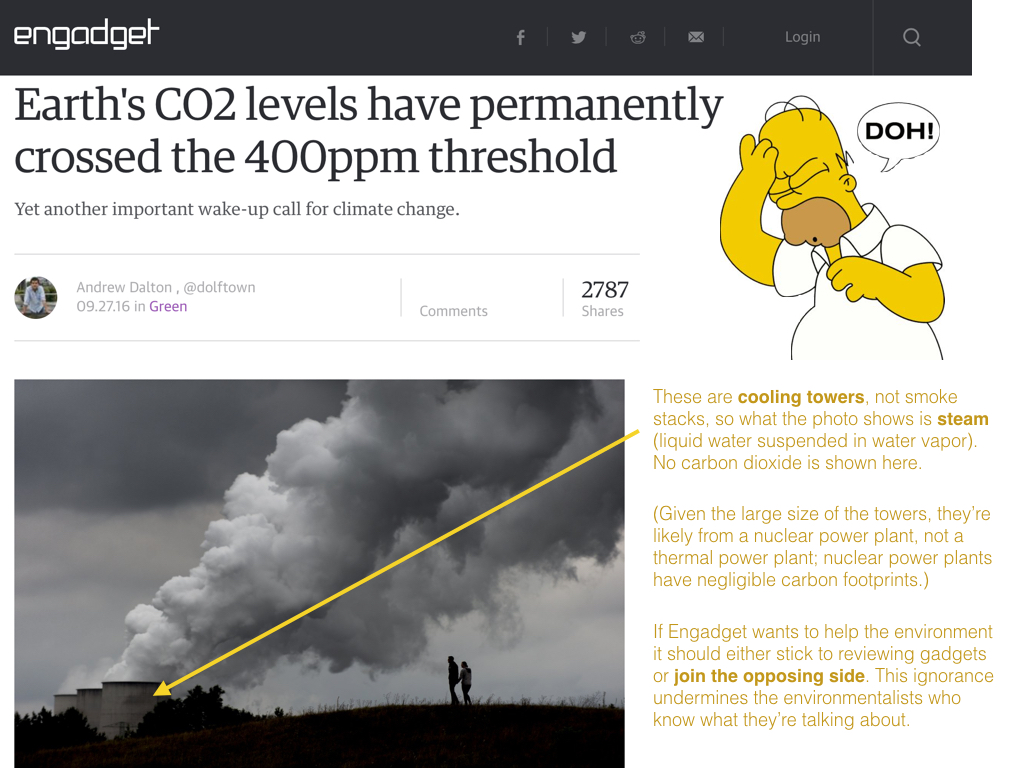
I also take to task people who think that knowledge is superfluous as long as their intentions are good (or at least consistent the the current "virtuous" narrative). For example, I did congratulate TIME for not using a photo of cooling towers for this article (unlike almost everyone else who uses images of cooling towers' steam to write about pollution),


but I do have to point out that most of what's seen coming out of those stacks is also steam. First, the color and the shape of the expansion give that away, but even if they didn't, gaseous $\mathrm{CO}_{2}$ is transparent, as is water vapor. (Steam is liquid water suspended in water vapor.) And soot and other common pollutants have distinctive colors; that white means water.

If you're surprised that combustion would generate water vapor, which condenses when it expands at the top of the stack, remember that hydrocarbon-based fuel combustion is mostly
$ \mathrm{C}_{n}\mathrm{H}_{m}  + (n+ m/4)\,\,\, \mathrm{O}_{2}\rightarrow n\,\,\, \mathrm{CO}_{2}  + m/2 \,\,\, \mathrm{H}_{2}\mathrm{O},$

and most of the rest (nitrous and sulfurous compounds, metals, soot and ash, the souls of the damned) are removed from the smoke before it's allowed to leave through the stacks (because of laws against pollution):


Sometimes I do take the nonsense dial to 11 --- but all the calculations are correct.

About a year ago, when I temporarily changed the name of this blog to Project 2016, the idea was to track non-work related learning, which is one of my hobbies; but time constraints made me choose between actually learning stuff and blogging about it, and I chose the learning.

So, expect some more carefully thought-out nonsense. Careful thinking is another one of my hobbies, so I practice it even on nonsensical topics. I have very strange hobbies: another one is moving heavy objects for no immediate purpose, like this gentleman


Live long and prosper -- JCS

Friday, September 30, 2016

Ah, "science" in the media, always good for a laugh

There's nothing wrong with the idea of science in the media, per se: I want more and better science in the media. But there's a lot wrong when people who clearly don't know any science write (or illustrate) pieces about science or related matters like engineering, the environment, and space exploration.


The Wall St. Journal, where people who don't understand basic Physics units write tweets about trading systems designed by hordes of Math and Physics PhDs:


With friends like Engadget "green" writers, the environment won't improve.


The Motley Fool, being its foolish self.


That's it for September. A lot of incipient posts in the hamper, but paid work got in the way of blogging. Such is life.

Saturday, September 24, 2016

Carbon capture, perpetual motion machines, and IGORs

There's one quick rule to evaluate energy-related technologies: if you can turn them into perpetual motion machines, they aren't real.

In conversation with an IGOR (Ignorant Grandstanding Oblivious Rabble-rouser), I pointed out that the idea of using atmospheric carbon dioxide to make fuel isn't entirely new (Nature did it first), but the technologies being proposed aren't realistic, for the reason above.

IGOR countered that these processes could, in his view, be the solution to our energy crisis (do we have one?), because the fuel produced by carbon-capture will provide the energy to keep the process going.

Ahem. Let's think about this, with a diagram:


What reasonable people say is that the energy extracted from the fuel will partially cover the energy needs of the capture and conversion process (that is $x > y$ but not by much); what IGORs say is that $y>x$. But if that were so, we could feed the exhaust from the energy production system into the input for the capture system, and get a perpetual motion machine that generates free energy.

Some of the more reasonable proponents of this carbon-capture and conversion idea suggest that the energy coming in can itself be green energy, like solar, and therefore there's a net "carbon-based" energy coming out of the system. Two points:
First, that's fine, but then why use part of that solar energy to create carbon-based fuels, instead of using the solar energy to replace the carbon-based fuels? Note that any $\mathrm{CO}_2$ that gets turned into fuel will yield another $\mathrm{CO}_2$ after the energy generation (conservation of the carbon), so no advantage there.
Second, the designs proposed look extremely wasteful of energy: capturing $\mathrm{CO}_2$ after it has diffused into the atmosphere is bound to require a lot of energy to flow non-$\mathrm{CO}_2$ gases in the atmosphere through the carbon-capture process. Better to stop $\mathrm{CO}_2$ at the source, if that's what you're after.
Of course, as I mentioned, Nature does provide us with a technology to use solar power to capture $\mathrm{CO}_2$ and turn it into fuel:


It also has the advantage of being pretty, giving shade, operating in silence, and bearing fruit. Trees. It's trees. Let's plant more trees. I like trees.

One particularly oblivious IGOR insinuated I was anti-environment because I prefer trees to useless noisy subsidy-harvesting machines.

With friends like that, the environment is doomed.

Monday, July 25, 2016

A rational case for Solar Roadways projects in organizations


The first time I heard of Solar Roadways my response was "so they are putting solar panels flat on the ground and shaded by cars?" My interlocutor correctly interpreted that as "What a thoroughly stupid idea; no point wasting more time on it." *

There are, however, some good reasons to start a Solar Roadways project in some organizations. Really: good, rational reasons, that you can convince an engineer with. Well, some engineers.

Because of the buzz surrounding Solar Roadways, the project might be funded. And a project funded means a number of ways to fund other projects that would not be funded. For example:

1. An overhead charge is applied to all outside grants and funding. For example, an organization might add a fifty-percent surcharge to any expenditure: spend 1000 on your Solar Roadways funded project, contribute an additional 500 to a general fund (from which the projects that aren't sexy or buzz-worthy can be funded).

2. Fund as much personnel as you can get away with from the Solar Roadways money; of course, funding them doesn't mean that they can't work on other things, and in many organizations it's difficult to tell which project a worker is working on without expending a lot of effort. Given its own problems, it's unlikely that Solar Roadways project funders will be too eager to get a serious audit of expenditures.

3. Fund as much infrastructure, capital investment, and current expenses with Solar Roadways project money. Basically same argument as personnel.

4. Use the buzz of having a Solar Roadways project to attract attention and more funding, to get potential donors to come to fund-raisers, to impress upon the alumni (for universities) how "with it" your institution is. Also, you can play the "Solar Freaking Roadways" clip with the Serenity captain over and over again for the nerdiest of your audience, thus distracting them from any inconvenient engineering professor whose pet project isn't being funded.

Obviously these aren't arguments for Solar Roadways as an energy source, but rather examples of why smart and knowledgeable people go along with nonsense like that.

Great video by Crazy Aussie Dave Jones (EEVBlog) on Solar Roadways:


- - - -

* Some people start going over the details and quibble over the durability of the panels and the visibility of the lights in them or whether they could really melt snow (hint: no, they can't).

That's like arguing about whether the container cross-bracing ties in a Maersk Triple-E would hold if instead of sailing it over water we attached rocket motors to the hull and sent it to orbit and then deorbited it towards the destination port.

(Yes, get it to orbital speed then deorbit, to make it even stupider than a simple --- though also highly unrealistic --- ballistic trajectory.)

The cross-bracing isn't the problem, the concept itself is demented.