Showing posts with label exercise. Show all posts

Wednesday, October 9, 2019

Fun with numbers for October 9, 2019

Rotten Tomatoes and Batwoman


The day after the pilot, a familiar pattern emerges:


Using the same math as these two previous posts, it's 198,134,550 (almost 200 million) times more likely that the critics are using the opposite criteria to those of the audience than they both using the same criteria.

A couple of days later, more data is available:


This data makes the case even more stark: it's now 2,924,953,580,108 (almost three trillion!) times more likely that the critics are using the opposite criteria to those of the audience than they both using the same criteria.

And today (with a tip of the Homburg to local vlogging nerd Nerdrotics), it's even worse:


With this data (ah, the joys of reusable models, even if "model" is a bit of a stretch for something so simple, relatively speaking) we get that it's now 11,028,450,795,963,200 (eleven quadrillion!) times more likely that the critics are using the opposite criteria to those of the audience than they both using the same criteria.

For what it's worth, I liked the pilot, despite my nit-picking it on twitter:


Aerobics: The Paper that Started The Craze.


Here are three explanations that all match the data:

I. The official story: running develops cardiovascular endurance. This is the story that led to the aerobics explosion, to jogging, and to all sorts of "cardio" nonsense. Note that this story is isomorphic to "playing basketball makes people taller."

II. The selection effect story: people with good cardiovascular systems can run faster than those without. This is the "tall people are better at basketball than short people" version of the story.

III. The athletes are better at both story: people who have athletic builds (strong muscles, large thoracic capacity, low body fat) are better at both running and cardiovascular fitness because of that athleticism.

Most likely the result is a combination of these three effects, or in expensive words, the three variables (cardiovascular fitness, muscular development, and running ability) are jointly endogenous. Note also the big excerpt from Body By Science at the end of this post.

Let's take  a closer look at that table:


Not that I'm questioning Cooper's data (okay, I am), but isn't it strange that there are no cases when, say a runner with a distance of 1.27 mi had VO2max of 33.6? That the discrete categories on one side map into non-overlapping categories on the other? No boundary errors? That's an unlikely scenario.

Also, no data about the distribution of the 115 research subjects over the five categories. That would be interesting to know, since the bins for the distance categories are clearly selected at fixed distance intervals, not as representatives of the distribution of subjects. (It would be extremely suspicious if the same number of subjects happened to fall into each category. But if they don't, that's informative and important to the interpretation of the data.)

I know this was the 60s; on the other hand, the 60s were the first real golden age of large-scale data processing (with those "computer" things) and a market research explosion.

One of the factors that confounds these "cardio" results is that training for a specific test makes you better at that test. Another is that strengthening the muscles that are used in a specific motion makes that motion less demanding and therefore puts less strain on the cardiovascular system.

This excerpt from Body By Science illustrates both of these confounds:


Grant Sanderson (3 Blue 1 Brown) on prime number spirals


A late addition: Elon Musk promises PowerPacks for CA


Which brings up two thoughts:

a. Is "just waiting on permits" the new "funding secured"?
 
b. Each powerpack has 210 kWh capacity, so one charges ~3 Teslas, assuming they're low on charge but not zero. (Typical tank truck ~ 11,000 gal tops-up 733 x 15 gal gas tanks. Just FYI)

Wednesday, November 16, 2016

Why I write careful posts on nonsensical topics

Basically, because I'm not allowed to write or talk about work-related matters.

So I apply my considerable intelligence, broad knowledge, and unbeatable modesty to things like the differences between powerlifting and bodybuilding (and the superiority of the former over the latter), using the standard B-school two-by-two matrix format (click for bigger):


I also take to task people who think that knowledge is superfluous as long as their intentions are good (or at least consistent the the current "virtuous" narrative). For example, I did congratulate TIME for not using a photo of cooling towers for this article (unlike almost everyone else who uses images of cooling towers' steam to write about pollution),


but I do have to point out that most of what's seen coming out of those stacks is also steam. First, the color and the shape of the expansion give that away, but even if they didn't, gaseous $\mathrm{CO}_{2}$ is transparent, as is water vapor. (Steam is liquid water suspended in water vapor.) And soot and other common pollutants have distinctive colors; that white means water.

If you're surprised that combustion would generate water vapor, which condenses when it expands at the top of the stack, remember that hydrocarbon-based fuel combustion is mostly
$ \mathrm{C}_{n}\mathrm{H}_{m}  + (n+ m/4)\,\,\, \mathrm{O}_{2}\rightarrow n\,\,\, \mathrm{CO}_{2}  + m/2 \,\,\, \mathrm{H}_{2}\mathrm{O},$

and most of the rest (nitrous and sulfurous compounds, metals, soot and ash, the souls of the damned) are removed from the smoke before it's allowed to leave through the stacks (because of laws against pollution):


Sometimes I do take the nonsense dial to 11 --- but all the calculations are correct.

About a year ago, when I temporarily changed the name of this blog to Project 2016, the idea was to track non-work related learning, which is one of my hobbies; but time constraints made me choose between actually learning stuff and blogging about it, and I chose the learning.

So, expect some more carefully thought-out nonsense. Careful thinking is another one of my hobbies, so I practice it even on nonsensical topics. I have very strange hobbies: another one is moving heavy objects for no immediate purpose, like this gentleman


Live long and prosper -- JCS

Sunday, November 13, 2016

Non-linearity is a pain in the neck and other smart content of this week

Non-linearity is a pain in the neck

Literally; and I use "literally" literally, not figuratively.

Most of the time we have an implicit linear worldview: if $x$ effort gives you $y$ result, then $(1+\epsilon)x$ effort should give you $(1+\epsilon)y$ result, approximately. And in many cases, where the $\epsilon$ is very small, this tends to be the case.

But the world isn't linear, especially in the gym. Especially in conditioning. (Editor note: conditioning is like cardio, except it actually works because it's high-intensity, short, and paused; that makes it very painful. This is why most people who are happy with no results prefer cardio, which delivers no results with only mild discomfort.)

Along with the basic, more functional conditioning movements (hill sprints, farmer's walks, stair sprints, sandbags), I've been doing medicine ball Atlas stones. Basically, one lifts a medicine ball from between one's feet to a platform above shoulder height (like an Atlas stone), then brings it back to the floor. Like any other conditioning exercise, this needs to be done correctly to avoid injury and not the CrossFit way of "fake it until you break it."

(The real Atlas Stone exercise. Those are not medicine balls.)

Medicine ball Atlas stone lifts have one of the most nonlinear pain response functions in the gym. Basically, for the first 5-10 reps, it feels like nothing is happening; the heart rate raises slowly and the muscles get a little hot. Then, at about 15, you discover muscles that never hurt before; discover them as they start hurting hard and fast. I discovered several new muscles in my neck --- and I regularly train neck as part of the posterior chain.  At 20-25, the ball has become pure neutronium, the platform has relativistically moved up several parsecs, and your blood pressure could drive a nuclear power plant turbine. So you rest 90 seconds, then restart; that's conditioning.

That's non-linearity.

In fact the response function is highly non-linear, not something that could easily be approximated with a low-degree polynomial, so I propose the following model:

Plot of $\mathsf{Pain} \doteq \exp(\exp(\exp( 0.035 \times \mathsf{Reps})))$

One of these days I'll write something serious about the misuse of linearity in everyday thinking; possibly also comment on the use of "exponential" to describe all convex functions and the unprofessionalism of drawing said "exponentials" on slides using the 'draw ellipse segment' tool in PowerPoint instead of plotting the actual function. But that's for another day.

Added Nov 16, 2016: while we wait for that "another day," here's a visual comment on convex functions:


Stephen Wolfram helps popularize science. Real science.

Stephen Wolfram, creator of Mathematica and author of A New Kind Of Science (but don't hold that book against him), helped the producers of the movie Arrival (2016) make less fools of themselves than the usual in scifi movies:
When I watch science fiction movies I have to say I quite often cringe, thinking, “someone’s spent $100 million on this movie—and yet they’ve made some gratuitous science mistake that could have been fixed in an instant if they’d just asked the right person”.
Part of that is the audience, who says "I love science" but really only likes the image (or at most the idea) of liking science and has no interest in actually learning any. It's like those people who like the idea of getting in shape, but don't exercise or change their unhealthy habits.
Occasionally one can see code. Like there’s a nice shot of rearranging alien “handwriting”, in which one sees a Wolfram Language notebook with rather elegant Wolfram Language code in it. And, yes, those lines of code actually do the transformation that’s in the notebook. It’s real stuff, with real computations being done. (Emphasis added.)
Here's Dr. Wolfram (whose alter ego is Mr. Tungsten --- couldn't resist 😀) talking about serious things:


Living in the future is great, never mind those who long for the "good" old times.

I have two words for these who long for the good bad old times: modern dentistry. (Not my original thought, but I've heard it from many sources; don't know original attribution. Still effective at capturing the power of technological change at an emotional level.)

Ai Build's system uses video cameras outfitted with machine learning algorithms to allow robots to learn from their mistakes—meaning they can operate more quickly, correcting for errors on the fly instead of moving slowly to prevent them. According to Cam, Ai Build's arms can print in half the time it would take using standard techniques. (Via Singularity Hub.) 

In one of the first medical applications of this concept, Synlogic has patented a version of E. coli engineered to develop “an unquenchable appetite for ammonia” and turn it into the amino acid arginine, which, unlike ammonia, is harmless to the human body. (Via Singularity Hub.)  

Media Briefed on New NASA Hurricane Mission


As you can see, NASA is causing all these hurricanes to create a New World Order where scientists will rule and… huh, no. It's just that hurricanes are kind of easier to spot from high above the atmosphere than from the basements where the people who come up with these NASA conspiracies spend their lives.


That's it for this geek-out. Live long and prosper. --JCS


(Mood music.)

Thursday, September 8, 2016

Multitasking at the gym


Powerlifting and other training (including conditioning) are not multi-taskable. It's very important to keep one's concentration and focus on the exercise. I cringe when I see people talking with each other while moving metal. Even during warm-up sets; perhaps especially during warm-up sets, when the low weight allows one to do a preflighting of the movement, check for any anomalies in mobility or weak or sore prime movers or stabilizers.

When walking short distances, cooking, or doing housework, I tend to listen to podcasts or sometimes to the audiotrack of YouTube hangouts (basically the equivalent of radio's Morning Zoo). These are ways to get some low-density information into the brainpan without distracting too much from the errands. (I also listen to podcasts on shared transportation, like shuttles. Too much entropy for anything else.)

Some podcasts I listen to (there are more; I usually only listen to a few episodes a week):


(Yes, I have a significant déformation professionelle.)

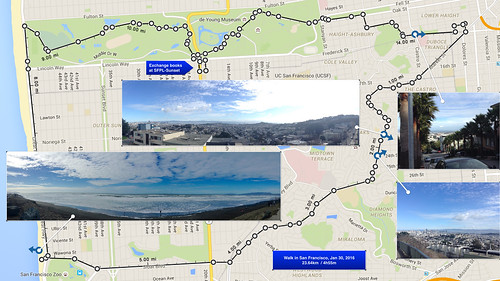
When I go for a real walk, what I call a walk-n-think, I typically listen to music, not any sources of information. The point is to think and clear the cobwebs of my mind. I find the Baroque a particularly good cobweb-solvent period. Here's a walk-n-think with a side-trip to exchange books at the SFPL:

Walk SF January 30, 2016

Once in a repetitive-motion machine in the gym, for oxygenation not conditioning purposes, the main determinant of the type of content is the movement of the head, in particular the eyes.

When walking on treadmills (my preferred cool-down approach) or rowing on a machine (which for me is real exercise, but of form and rhythm, not muscle), the head moves too much to fix the eyes on a screen; as the activity itself requires less attention than the errands, freeing attention for content, my choices of media are audio lectures and audio books.

(I only run on treadmills for High-Intensity Interval Training, which is conditioning, which means it cannot be multitasked. When doing anything that stresses the body, I always want 100% of the attention to be on the exercise. I have this strange desire to avoid injury, ridicule, and absence of gains; sort of the philosophical opposite of CrossFit.)

I should clarify that I'm using "lecture" to mean all sorts of purposeful speeches, not just university lectures. I do have a number of these speeches and lectures which work out well, many of them extracted from videos of talks where there were no significant visuals (or the visuals were the dreaded "power points," which are speaker's notes not audience-centered visuals).

As for audiobooks, I've been a Platinum member of Audible for fifteen years, which means I have two new books per month, which I complement by filling up on the seasonal sales and the occasional extra purchase.

Here are a few of my latest Audible purchases:


 On average I listen to around 30 audiobooks per year, some of which are re-listens.

(Yes, I re-read and re-listen to books. There are some books I read pretty much every year… Waugh, Wilde, and Wodehouse; certain Poirots and Maigrets; a few favorite Discworld pieces. There are 1000-page books I read every year, though that's just Anathem. And Cryptonomicon. And Reamde. And Seveneves, now on its second year. Guess who my favorite living author is.)

For other machines, like elliptical runners, stairclimbers, and exercise bicycles, the head doesn't move, so it's feasible to use the eyes. My old-but-trusted iPad 1.0 has seen this gym duty pretty much from the first day I bought it, which was the day it came out. (100% impulse purchase, as I was coming back from brunch and passed an Apple Store.)

Though in the past I've read books (paper books), journals (academic magazines), and magazines on paper on these machines, and have evolved to read electronic versions of these, I find that I prefer to give the eyes a break by letting them watch video instead of processing written words. I tend to watch lectures (again including speeches, but in this case a lot more real lectures) on the elliptical and the stairclimber, and to read books (ebooks with large type) only on the exercycle.

(Basically I use elliptical, exercycle, and stairclimbers in my building exercise room. It's not a "gym event," rather a "I need to take a break and instead of vegetating in front of the TV, which I no longer have service for, I can go do some movement while imbibing some basic knowledge.)

I keep a Rite-in-the-rain notebook and a Fisher space pen nearby in case I want to make notes, something that confuses other users of our exercise room. And that others have started to copy.

I hasten to point out that despite the déformation professionelle mentioned above, I tend to think of these books and lectures as leisure, so I keep them broadly within my areas of interest but not focussed on my actual area of work. For example, here are a few courses that I've enjoyed on the elliptical machines in the exercise room:


It's worth mentioning that real intellectual work cannot be multitasked, as indicated by the position of textbooks and research papers in the diagram. Anytime I'm looking to learn something, that requires dedicated attention, note-taking, and a block of dedicated time.

I don't mean work-related textbooks (though american textbook prices do their darndest to discourage the intellectually curious from serious study) or research papers (ditto with the gating, but public libraries and authors' own webpages are a good workaround), but even when I'm trying to learn something, say geology, our of pure curiosity, reading textbooks and research papers has been a much better experience than the materials that now pass for science popularization.

(My opinion on the decline of science popularization is well established in this blog.)

One thing I used to do at the gym (the real big gym, not the exercise room and not the powerlifting gym I occasionally go to instead of driving to the big gym) and eventually stopped due to social pressure, was to watch FoodTV network on the gym TV while cooling down on a treadmill or an elliptical, after 90-120 minutes of iron and conditioning. For some reason, those whose entire workout is 30 min of slow walking on the elliptical (what I call a Potemkin workout, still better than Planet Fatness or CrossFit) were not happy with my selection of programming.

Go figure.

Friday, August 19, 2016

The strange case of the oscillating black hole at the gym

There's a micro-black hole at my gym, and it oscillates between a position under the squat cages and the deadlift platform, in synchrony with my powerlifting program.

It's the only possible explanation.

The data: following my not-very-demanding powerlifting program (which is very low volume, even for powerlifting), I should have gained $5\%$ in both the squat and the deadlift in the last six weeks. This is feasible because I'm recovering strength from the beginning of the year, not creating new strength. (Who said powerlifters have crazy superstitions?)

Clearly, what is happening is that the same mass (bar + weights) is exerting a larger force on my body, which means that there's a micro-black hole under the gym. Since I estimate that there's a 3-meter foundation, this being earthquake territory and all, I postulate that the black hole is below that:


Furthermore, it has to move, since it doesn't affect bench press (where, despite a damaged right rotator cuff, I'm recovering strength well above the program envelope) but it affects the other two lifts. Since it affects both lifts the same percentage, that black hole has to move diagonally, as seen above. It also oscillates back and forth between the squat and deadlift stations.

Two black holes, you say? Don't be ridiculous. Two back holes, indeed! Pah!

So, a little back-of-the-drawing calculation, the kind that drives OCD quants crazy...


(with three or four corrections along the way, including a slight ahem when I used $c = 3\times 10^{9}$ instead of the correct $c = 3\times 10^{8}$ m/s)

... and I have my micro-black hole. As small as the total gains of an entire continent's worth of CrossFitters, at a Schwarzchild radius of $3\times 10^{-16}$ meter and as heavy as a Planet Fitness personal trainer, at a mass of $2\times 10^{11}$ kilogram. That mass means that the black hole won't evaporate anytime soon, so my stalled gains will continue.

(The time to evaporate a black hole with a mass of $10^{11}$kg  is in the billions of years, about the time it would take for a CrossFitter to do one good chin-up or a Planet Fitness client to lose five ounces of fat.)

Clearly this is an important discovery. Hello, Nobel Committee? Got a pick for 2017 Physics yet?


Alternative explanation 1: weight gain on my part

First off, to cancel a $5\%$ increase in squat and deadlift, I'd have to have gained close to $15\%$ of my bodyweight over six weeks. That's not impossible (or even unheard of), but in reality I've been losing weight at about 1kg per week, mostly fat, hopefully more than 1.5kg of fat per week (muscle mass increasing at 0.5kg/week during a recovery is reasonable).

Also, weight gain wouldn't affect squat and deadlift in the same way, unless I gained all the weight above my sternum. (I continue to improve my mental skills, but that doesn't significantly increase the mass of the brain...)

In an ass-to-grass squat (my type of squat), the femur goes over a 110-120 degree arc, hence getting to the weakest part of the quads force curve. So, some more weight in the torso may affect the ability to squat heavy. But for the deadlift, the drive with the legs is only an arc of 60-70 degrees, well away from the weak part of the force curve for the quads, therefore the loss of deadlifting power given additional bodyweight should be much lower than the loss for the squat, not the same. But the same it is.

(In the squat my weakness is the quads, in the deadlift, the spinal erectors; never my glutes. Hip thrusts, baby, hip thrusts FTW! I do leg-extensions with the full stack for reps, but only an ass-to-grass squat hits the quads at their full extension...)

This explanation is therefore dismissed.


Alternative explanation 2: poor supplementation

A picture is worth a thousand words (and about two hundred dollars):


Of course, I eschew that marvelous "supplement" family, anabolic steroids, or if one wants to be a little more discreet, TRT, testosterone replacement therapy. I like my reproductive system to stay at manufacturer's specification. It's kind of a big deal for me, to have the theoretical capability for reproduction (Theoretical because the 3.75 billion women in the world took a vote and unanimously –minus my mother– decided that for the good of the universe I should not reproduce; who am I to question democracy?)

This explanation is therefore dismissed.


Alternative explanation 3: I'm no longer an 18-year-old kid.

Poppycock and balderdash! Balderdash, I say!

Age is but a number and you're as young as you feel. Besides I'm barely in my early middle age -- just a few months past 30.*

This explanation is dismissed with extreme prejudice and a SEAL Team 6 visit.


Conclusion

The only possible logical conclusion is that, like in the 1990 David Brin scifi novel Earth, there's a naughty micro-black hole oscillating between the space under the squat cages and the lifting platforms, and by enormous coincidence its period matches my powerlifting program.

Obviously the solution is to combine the Westside Barbell approach of growing a big belly with the Testosterone Nation recommendation of synergistic beard growing and head shaving so that, even with increasing gravity, gains will come:


It's Science!


-- -- -- --
* 236 months, to be precise.

Thursday, June 30, 2016

Some thoughts on exercise


(Based on a twitterhea that started after I came back from the gym today. I'm still recuperating from a long trip and a upper respiratory infection from the return flight.)

Strength training

If I could only do one strength exercise, that would be the deadlift, possibly with a trapezoid ("hex") bar. Interestingly, if I could only do two exercises, those would be squat & pulldown, so there's no nesting of the exercise sets. Actually the topology becomes ever more complex: three exercises would be squat, pulldown, incl. press; four exercises would be squat, pulldown, flat bench press, military ("shoulder") press. Past that, the topology becomes more workable, with five exercises adding back the deadlift and six adding horizontal row.

An alternative topology, recognizing the importance of deadlifts:

(Yes, military "shoulder" press ahead of [flat] bench press; much more useful for life, plus pecs get worked on pulldowns.)

In reality, I do all six exercises (and a few more strength exercises) in a standard three-split powerlifting program (Monday: squat; Wednesday: bench; Friday: deadlift).

I seldom do any biceps or triceps work, as I find the upper arm gets enough exercise from the compound movements. Once a month or so, if I'm not too tired on a bench press day I might do three sets of standing curls superset with three sets of rope press-downs; but seldom more than once a month, and my arms aren't exactly skinny.


Accessory work

(Understood as accessory beyond the accessory work for the powerlifting lifts.)

Core: a lot of people worry about having "six-pack" abs; I train the core for strength, because it's a big deal in stabilizing movement and maintaining spinal health. I do a variety of exercises for the abs, obliques, and transverses, all under load. Unlike most gym-goers I understand that what makes for pretty six-packs is lack of fat, while what makes for good spine stability is strong muscles.

Specific posterior chain exercises: yes, the deadlift works the posterior chain, no kidding. But since standing up straight is somewhat important, I do a lot of other exercises targeting parts of the posterior chain beyond the glutes, particularly the various spinal extensors.

Neck (yes, I know it's in the posterior chain, at least the extensors): hey it's no big deal; it just HOLDS THE HEAD. Maybe gymbros could cut two or three of the hundred sets of standing curls they do per workout to strengthen the muscles that HOLD THEIR HEADS. Then again, perhaps they understand that there's nothing valuable there. Extension (with load), rotation, flexion (with load), plus careful mobilization.

Wrist: bodybuilders do do some wrist work, as their forearms are visible outside of a t-shirt, but they do it for show. I do wrist work because it protects the movement of the hands, which is kind of important for life. Wrist curls, reverse wrist curls, internal and external rotation with load.

Grip: I have a gripper, I use it. Short of a Hammer Strength grip machine (few gyms have those and even fewer the MedX equivalent), best thing for developing grip strength. No point in having upper body strength if the grip can't hold the load (bodybuilding bros say "strength? it's all about size, bro"), like having a very powerful engine in a car with bad tyres.

Rotator cuff: another area that needs to be protected against damage; I do a variety of low load movements of all the rotations of the rotator cuff, then train the two main movements (rotate forward, rotate backward) with standard strength training programming.


Conditioning

I'm a big fan of sled pushing and heavy farmer's walks, but mostly I end up doing treadmill intervals, hill sprints, or stairway sprints as that's what's available. I've tried to do farmer's walks with heavy dumbbells in commercial gyms, but unless the gym is almost empty, it's futile and garners strange looks from the know-nothings that mostly populate those gyms.*

In the past I have run mid-to-long distance, but that was in an age of ignorance. Quite a lot of information has come to light about the superiority (not equivalence, superiority) of high-intensity interval training over long low-intensity "cardio" for conditioning purposes.

Thinking about functional value of this conditioning training, it really matches real-life needs more than any long low-intensity training: usually if there's any running to be done (for example), it's a short burst of high speed.

I do a number of other activities that look like exercise but aren't:

Rowing is a hobby and I prefer to do it on the water. It's a very calming activity, considering how it's basically 15 to 20 explosive movements per minute. Even on a Concept II, the movement is very calming. It's basically yoga --- at 15-20 explosive movements per minute. If I'm doing it on a machine, I might listen to audiobooks: multitasking of the kind that works, unlike multitasking attention.**

Walking is what I do to clear my mind. I like to take long walks to think; it's an habit I cultivate that most people abhor (thinking, not walking; ok, most people abhor walking as well, but mostly they avoid, abjure, and detest having to think). When I say "long" I mean 25-50km long. This has led to some complaints from friends whose idea of long is "ten minutes" rather than "fifteen hours."

Working, reading, studying, watching lectures or other educational videos on "cardio" machines, typically the elliptical, treadmill, or stationary cycle. Since I have a gym in my building, and these machines tend to be available during my work hours, I can simply translate "sitting" into "slow moving" and get some advantageous oxygenation during the intellectual work. I don't count these as exercise because they don't get anywhere near the level of intensity that would create the need for the body to adapt, i.e. to gain any new capabilities.


Mobility

A lot of strength athletes pay lip service to mobility, but not more than that. I did that too when I was young and foolish.

Now in my early middle age (ahem...), I find that the ability to reach and stretch is kind of important so I've been spending more and more time making sure that I get as much range of motion as possible, both in the gym (before and after working out) and several times a week outside of the gym.


And an inexplicable phenomenon...

Something that happens at some commercial gyms has been puzzling me: I finish my workout (warm-up, strength training, accessory work, mobility) and do a short cool-down on a treadmill or elliptical, walking slowly... and get the evil eye from the people on the machines next to me.

I can't explain it; I've surmised that these people's entire workout is 20-30 minutes of slow walking (sometimes slower than my own cool-down) on these machines, while I do my 15-20 minutes at the end of 90-120 minutes or more of moving metal (sometimes, a lot of metal), so there may be some divergence of the minds there.

Oh, on an unrelated note, I tend to switch the TV in front on my machine to FoodTV or the Travel network (if there's a food show on it) during the cool-down; I like food and food shows. I notice that no one else seems to be watching that channel, although they all appear to like food a whole lot.

Strange.


-- -- -- --

* Also, farmer's walks with dumbbells are dangerous: while it's difficult to get your feet under a standard farmer's walk rig without doing it on purpose, it's a law of Physics that a dropped dumbbell will always hit your foot edge on. Check it.

** I end up doing a lot of rowing on machines because going to the Berkeley Lagoon is a schlep and then I have to pay a rental fee for a shell (I'm not a member of the rowing club). Since I have my own Concept IIc at home, I tend to use that.

The 15-20 strokes/minute rhythm is because I'm short but with a heavy torso (long torso to begin with, and powerlifting muscles weigh a lot), so I need a very slow return not to lose speed on the water due to my own inertia.

(I could row much faster on a machine, of course, but that would create bad habits for the water. On a related note, the way most gym goers – especially those who do something that rhymes with Fosscrit – row on the machines is hilarious: on the water they wouldn't move at all.)