Sunday, November 20, 2016

Again, the problem with science communication

The problem with science communication is the science communicators who aren't interested in communicating science.

Take, for example, this tweet:
Yes, it's quite obvious that the Science Channel twitterer is referring to the solar system, not the galaxy.

No. That's not true.

The announced television show itself, I'm sure will get that right. But the twitterer? I literally can't even, as the kids say. And I literally can't even... bet a cup of coffee that the twitterer understands the difference between the solar system and the galaxy --- because I have an MBA.

Yes, a Master's degree in Business Administration, and that's what tells me that it's quite likely that the twitterer has no clue about the science. First, because it was posted at midnight on Friday; second, because it's television; and third because it's on twitter.

It's not even a case of people who "love" science (as long as they don't have to learn any). It's more a case of 'we need a "communications/social media team" for this property.' (Property here refers to the Science Channel.) That's the twitter part: the team is grown as an appendage to the marketing group because that's how people in media tend to see twitter, just another channel to add to the communications mix.

And these "communication/social media team" members are recruited from communication programs and from people who are part of the influence network of those in charge of recruiting, because that's how things are done in mass media conglomerates. So that's the television part.

At midnight on a Friday, the most junior or least competent members of the team will be the ones operating the account. And those are likely to be the ones who are least likely to know the difference between galaxies and solar systems.

But the recruitment of people who know nothing about science to positions of science communication isn't the worst problem.

The worst problem is that there's no problem, not really, because:
  • Since the audience doesn't care, the advertisers don't care either. After all, it's not like they really want a critical thinking audience for their commercials. (Remember, I have an MBA. Only few products and companies want a critical thinking audience.)
  • Since the advertisers don't care, the channel management doesn't care. And most in management have no interest in science; it's a product to be sold, just like potato chips and time-share vacations.
And the science-educated audience, the ones who notice these things? Well, everyone hates a know-it-all tattle-tale nerd. Until the technological society that was built by engineers on the foundations of science collapses.

Then, well, then that was a totally unpredictable act of God Nature.
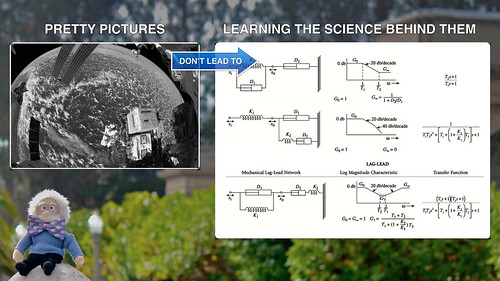
Problem with science popularization

Wednesday, November 16, 2016

Why I write careful posts on nonsensical topics

Basically, because I'm not allowed to write or talk about work-related matters.

So I apply my considerable intelligence, broad knowledge, and unbeatable modesty to things like the differences between powerlifting and bodybuilding (and the superiority of the former over the latter), using the standard B-school two-by-two matrix format (click for bigger):


I also take to task people who think that knowledge is superfluous as long as their intentions are good (or at least consistent the the current "virtuous" narrative). For example, I did congratulate TIME for not using a photo of cooling towers for this article (unlike almost everyone else who uses images of cooling towers' steam to write about pollution),


but I do have to point out that most of what's seen coming out of those stacks is also steam. First, the color and the shape of the expansion give that away, but even if they didn't, gaseous $\mathrm{CO}_{2}$ is transparent, as is water vapor. (Steam is liquid water suspended in water vapor.) And soot and other common pollutants have distinctive colors; that white means water.

If you're surprised that combustion would generate water vapor, which condenses when it expands at the top of the stack, remember that hydrocarbon-based fuel combustion is mostly
$ \mathrm{C}_{n}\mathrm{H}_{m}  + (n+ m/4)\,\,\, \mathrm{O}_{2}\rightarrow n\,\,\, \mathrm{CO}_{2}  + m/2 \,\,\, \mathrm{H}_{2}\mathrm{O},$

and most of the rest (nitrous and sulfurous compounds, metals, soot and ash, the souls of the damned) are removed from the smoke before it's allowed to leave through the stacks (because of laws against pollution):


Sometimes I do take the nonsense dial to 11 --- but all the calculations are correct.

About a year ago, when I temporarily changed the name of this blog to Project 2016, the idea was to track non-work related learning, which is one of my hobbies; but time constraints made me choose between actually learning stuff and blogging about it, and I chose the learning.

So, expect some more carefully thought-out nonsense. Careful thinking is another one of my hobbies, so I practice it even on nonsensical topics. I have very strange hobbies: another one is moving heavy objects for no immediate purpose, like this gentleman


Live long and prosper -- JCS

Sunday, November 13, 2016

Non-linearity is a pain in the neck and other smart content of this week

Non-linearity is a pain in the neck

Literally; and I use "literally" literally, not figuratively.

Most of the time we have an implicit linear worldview: if $x$ effort gives you $y$ result, then $(1+\epsilon)x$ effort should give you $(1+\epsilon)y$ result, approximately. And in many cases, where the $\epsilon$ is very small, this tends to be the case.

But the world isn't linear, especially in the gym. Especially in conditioning. (Editor note: conditioning is like cardio, except it actually works because it's high-intensity, short, and paused; that makes it very painful. This is why most people who are happy with no results prefer cardio, which delivers no results with only mild discomfort.)

Along with the basic, more functional conditioning movements (hill sprints, farmer's walks, stair sprints, sandbags), I've been doing medicine ball Atlas stones. Basically, one lifts a medicine ball from between one's feet to a platform above shoulder height (like an Atlas stone), then brings it back to the floor. Like any other conditioning exercise, this needs to be done correctly to avoid injury and not the CrossFit way of "fake it until you break it."

(The real Atlas Stone exercise. Those are not medicine balls.)

Medicine ball Atlas stone lifts have one of the most nonlinear pain response functions in the gym. Basically, for the first 5-10 reps, it feels like nothing is happening; the heart rate raises slowly and the muscles get a little hot. Then, at about 15, you discover muscles that never hurt before; discover them as they start hurting hard and fast. I discovered several new muscles in my neck --- and I regularly train neck as part of the posterior chain.  At 20-25, the ball has become pure neutronium, the platform has relativistically moved up several parsecs, and your blood pressure could drive a nuclear power plant turbine. So you rest 90 seconds, then restart; that's conditioning.

That's non-linearity.

In fact the response function is highly non-linear, not something that could easily be approximated with a low-degree polynomial, so I propose the following model:

Plot of $\mathsf{Pain} \doteq \exp(\exp(\exp( 0.035 \times \mathsf{Reps})))$

One of these days I'll write something serious about the misuse of linearity in everyday thinking; possibly also comment on the use of "exponential" to describe all convex functions and the unprofessionalism of drawing said "exponentials" on slides using the 'draw ellipse segment' tool in PowerPoint instead of plotting the actual function. But that's for another day.

Added Nov 16, 2016: while we wait for that "another day," here's a visual comment on convex functions:


Stephen Wolfram helps popularize science. Real science.

Stephen Wolfram, creator of Mathematica and author of A New Kind Of Science (but don't hold that book against him), helped the producers of the movie Arrival (2016) make less fools of themselves than the usual in scifi movies:
When I watch science fiction movies I have to say I quite often cringe, thinking, “someone’s spent $100 million on this movie—and yet they’ve made some gratuitous science mistake that could have been fixed in an instant if they’d just asked the right person”.
Part of that is the audience, who says "I love science" but really only likes the image (or at most the idea) of liking science and has no interest in actually learning any. It's like those people who like the idea of getting in shape, but don't exercise or change their unhealthy habits.
Occasionally one can see code. Like there’s a nice shot of rearranging alien “handwriting”, in which one sees a Wolfram Language notebook with rather elegant Wolfram Language code in it. And, yes, those lines of code actually do the transformation that’s in the notebook. It’s real stuff, with real computations being done. (Emphasis added.)
Here's Dr. Wolfram (whose alter ego is Mr. Tungsten --- couldn't resist 😀) talking about serious things:


Living in the future is great, never mind those who long for the "good" old times.

I have two words for these who long for the good bad old times: modern dentistry. (Not my original thought, but I've heard it from many sources; don't know original attribution. Still effective at capturing the power of technological change at an emotional level.)

Ai Build's system uses video cameras outfitted with machine learning algorithms to allow robots to learn from their mistakes—meaning they can operate more quickly, correcting for errors on the fly instead of moving slowly to prevent them. According to Cam, Ai Build's arms can print in half the time it would take using standard techniques. (Via Singularity Hub.) 

In one of the first medical applications of this concept, Synlogic has patented a version of E. coli engineered to develop “an unquenchable appetite for ammonia” and turn it into the amino acid arginine, which, unlike ammonia, is harmless to the human body. (Via Singularity Hub.)  

Media Briefed on New NASA Hurricane Mission


As you can see, NASA is causing all these hurricanes to create a New World Order where scientists will rule and… huh, no. It's just that hurricanes are kind of easier to spot from high above the atmosphere than from the basements where the people who come up with these NASA conspiracies spend their lives.


That's it for this geek-out. Live long and prosper. --JCS


(Mood music.)

Wednesday, November 9, 2016

Powerlifters vs Gym Rats, take 2

(This is a redo of the numbers in my previous powerlifters vs gym rats post, with assumptions that are less favorable to powerlifters.)

First, since we need some sort of metric to compare athletes, I'll unbiasedly 😀 choose the average of three lifts, bench press, deadlift, and squat, as a percentage of the bodyweight of the athlete. Call that metric $S$.

We'll use a standard Normal for the distribution of this metric, by subtracting the mean (100 percent of bodyweight for non-powerlifters, assuming that the average gym rat can bench, deadlift, and squat their own bodyweight) and dividing by the standard deviation (say 15 percent of bodyweight, using the scientific approach of judging 10 to be too little and 20 to be too much). In other words, for non-powerlifters, $z \doteq (S-100)/15.$

As in the previous post, we'll assume that powerlifters are 1 percent of the gym rats; but instead of the powerlifters having a mean at 2 (in $z$ space, 130 in $S$ space), they only have a one-SD advantage, that is their mean is at 1 (in $z$ space, 115 in $S$ space). In other words

$\qquad z \sim \mathcal{N}(0,1)\qquad $ for non-powerlifters
$\qquad z \sim \mathcal{N}(1,1)\qquad $ for powerlifters

Using these assumptions we can now compute the percentage of powerlifters that exist in a gym population above a given threshold; we can also compute the median score of all athletes who score above that threshold (click for larger):


Note that the conditional median that we're using here is lower  than the conditional mean, as the conditional distribution is skewed to the right, i.e. has a long right tail. The choice of the median is more informative for skewed distributions as a "sense of what we'll see in the gym."*

It's interesting to note that this is the median of the combined distribution of powerlifters and other gym rats, weighted by their proportion in the population above the threshold, so the difference between this median and the threshold is a non-monotonic function of the threshold as the curvature and the weight of the distribution of each type of athlete change significantly in the $1-8$ range of the table.

Under these weaker assumptions (pun intended), only when the threshold for inclusion passes 5 standard deviations from the other gym goers' mean do powerlifters become the majority of the qualifying athletes. Unless the gym is full of football players (that's american football), weightlifters, and strongman competitors, I think these assumptions are too unfavorable to powerlifters.

Here are some strong athletes moving metal, for variety (NSFW language):


"While they squat I eat cookies" has to be the most powerlifter-y sentence ever.

Update Nov 11, 2016: Here's the percentage of powerlifters in the population of qualifying athletes for different assumptions about the advantage of powerlifters (i.e. the mean of the powerlifters' distribution in standard deviation units); click for larger:


- - - - - -
* Unless there are CrossFit-ers in the gym, in which case what we typically see in the gym is dangerous, counter-productive nonsense.

Thursday, October 27, 2016

Kicking "Angels and Demons" while it's down

First, the ever entertaining Cinema Sins:


Now for some science. Let's assume that the stolen vial contained 1 gram of antimatter. Then, the explosion would release $E = mc^2 = (0.002) \times (3 \times 10^8)^2 = 1.8 \times 10^{14}$ Joule. At 4.184 petajoule per megaton of TNT equivalent, that is an explosion of roughly 43 kiloton.

(The more observant readers will notice that there's two grams in the energy computation. That's one gram each matter and antimatter.)

The operational ceiling of helicopters is around 25,000 ft, but the helicopter piloted by Ewan McObi-Wan Kenobi is nowhere close to that altitude when he jumps. An air burst of 43 kiloton even at say 10,000 ft would create a lot more damage than shown in the movie. (For comparison, Hiroshima's burst was at the yield-optimized height of 2,000 ft and with a yield of about 15 kt.)

So Ewan McThe Ghost Writer would probably be a carbonized carmelengo rather than a usurper to the Vatican throne. And probably so would the faithful in St. Peter's square and the Cardinals in Busch Stadium The Sistine Chapel.

- - - - Fait divers - - - -

Here's the page that CERN put up to address the errors in the movie.

Nikolaj Lie Kaas, who plays the assassin, plays the corrupt CEO of the energy company in the recent Danish series "Follow The Money." I guess he's typecast as the sociopathic type now.

I claim extra nerd points for using RStudio to do the computations (was already open; it's pretty much always open these days):


Sunday, October 23, 2016

Gravity "batteries"

When there's too little demand for electricity, certain grid operators (like the Portuguese one) use excess capacity to pump water from downstream of dams to the dam reservoir. This is a way to store energy for peak demand.

I understand that some mountainous region is studying the possibility of replicating this with a funicular that would operate as the water in the dam. The losses involved in moving the funicular imply low roundtrip efficiency (the ratio of the energy recovered to the energy entered into the "battery"). And, of course, the funicular can't be used for passengers, unless there's some special discount for unpredictable schedules.

At least two people have told me about a start-up (I forgot its name) that wants to solve the battery problem by using the same approach, only with dedicated masses on vertical tracks.

The tragedy of engineering is the murder of beautiful illusions by ugly numbers.

Let's say this company can use $100\%$ roundtrip-efficient motor/generators, that is, all the electrical energy that is converted into potential energy of the moved mass can be recovered as electrical energy with zero losses in the whole process. (Yes, this is a ridiculously generous assumption, but it won't matter.)

Say this company has a 1000 metric ton mass that can be raised up to 10 meters. It can therefore accumulate $98$ megajoule (MJ) or $27.44$ kWh. Sounds ok-ish for a battery, except:

1. If that mass is made of lead (density = $11.34$ kg/l), a cheap-ish dense material, its volume is 88.2 cubic meters. That's large for a battery: it's a cube almost 4.5 meters on the side. Remember that this assumes $100\%$ roundtrip efficiency motor/generators.

2. Gasoline has an energy density of $32$ MJ/l and jet fuel has an energy density of around $30$ MJ/l; using a readily available commercial-grade combined-cycle generator with around $65\%$ total efficiency, 98 MJ can be generated with less than 4 liters of jet fuel or gasoline.

Okay, the combined cycle generator takes some space, but so do the motor/generators and the support frame for the 1000 ton mass. And the space for the vertical track, of course.

Numbers. Killing illusions. No wonder so many people avoid them.

- - - -

To make up for the bursted bubble of delusion, here's the feel-good video of this week:


Sunday, October 9, 2016

Aging engineers versus experienced engineers


There are growing complaints that Silicon Valley companies discriminate against middle-aged engineers. But it might not be just ageism, it might just be aggregation error.

Engineering comprises mainly two things: a body of knowledge and a problem-solving mindset. To be a good engineer one needs an up-to-date body of knowledge in the relevant field and a facility with different problem-solving approaches used in the field (and possibly outside it as well).

(For the moment let's leave aside the problem-solving mindset; its dynamics are complicated and very situation-dependent: while some engineers acquire and develop problem-solving skills with experience, other fossilize their thinking, for example due to organizational practices.)

As part of what I do is continuing education, I have observed the dynamics of the body of knowledge as engineers' careers progress.

  • The largest group by far (sadly), makes little attempt to keep up-to-date with their field after formal education ends. In conversation, after a corporate training event, a member of this group told me that keeping up-to-date was "very nice in theory, but we don't have the time." All of us would like more time; but this person spent tens of hours per week watching TV. One of those hours per week spent updating their skill set would mean 52 hours per year, which would be more than enough (most of the participants in that event had fewer than 20h/year of training or study, and self-paced learning can be much more effective than group events.)
  • Most of the remaining engineers realized their technical obsolescence would become a problem and were retooling themselves for a management job. The main problem with this attitude is that there will always be fewer management jobs than engineers who plan to go into management. Secondarily, firms have both partially replaced management jobs with consultancy engagements and started prioritizing management-trained applicants over engineers.
  • A few engineers fell into a third category: those who keep up-to-date either because they realize the job implications of doing so or because they really love their engineering field. The problem, for those in this group, is that their small number makes them liable to be categorized into one of the other groups.

Placing ourselves in the position of Google, for example, the decision to consider a candidate who's been out of formal education for several years versus considering one that's just graduated --- even if Google believes that the energy of youth can be balanced by the temper of experience --- comes down to which of the three groups above the older candidate will fall into.

In the absence of good information, statistically the older candidate will be in the first group, in other words, aged, not experienced, a distinction that most of the engineers can but will not make (as it defeats their case).

(The younger candidate's type is irrelevant, because being fresh from school means an up-to-date skill set, at least for the near future.)

There are obviously many confounds: consider a choice between a newly minted computer engineer from Idaho State - Tubertown with no code to show (not even from school projects) versus a 45-year-old Caltech graduate class of '95 who has code on GitHub that is particularly relevant to the job, for example.

For the other engineers, who have been lax in their updating of skills, there's a solution: it's never too late to learn. And then: show, don't tell.