Yes, the first observation is that I am a science geek. Some people binge-watch Kim Cardassian, some people binge-watch Netflix, some people binge-watch sports; I binge-watch college lectures on subjects that excite me.
(This material has no applicability to my work. Learning this material is just a hobby, like hiking, but with expensive books instead of physical activity.)
To be fair, this course isn't a MOOC; these are lectures for a live audience, recorded for students who missed class or want to go over the material again.
The following is the first lecture of the course, and to complicate things, there are several different courses from UC-Stalingrad with the same exact name, which are different years of this course, taught by different people. So kudos for the laziness of not even using a playlist for each course. At least IHTFP does that.
(It starts with a bunch of class administrivia; skip to 7:20.)
Production values in 2013, University of California, Berkeley
To be fair: for this course. There are plenty of other UC-Leningrad courses online with pretty good production values. But they're usually on subjects I already know or have no interest in.
Powerpoint projections of scans of handwritten notes; maybe even acetate transparencies. In 2013, in a STEM department of a major research university. Because teaching is, er…, an annoyance?
The professor points out that there's an error in the slide, that the half-life of $^{232}\mathrm{Th}$ is actually $1.141 \times 10^{10}$ years, something that he could have corrected before the class (by editing the slide) but decided to say it in class instead, for reasons...?
The real problem with these slides isn't that handwriting is hard to read or that use of color can clarify things; it's the clear message to the students that preparing the class is a very low priority activity for the instructor.
A second irritating problem is that the video stream is a recording of the projection system, so when something is happening in the classroom there's no visual record.
As a former and sometimes educator, I don't believe in the power of lectures without practice, so when the instructor says something like "check at home to make sure that X," I stop the video and check the X.
For example, production of a radioactive species at a production rate $R$ and with radioactive decay with constant $\lambda$ is described by the equation at the top of the highlighted area in the slide above and the instructor presents the solution on the bottom "to be checked at home." So, I did:
Simple calculus, but makes for a better learning experience. (On a side note, using that envelope for calculations is the best value I've received from the United frequent flyer program in years.)
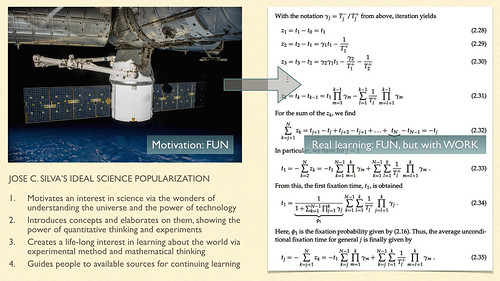
This, doing the work, is the defining difference between being a passive recipient of entertainment and an active participant in an educational experience.
Two tidbits from the early lectures (using materials from the web):
Binding energy per nucleon explains why heavy atoms can be fissioned and light atoms can be fused but not the opposite (because the move is towards higher binding energy per nucleon):
The decay chains of Uranium $^{235}\mathrm{U}$ and Thorium $^{232}\mathrm{Th}$:
(Vertical arrows are $\alpha$ decay, diagonals are $\beta$ decay.)
Unfair comparison: The Brachistochrone video
It's an unfair comparison because the level of detail is much smaller and the audience is much larger; but the production values are very high.
Or maybe not so unfair: before his shameful (for MIT) retconning out of the MIT MOOC universe, Walter Lewin had entire courses on the basics of Physics with high production values:
(I had the foresight to download all Lewin's courses well before the shameful retconning. Others have posted them to YouTube.)
Speaking of production values in education (particularly in Participant-Centered Learning), the use of physical props and audience movement brings a physicality that most instruction lacks and creates both more immersive experience and longer term retention of the material. From Lewin's lecture above:
There are growing complaints that Silicon Valley companies discriminate against middle-aged engineers. But it might not be just ageism, it might just be aggregation error.
Engineering comprises mainly two things: a body of knowledge and a problem-solving mindset. To be a good engineer one needs an up-to-date body of knowledge in the relevant field and a facility with different problem-solving approaches used in the field (and possibly outside it as well).
(For the moment let's leave aside the problem-solving mindset; its dynamics are complicated and very situation-dependent: while some engineers acquire and develop problem-solving skills with experience, other fossilize their thinking, for example due to organizational practices.)
As part of what I do is continuing education, I have observed the dynamics of the body of knowledge as engineers' careers progress.
The largest group by far (sadly), makes little attempt to keep up-to-date with their field after formal education ends. In conversation, after a corporate training event, a member of this group told me that keeping up-to-date was "very nice in theory, but we don't have the time." All of us would like more time; but this person spent tens of hours per week watching TV. One of those hours per week spent updating their skill set would mean 52 hours per year, which would be more than enough (most of the participants in that event had fewer than 20h/year of training or study, and self-paced learning can be much more effective than group events.)
Most of the remaining engineers realized their technical obsolescence would become a problem and were retooling themselves for a management job. The main problem with this attitude is that there will always be fewer management jobs than engineers who plan to go into management. Secondarily, firms have both partially replaced management jobs with consultancy engagements and started prioritizing management-trained applicants over engineers.
A few engineers fell into a third category: those who keep up-to-date either because they realize the job implications of doing so or because they really love their engineering field. The problem, for those in this group, is that their small number makes them liable to be categorized into one of the other groups.
Placing ourselves in the position of Google, for example, the decision to consider a candidate who's been out of formal education for several years versus considering one that's just graduated --- even if Google believes that the energy of youth can be balanced by the temper of experience --- comes down to which of the three groups above the older candidate will fall into.
In the absence of good information, statistically the older candidate will be in the first group, in other words, aged, not experienced, a distinction that most of the engineers can but will not make (as it defeats their case).
(The younger candidate's type is irrelevant, because being fresh from school means an up-to-date skill set, at least for the near future.)
There are obviously many confounds: consider a choice between a newly minted computer engineer from Idaho State - Tubertown with no code to show (not even from school projects) versus a 45-year-old Caltech graduate class of '95 who has code on GitHub that is particularly relevant to the job, for example.
For the other engineers, who have been lax in their updating of skills, there's a solution: it's never too late to learn. And then: show, don't tell.
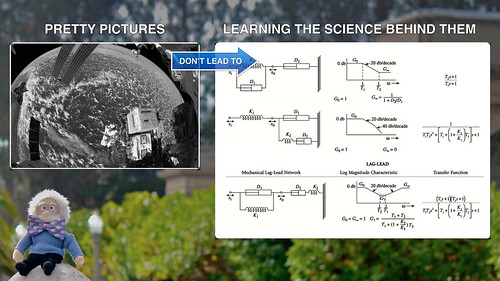
Science identity products like t-shirts, mugs, posters, and computer wallpapers are used to signal that the owner has an interest in science; unfortunately, because this interest in science has become fashionable -- at least in some segments of the population -- poseurs also buy these objects, lowering the quality of the signal.
I've written often (one, two, three, four, five times at least) about the problems with using science as an identity product, as with the people who "love science" as long as they don't have to learn any.
These products aren't necessarily only appealing to poseurs, though. People with a real interest in science and in science education also like them for, among other reasons,
1. Identity signaling. Like the poseurs, except it this case it's a real signal. People want to communicate their interest in science and the beauty of some scientific results and natural phenomena. (I own quite a few science identity products myself.)
2. Recruitment. These products can be useful motivators for bringing newcomers into an appreciation of science. By showing that there are other nerdsgeeks people interested in science, they create social conditions for others to come out as nerdsgeeks people interested in science.
3. Mere exposure. People like or at least feel more comfortable with things that appear familiar. The more exposure people have to scientific concepts and images, even if as part of jokes or background material in sitcoms like The Big Bang Theory, the less aversion they may feel when science content is presented to them.
There's one possible disconnect undermining these three points, though: that people who are influenced by exposure to the science identity products only like the aesthetics:
The big problem with the poseurs, which is a real problem not just my "I liked that band before it was cool" complaint, is not that they use the products to pretend to like science, though that would be bad enough. The real problem is that poseurs know that they don't actually like (or know) real science, so they feel threatened by those who do and take action to counter that threat, usually distracting from the science.
As my previous post showed, many poseurs in the media try to be "sciencey" but they fail miserably because in the end they don't understand that science is not like literature or art where the judgment of some other people is what matters. In science, reality is what matters. Poseurs don't get that, because to them reality is whether others buy into their pose.
Popular science content
Making science accessible to the general public is one of the most effective ways to improve society: it allows more people to partake of the benefits of knowledge (for example, avoiding junk science and quackery), it helps garner support for scientific enterprises that require public funding, and it creates the foundations for new generations with more and better scientists.
The problem is that popularizers can be real science popularizers or they too can be poseurs. And the poseur popularizers tend to be more popular. The glaring exception is Carl Sagan, but that's because he was both a pioneer in popularization and a real research scientist prior to that.
The most obvious difference is that Carl Sagan's Cosmos was designed to impress people with the power of science, while many current popularizers design their programs to impress upon the audience (a) how special they, the audience, are; and (b) how smart, knowledgeable, and suave the popularizer is. There are some exceptions, but they aren't the most successful popularizers, at least not on TV.
A rule-of-thumb that works for me is to ask whether the popularizer is an active researcher (or was until recently active) in the field. People whose job is some variation of "science popularizer" tout-court, even if they have some scientific training (which many of them don't), tend to focus on people and events rather than concepts and principles. In other words, they popularize the story of science rather than the actual science. (In many cases they either avoid the science completely, or they get most of it wrong.)
This rule works for two reasons:
First, an active researcher will know the science better than a non-researcher popularizer. This IMNSHO more than balances any communication advantages the non-researcher might have. One of the hilarious examples of this advantage is The Igon Value Problem, where active researcher Steven Pinker takes on the intellectual lightweight Malcolm Gladwell. (But supporting my observation above, Gladwell is more popular than Pinker.)
Second, an active researcher has to protect his/her reputation in the field. This adds motivation to get things right to the knowledge (the ability to do things right). When no one in Astrophysics takes you seriously (because you call yourself a scientist but your career total citations of 150 mark you as a museum manager), you can say ignorant things on twitter about planes and helicopters. An engineer who wrote nonsense like this would be mocked at any future technical conferences he/she attended:
Personally I decided to read textbooks in lieu of popularization books,* but there are some popular books I've read that I found worthy of recommendation, so here are two for now:
Deep science (or other technical) content
Leaning technical material is something that requires audience (perhaps in this case "student" would be the better term) participation.
Lectures can motivate study and are a good introduction to the material, but only self-paced study and practice exercises can make technical material stick.
There's a qualitative difference between (to quote again from my old post about Heisenberg) understanding that this is a joke, i.e. popularizer-level understanding:
Police officer: "Sir, do you realize you were going 67.58 MPH?
Werner Heisenberg: "Oh great. Now I'm lost."
and being able to completely spoil the joke by computing the actual uncertainty (deep understanding):
A simplified form of Heisenberg's inequality, good enough for our purposes, is
$\qquad \Delta p \, \Delta x \ge h $
Going by orders of magnitude alone, assuming that the mass of Heisenberg plus car is in the order of 1000 kg, and noting that the speed is given to a precision of 0.01 mi/h, an order of magnitude of 10 m/s, with $h \approx 10^{-34}$ Js, we get a $\Delta x$ of the order of
$\qquad \Delta x \approx \frac{ 10^{-34} }{10 000} = 10^{-38}$ m.
Only practice and study can create the kind of deep understanding that allows you to spoil people's fun at parties with numerical sidebars like this. Certainly something to aspire to...
That's not to say that lectures don't have value; I think of them as the warm-up sets you do before actually exercising. In that sense, they are very important, since they provide a passive experience that gets the material into context, setting up the active experiences of self-paced study and practice exercises.
Walter Lewin, shamefully retconned out of OCW and their official YouTube channels by MIT for undisclosed non-scientific transgressions, was one of the best Physics instructors online; even better than Feynman, since Lewin used actual in-class demonstrations and calculations matched to the examples. Here's a great class on standing waves:
1. MOOCs have economies of scale in production and diffusion, but the difficult parts of education, personalized attention, for example, don't scale.
2. MOOCs can derive brand equity from the institutions associated with the teaching, but whether that brand equity is deserved is an open question: there are many components to education beyond what most MOOCs offer. I made some observations about that regarding the Kenan-Flagler Online MBA.
3. MOOCs built out of classroom teaching and associated materials are audience-targeted; a course like Lewin's works well at MIT and possibly CalTech, but the speed of exposition and the amount of off-classroom work that Lewin expected from his students will not work for most other universities. Other materials, like textbooks, may partially make up for this, but even so most students would probably prefer better match between materials and audiences.
4. The major weakness of MOOCs as they exist now is the lack of evaluation and, in many cases, of ways to check your exercises. Since audiences (students) learn from these exercises, done individually and then corrected by a knowledgeable instructor, this is actually a much bigger weakness than I noted on the "MOOC-rize this" post.
In conclusion
There's nothing wrong about being out and proud as a nerdgeek someone who likes science; take care to avoid poseurs, both individuals and media darlings who don't have a track record of research; and if you want to learn more (kudos to you), there are plenty of MOOCs and other free resources to help you. One of those resources is called a Public Library and for the effort of getting a library card you can get a good education because in the end what matters is that you want to learn.
In the end what matters is that you want to learn. Poseurs don't want to.
-- -- -- -- -- -- FOOTNOTE -- -- -- -- -- --
* I find textbooks to do a better job than popularization books since I want to learn things at a more proficient level than a passing understanding. This requires time and effort, but I like it. (Hey, I lift heavy weights for no reason other than I like lifting heavy weights, so this isn't that different.)
The one enormous barrier to this approach is the ridiculous cost of textbooks in the US. I was interested in molecular biology, so I got Molecular Biology of the Gene, I believe for its weight in gold. There's now a new edition which costs its weight in diamonds, so I won't get that. Note that this is a personal interest in molecular biology; this is not work-related or anything monetizable, so the $\$200$ are a hobby expenditure. Which is fine, but still could discourage others from buying such an expensive book for a hobby.
I rationalize the cost by reminding myself of an old business associate who spent $\$150$ on a date with someone who, according to his later report, made Lady Macbeth sound warm and cuddly. So, that's about 3/4 of a textbook he could have bought there...
Some influential science popularizers are doing a disservice to public understanding of science and possibly even to science education.
Yes, it's a strong statement. Alas, it's a demonstrable one.
With the caveats that I enjoy the Mythbusters show, especially the recent series with their back-to-origins style, and that this post is not specifically about them, the recent episode about The A-Team presented an almost-perfect example of the problem.
"Stoichiometry."
Midway through the episode Adam uses this word. It's an expensive way of saying "mass balancing of chemical equations" (not how it was described in the show). And then, well... and then Jamie proceeded to not use stoichiometry.
To be concrete: they were exploding propane. Jamie tried mixing it with pure oxygen and got a big explosion. Then they mention stoichiometry. At this point, what they should have done was to introduce some basic chemistry.
The propane molecule has 3 carbon and 8 hydrogen atoms, $\mathrm{C}_{3} \mathrm{H}_{8}$. It burns with molecular oxygen, $\mathrm{O}_{2}$, yielding carbon dioxide, $\mathrm{C} \mathrm{O}_{2}$, and water vapor, $\mathrm{H}_{2} \mathrm{O}$.
Chemists represent reactions with equations, like this:
This equation is unbalanced: for example, there are three carbons on the left-hand side, but only one on the right-hand side. By changing the proportions of reagents, we can get both sides to match:
Once we have this balance, we can determine that we need 160 grams of oxygen for each 44 grams of propane. For this we need to look up the atomic masses (to compute molar masses) of carbon (12 g/mol), hydrogen (1 g/mol) and oxygen (16 g/mol). (*)
Back on the Mythbusters, after mentioning stoichiometry, Jamie starts trying out different proportions of propane to oxygen. If he had actually used stoichiometry he'd already have the proportions calculated, as I did above, about four times more oxygen than propane by mass; no need to experiment with different proportions.
(Yes, there'a a lot of experimentation in engineering, but no engineer ignores the basic scientific foundations of her field. Chemical engineers don't figure out mass balances by trial and error; they use trial and error after exhausting the established science.)
This illustrates a major problem in the way science is being popularized: to a segment of the educated and interested audience, science is an identity product. Like a Prada bag or a sports franchise logo on a t-shirt, they see science as something that can signal membership in a desired group and exclusion from undesirable groups.
Hence the word "stoichiometry" inserted in a show that doesn't actually use stoichiometry.
"Stoichiometry" here is, like the sports franchise logo, purely a symbol. The audience learns the word, in the sense that they can repeat it, but not the concept, let alone the principles and the tools of stoichiometry. The audience gains a way to signal that they "like" science, but no actual knowledge. Like a sedentary person who wears "team colors" to watch televised games.
Some successful science popularizers pander to this "like, not learn, science" audience, instead of trying to use that audience's interest in science to educate them.
So what, most people will ask. It's the market working: you give the audience what they want. And there's no question that selling science as identity is good business. Shows like House MD, Bones, The Big Bang Theory, all take advantage of this trend. Gift shops at science museums cater to the identity much more than the education: a look at their sales typically finds much more logo-ed merchandize than chemistry sets or microscopes.
(Personal anecdote: despite having threesciencemuseums nearby, I had to use the web to get a real periodic table poster. A printable simple table from Los Alamos National Lab.)
"Liking" science without learning it is bad for society:
1. Crowds out opportunities for education. People have limited time (and money) for their hobbies and activities. If they spend their "science budget" on identity, they won't have any left for actual science learning. Many more people read Feynman's twoautobiographies than his Lectures On Physics or his popularphysicsbooks.
2. Devalues the work of scientists and engineers, by presenting a view of science that excludes the hard work of learning and the value of the knowledge base (trial-and-error in lieu of mass balance calculations, for example). Some people end up thinking that science is just another type of institution credential (or celebrity worship) instead of being validated by physical reality.
3. Weakens science education. Some people who go into science expect it to be easy and entertaining (in the purely ludic sense), instead of hard but rewarding (deriving satisfaction from really understanding something), as that's what the popularization depicts. They then want schools to match those expectations. While colleges may not want to simplify science and engineering classes, they put pressure on faculty for more "engaging" teaching: less technical, more show. (**)
4. As science becomes more of an identity product to some people, and increasingly perceived as identity-only by others, it becomes more vulnerable to non-scientific identity threats, such as derailing a major scientific and technical achievement in space exploration by talking about sartorial choices and sociological forces in academia.
First, we should recognize that an interest in science, even if currently trending towards identity, can be channeled into support for science and science education. As societal trends go, a generalized liking for science is better than most alternatives.
Second, there are plenty of sources of information and education that can be used to learn science. There's a broad variety of online resources for science education at different levels of knowledge, free and accessible to anyone with an internet connection (or indeed a library card; books were the original MOOCs).
Third, current "science as identity" popularizers may be open to educating their audiences. Contacting them, offering feedback, and using social media to otherwise proselytize for science (as in scientific knowledge and thinking like a scientist) might induce them to change their approach.
The most important thing anyone can do, though, is to try to get people who "like" science to understand that they should really learn some.
(Final note on the A-Team episode: Adam should have played Murdock, not Hannibal.)
- - - -
(*) I learned to do this on my own as a kid, but the material was covered in ninth grade chemistry. (A long time ago in a country far away, in ninth grade you chose a technical or artistic area in school; mine was 'chemical technology' because my school didn't have electronics.) A side-effect of my early interest in chemistry is that I have quasi-Brezhnevian eyebrows: you burn them off five or six hundred times, they grow back with a vengeance.
(**) Some schools protect their main reputation-building degrees by creating non-technical versions of the technical courses and bundling them into subsidiary degrees. So, for example, they have information technology courses, which sound like computer science courses but are in fact nothing like them.
Another approach is the encroachment of humanities, arts, and social sciences "breadth" requirements into science and engineering degrees. When I studied EECS in Europe, we had five years of math, physics, chemistry, and engineering courses. A similar degree in the US has four years and usually a minimum of one-year-equivalent of those "breadth" requirements, though some people can have more than two-year-equivalent by choosing "soft engineering" courses like "social impact of computers."
Participant-centered learning is not scalable, so it's MOOC-resistant.
A couple of colleagues (in different fields) have shared MOOC-related worries with me. The logic goes, our research jobs are funded to a large extent by teaching, and if the need for teachers disappears, many schools will stop hiring expensive research faculty. Cathy "Mathbabe" O'Neil suspects MOOCs will have tragic consequences for mathematics research.
I'm not convinced.
As I see it, there are three main MOOC threats to traditional higher education: cost-effectiveness, brand equity of the schools offering the MOOCs, and quality of content. There's also one main visible weakness, certification.
Cost-effectiveness. The cost-effectiveness of MOOCs is the main argument I hear for "the end of universities as we know them," to which I say: if you can replace class X with videos of lectures and computer-graded problems sets, good riddance to class X.
Distance learning is an old proposition, it started with something called "a book." MOOCs add better media, the possibility of computer graded problem sets (for some fields, and requiring a significant investment in problem set design), and tutoring or discussion affordances.
But here's the crux: the scalable parts of MOOCs are the easy part of education. The hard part is motivating students, interacting with them and being responsive to their questions, taking the time to understand the reason for their incomprehension, and reacting in real time to information they bring into the class or developments in the field.
So, while MOOCs will work really well for highly motivated, studious students (nerds like me), the average student will need more personalized attention than is cost-effective to offer in large scale.
Repeat after me: Personalized attention doesn't scale.
True, many classes in many institutions of higher learning don't deliver anything more than the scalable parts of the MOOCs; no personalized attention or significant interaction with the students at all. Those classes are ripe for replacement by MOOCs, and that's good.
This is what gets me steamed about Mathbabe's post: if the professors don't add value to a student reading the textbook and solving the problem sets (that in many cases are straight off teachers' manuals from the textbook publisher and graded by teaching assistants), then what is the purpose of hiring someone with a deep understanding of the field a/k/a a research faculty member?
The answer to that lies in the value of an instructor with a deep understanding of the field to manage participant-centered learning (now called "flipped classroom" but in fact the only way anyone ever really learned any technical material was by practicing it).
Brand equity. Who wouldn't rather say "I took the Caltech Machine Learning course" rather than "I took the Cal State-Moraga Machine Learning course"? This is indeed a problem, but to a large extent it's a matter of brand credibility footprint, not a technological issue.
With prestigious schools creating extension campuses and joint ventures with other universities, MOOCs are only a small part of the problem. And let's remember that brand extensions are not one-way propositions; MOOC-rizing courses may dilute a school's brand equity. (So may having extension campuses, of course. Armani Exchange doesn't help the brand equity of Armani.)
Talking to some Hahvahd B.S. colleagues, I got the distinct impression that they believe the student physical presence in their Cambridge (Allston, really) campus is an essential part of the brand identity, one that they are not willing to compromise on. I'd venture that at Hahvahd B.S. they know a thing or two about the network and identity dimensions of brand equity.
So, I agree that the brand equity is an issue, but more because of extension campuses and joint ventures than MOOCs, since the brand credibility footprint is much more likely to encompass the former than the latter. (Says the visiting professor at TheLisbonMBA, a joint venture of UCP, UNL, and MIT.)
Quality. Obviously there's a difference between the quality of the classes taught at Caltech and at [the fictional] Cal State-Moraga; and that is part of the brand equity of Caltech. But the real question is whether the students of CS-Moraga are going to benefit from a class that was designed for Caltech students more than from one that was designed specifically for them.
Note that this immediately raises the question of whether CS-Moraga classes are customized to their student population (that is now, before being MOOC-rized). And that's again the issue of what faculty are doing at CS-Moraga: if they rely on the textbook and the teachers' materials provided by the textbook publisher in order to save themselves the trouble of actually preparing a class, then as I said above, good riddance.
On the other hand, in participant-centered learning the instruction follows from the participants' needs and skills, moving at their pace, therefore for good quality the instructor must have a broad training in the general field and a deep understanding of the materials of the class.
It's incumbent upon the faculty to make itself more valuable than a cost-effective MOOC, or a textbook for that matter. Otherwise, it's their own fault if they're MOOC-rized
Certification. Certification of knowledge is the weak point of MOOCs as they currently exist, but it's important to note two issues with this.
First, certification cannot be the only function of universities or research faculty, as certification alone doesn't require the large infrastructure and cost of a university or the need for broad research programs.
Second, and much more critical, if the MOOC certification weakness is part of the advantage of a traditional university, that weakness ends if universities stop taking their certification responsibilities seriously. When some schools graduate computer engineers who never wrote a program that passed a compiler's syntax check, let alone run, let alone run correctly or efficiently — to choose an example I heard from someone I trust — then the credibility of universities as certification mechanisms comes into question, and their advantage vis-a-vis MOOCs in this regard evaporates.
(Yes, there's a third possible issue, that of MOOCs adding some sort of credible certification. I believe that that's a long way off, given how it would require (a) an infrastructure to prevent fraud; (b) some sort of long-term evaluation, since not everything can be certified with a short test; and (c) legal protection in case of unacceptable demographic results in aggregate, which universities seem to have had grandfathered in, but other institutions have found themselves liable to.)
I for one welcome our new MOOC multimedia limited-interaction e-textbooks for the 21st Century. As a complement to real instruction: customized, personal, and responsive. And as a mechanism for making universities take certification seriously.


 Binding energy per nucleon explains why heavy atoms can be fissioned and light atoms can be fused but not the opposite (because the move is towards higher binding energy per nucleon):