Sunday, January 8, 2017

Numerical thinking - A superpower everyone can get


There are significant advantages to being a numerical thinker. So, why isn't everyone one?

Some people can't be numerical thinkers (or won't be numerical thinkers), typically due to one of three causes:
Acalculia: the inability to do calculations; in its pure form a type of brain damage, but more commonly a consequence of bad educational system. 
Innumeracy: lack of mathematical and numerical knowledge, again generally as the result of a bad educational system. 
Numerophobia: a fear of numbers and numerical (and mathematical) thinking, possibly an attitude brought on by exposure to the educational system.
On a side note, a large part of the problem is the educational system, particularly the way logic and math are covered in it. Just in case that wasn't clear.

Numerical thinkers get a different perspective on the world. It's like a superpower, one that can be developed with practice. (Logical thinkers have a related, but different, superpower.)

Take, for example, this list of large power generating plants, from Wikipedia:


Left to themselves, the numbers on the table are just descriptors, and there's very little that can be said about these plants, other than that there's a quick drop in generation capacity from the first few to the rest.

When numerical thinkers see those numbers, they see the numbers as an invitation to compute; as a way to go beyond the data, to get information out of that data. For example, my first thought was to look at the capacity factors of these power plants: how much power do they really generate as a percentage of their nominal (or "nameplate") power.

Sidenote: Before proceeding, there's an interesting observation I should make here, about operational numerophobia (similar to this older post): in social interactions when this type of problem comes up, educated people who can do calculations in their job, or at least could during their formal education, have trouble knowing where to start to convert a yearly production of 98.8 TWh into a power rating (in MW). 
Since this is trivial (divide by the number of hours in one year, 8760, and convert TW to MW by multiplying by one million), the only explanation is yet another case of operational numerophobia. End of sidenote.

Capacity (or load) factor is like any other efficiency measure: how much of the potential is realized? Here are the results for the top 15 or so plants (depending on whether you count the off-line Japanese nuclear plant):


Once these additional numbers are computed, more interesting observations can be made; for example:

The nuclear average capacity factor is $87.7\%$, while the hydro average is just $47.2\%$. That might be partly from use of pumped hydro as storage for surplus energy on the grid (it's the only grid-scale storage available at present; explained in the video below).

That is the power of being a numerical thinker: the ability to go beyond simple numbers and have a deeper understanding of reality. It's within most people's reach to become a numerical thinker, all that's necessary is the will to do so and a little practice.

Alas, many people prefer the easier route of being numerical-poseurs...

A lot of people I interact with pepper their discussions with numbers and even charts, but they aren't numerical thinkers. The numbers and the charts are props, mostly, like the raw numbers on the Wikipedia table. It's only when those numbers are combined among themselves and with outside data (none in this example), information (the use of pumped hydro as grid-level storage), and knowledge (nameplate vs effective capacity, capacity factors) that they realize their potential for informativeness.

A numerical thinker can always spot a numerical-poseur. It's in what they don't do.

- - - -

Bonus content: Don Sadoway talking about electricity storage and liquid metal batteries:


Tuesday, December 27, 2016

Interstellar delivers truth bombs

Early on in the movie Interstellar there are two important lessons about what makes a society fail (or succeed), both delivered in the parent-teacher conference that Cooper attends.

Lesson one: don't underestimate the power of engineering (and science)


Lesson two: beware of those who would rewrite the truth


(Excerpts from the novelization of the movie by Greg Keyes. No, I'm not a nerd. Ok, I am.)

Andrew Rader points out some problems with the movie:


The main problem was also pointed out by Kip Thorne in The Science of Interstellar: that fighting the blight on Earth would make a lot more sense than going to a different planet.

Thorne also raises the problem of orbital mechanics in chapter 7 of the book:


and proposes a few speculative mechanisms to get the necessary changes in velocity from gravity assists. Note that there are two decelerations one of $c/3$ and one of $c/4$ for a total speed change of  $7c/12$ or $1.75\times 10^{8}$ m/s. Returning to the Endurance requires an increase in speed of $1.75\times 10^{8}$ m/s as well.

To see the size of the problem, let's say they take 500 seconds (8 minutes and 20 seconds) to do each maneuver (while the rest of the Universe ages significantly) and the Ranger's mass is 2 metric tons (for simplicity, we'll assume that the water taken in on the planet makes up for the loss of Dr. Doyle to stupidity, indiscipline, and lack of planning). If we assume constant thrust for simplicity, assume away all friction and ignore the propellant mass loss (yay, infinite specific impulse!), the thrust needed for each maneuver is $7 \times 10^8$ Newton or about the same as 1077 SpaceX Merlin engines (averaging their atmosphere and vacuum thrust to 650 kN). Since there's propellant mass loss, let's say we "only" need the equivalent of 900 Merlin engines. So, yes, only a gravity assist would do.

Yes, it's an oversimplification, but didn't feel like solving the Tsiolkovsky equation. Hence the drop from 1077 to 900 engines. (That's still equivalent to 100 Falcon 9 rockets.) By the way, Thorne appears unconvinced of the feasibility of those gravity assists and hence of the feasibility of whole expedition to Miller's planet. But at least they tried to be accurate with some science in the movie.

Oh, and speaking of nerds:


Wednesday, December 14, 2016

Love of science and depth of knowledge

For a successful modern society, reality must take precedence over public relations, for Technology cannot be fooled. -- Adapted by JCS from Richard Feynman's final sentence in his appendix to the Report of the PRESIDENTIAL COMMISSION on the Space Shuttle Challenger Accident.

Thinking In Engineering

Suppose someone says "I love French [the language]." You'd probably assume they spoke French. If someone says "I love skiing," you'd probably assume they can ski; if someone says they "love science," well, that's a bit more complicated.

In fact, if people "loved French" like they "love science," most of them wouldn't be able to translate "Oui."

And that's a problem on three different levels:

1. At the most basic level, pretending to like science but with no interest in learning any (which is what "I love science" people do) creates a disconnect between words and reality. That disconnect has been thoroughly exploited by publicity-seeking celebrities, opportunistic politicians, and greedy stem-o-preneurs to advance their own agendas.

2. Past this basic 'branding/image-driven' level, we find that those who benefit from a distortion of the meaning of science (STEM, really) and those who are afraid their pretense will be exposed actually act against the advancement of science (STEM, really), using arguments more suited to politics ("x percent of scientists believe that..." as if science was a matter of votes) or authoritarian autocracies.

3. But at a very deep level, this "I love science" pretense corrupts the very idea of actually knowing or understanding something, which is essential to the development (and maintenance) of our technological-dependent society.

A previous blog post has touched on this idea, but we'll elaborate on it here, with some implications.

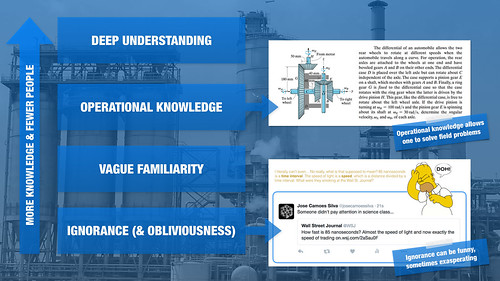
The figure at the top describes four levels of knowledge, roughly separated by their real-world implications; a big problem with the "I love science" crowd is that they act as if the differences between these levels have no real world implications, which they do. From top to bottom:

Ignorance, particularly when combined with obliviousness, can be funny but can also be exasperating. I make some hay from media ignorance in a number of posts (one, two, three), and YouTubers Thunderf00t and EEVblog have fun debunking nonsense that's based on exploiting this ignorance.

But ignorance of science persists, and persists in people who "love science," mostly because their interlocutors are not willing to ask questions. Imagine that someone said they love French; we could then say "tu parles Français, alors?" The people who love French like they "love science" will hear gibberish. This would be an immediate "poseur" alarm; but most people who would do it for French won't ask these questions for science.

(One may even be called anti-social for asking sciencey things to someone who "loves science.")

A passing familiarity with the topic can be a dangerous social trap. As the joke goes, these are the people who believe they can argue successfully with an expert based on having heard a TED talk on the subject while cycling at the gym. It's particularly dangerous when this passing familiarity is acquired by reading popularization tomes created by popularizers (instead of people working in the field).

The problem with passing familiarity is that most people tend to overestimate the reach of their familiarity, mistaking the recognition of sentences for actual understanding of those sentences. In our continuing French example, this would be the case of someone who had some French lessons decades ago and watches French movies with subtitles but can't do much more than ask people in France if they speak English.

In STEM this is a complicated level, since there are people who have a reasonable qualitative understanding of the issues without being able to actually solve technical problems (of any complexity), while there are others who follow the Mythbusters' "science as big booms" or focus on the scientists rather than the science.

There's a second-order effect in this problem, which comes from the importance of quantitative thinking in STEM. Many people have some sort of numerophobia: they resist numerical thinking for whatever reason. Perhaps insecurity, perhaps bad experiences with the educational system. But for STEM, once we're past the basics, numbers matter. Numbers become all that matters.

(There's an interesting case of this familiarity-level overreach in Business Management [as a discipline]: many people who have a vague familiarity with business speak think that they actually know business material. Some of them say things as ignorant as "management is just common sense," at which point I ask them to value an option or process some market research data using common sense.)

Operational knowledge is the level at which most people who actually know something operate. For our French example, that would be a person who can communicate like a French person (talk with French people, watch French-language movies and TV shows, write blog posts in French, read French books).


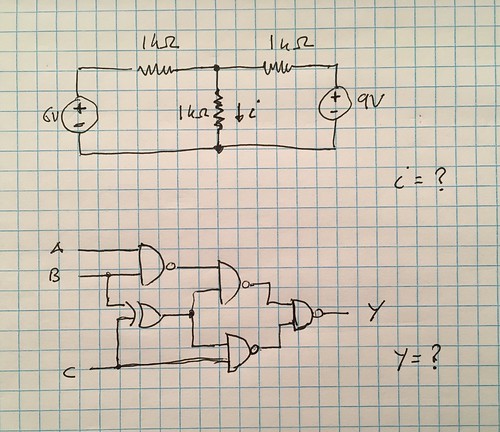
In STEM this level is easy to separate from the passing familiarity (and to divide into sub-levels) by using actual applications. In the chart at the top of the post, computing the angular speed of the axles of a differential is a simple, high-school level Physics question; the kind of thing engineering students have to know how to do in their freshman year.

I have in the past suggested screening social interactions using simple questions, sometimes as simple as asking for basic unit conversion (how many Joule in a kilowatt-hour?) sometimes with a problem or two:

Fundamentals. Usually forgotten before end of formal education.

A deep understanding of the field is something most people, including those who have operational knowledge, have no need for. Continuing with the French example, this would be the case of someone who creates crossword puzzles for Le Monde, copyedits literature tomes in French, and generally argues fancy matters of language.

In STEM these tend to be the Research and Development departments, the research scientists, the design engineers, the specialized technical consultants. In other words, the people who create the future of our technological society.

(At this point one feels obliged to note that people with a deep understanding of STEM tend to be the most reviled in most social environment: cf. definitions for nerd and geek.)


What is both ironic and dangerous is that (as indicated in the chart at the top) the number of people in each level of knowledge decreases with increasing knowledge, but (not indicated in the chart) the level of confidence these same people have in their statements about STEM doesn't. I believe that this is a definite change relative to a few decades ago, and not a change for the better.

It appears that the cost of increasing the popularity of "loving science" was the loss of meaning of "knowing science" (STEM, really). This is a dangerous trend in a technology-dependent society.

Sunday, November 20, 2016

Again, the problem with science communication

The problem with science communication is the science communicators who aren't interested in communicating science.

Take, for example, this tweet:
Yes, it's quite obvious that the Science Channel twitterer is referring to the solar system, not the galaxy.

No. That's not true.

The announced television show itself, I'm sure will get that right. But the twitterer? I literally can't even, as the kids say. And I literally can't even... bet a cup of coffee that the twitterer understands the difference between the solar system and the galaxy --- because I have an MBA.

Yes, a Master's degree in Business Administration, and that's what tells me that it's quite likely that the twitterer has no clue about the science. First, because it was posted at midnight on Friday; second, because it's television; and third because it's on twitter.

It's not even a case of people who "love" science (as long as they don't have to learn any). It's more a case of 'we need a "communications/social media team" for this property.' (Property here refers to the Science Channel.) That's the twitter part: the team is grown as an appendage to the marketing group because that's how people in media tend to see twitter, just another channel to add to the communications mix.

And these "communication/social media team" members are recruited from communication programs and from people who are part of the influence network of those in charge of recruiting, because that's how things are done in mass media conglomerates. So that's the television part.

At midnight on a Friday, the most junior or least competent members of the team will be the ones operating the account. And those are likely to be the ones who are least likely to know the difference between galaxies and solar systems.

But the recruitment of people who know nothing about science to positions of science communication isn't the worst problem.

The worst problem is that there's no problem, not really, because:
  • Since the audience doesn't care, the advertisers don't care either. After all, it's not like they really want a critical thinking audience for their commercials. (Remember, I have an MBA. Only few products and companies want a critical thinking audience.)
  • Since the advertisers don't care, the channel management doesn't care. And most in management have no interest in science; it's a product to be sold, just like potato chips and time-share vacations.
And the science-educated audience, the ones who notice these things? Well, everyone hates a know-it-all tattle-tale nerd. Until the technological society that was built by engineers on the foundations of science collapses.

Then, well, then that was a totally unpredictable act of God Nature.

Problem with science popularization

Wednesday, November 16, 2016

Why I write careful posts on nonsensical topics

Basically, because I'm not allowed to write or talk about work-related matters.

So I apply my considerable intelligence, broad knowledge, and unbeatable modesty to things like the differences between powerlifting and bodybuilding (and the superiority of the former over the latter), using the standard B-school two-by-two matrix format (click for bigger):


I also take to task people who think that knowledge is superfluous as long as their intentions are good (or at least consistent the the current "virtuous" narrative). For example, I did congratulate TIME for not using a photo of cooling towers for this article (unlike almost everyone else who uses images of cooling towers' steam to write about pollution),


but I do have to point out that most of what's seen coming out of those stacks is also steam. First, the color and the shape of the expansion give that away, but even if they didn't, gaseous $\mathrm{CO}_{2}$ is transparent, as is water vapor. (Steam is liquid water suspended in water vapor.) And soot and other common pollutants have distinctive colors; that white means water.

If you're surprised that combustion would generate water vapor, which condenses when it expands at the top of the stack, remember that hydrocarbon-based fuel combustion is mostly
$ \mathrm{C}_{n}\mathrm{H}_{m}  + (n+ m/4)\,\,\, \mathrm{O}_{2}\rightarrow n\,\,\, \mathrm{CO}_{2}  + m/2 \,\,\, \mathrm{H}_{2}\mathrm{O},$

and most of the rest (nitrous and sulfurous compounds, metals, soot and ash, the souls of the damned) are removed from the smoke before it's allowed to leave through the stacks (because of laws against pollution):


Sometimes I do take the nonsense dial to 11 --- but all the calculations are correct.

About a year ago, when I temporarily changed the name of this blog to Project 2016, the idea was to track non-work related learning, which is one of my hobbies; but time constraints made me choose between actually learning stuff and blogging about it, and I chose the learning.

So, expect some more carefully thought-out nonsense. Careful thinking is another one of my hobbies, so I practice it even on nonsensical topics. I have very strange hobbies: another one is moving heavy objects for no immediate purpose, like this gentleman


Live long and prosper -- JCS

Sunday, November 13, 2016

Non-linearity is a pain in the neck and other smart content of this week

Non-linearity is a pain in the neck

Literally; and I use "literally" literally, not figuratively.

Most of the time we have an implicit linear worldview: if $x$ effort gives you $y$ result, then $(1+\epsilon)x$ effort should give you $(1+\epsilon)y$ result, approximately. And in many cases, where the $\epsilon$ is very small, this tends to be the case.

But the world isn't linear, especially in the gym. Especially in conditioning. (Editor note: conditioning is like cardio, except it actually works because it's high-intensity, short, and paused; that makes it very painful. This is why most people who are happy with no results prefer cardio, which delivers no results with only mild discomfort.)

Along with the basic, more functional conditioning movements (hill sprints, farmer's walks, stair sprints, sandbags), I've been doing medicine ball Atlas stones. Basically, one lifts a medicine ball from between one's feet to a platform above shoulder height (like an Atlas stone), then brings it back to the floor. Like any other conditioning exercise, this needs to be done correctly to avoid injury and not the CrossFit way of "fake it until you break it."

(The real Atlas Stone exercise. Those are not medicine balls.)

Medicine ball Atlas stone lifts have one of the most nonlinear pain response functions in the gym. Basically, for the first 5-10 reps, it feels like nothing is happening; the heart rate raises slowly and the muscles get a little hot. Then, at about 15, you discover muscles that never hurt before; discover them as they start hurting hard and fast. I discovered several new muscles in my neck --- and I regularly train neck as part of the posterior chain.  At 20-25, the ball has become pure neutronium, the platform has relativistically moved up several parsecs, and your blood pressure could drive a nuclear power plant turbine. So you rest 90 seconds, then restart; that's conditioning.

That's non-linearity.

In fact the response function is highly non-linear, not something that could easily be approximated with a low-degree polynomial, so I propose the following model:

Plot of $\mathsf{Pain} \doteq \exp(\exp(\exp( 0.035 \times \mathsf{Reps})))$

One of these days I'll write something serious about the misuse of linearity in everyday thinking; possibly also comment on the use of "exponential" to describe all convex functions and the unprofessionalism of drawing said "exponentials" on slides using the 'draw ellipse segment' tool in PowerPoint instead of plotting the actual function. But that's for another day.

Added Nov 16, 2016: while we wait for that "another day," here's a visual comment on convex functions:


Stephen Wolfram helps popularize science. Real science.

Stephen Wolfram, creator of Mathematica and author of A New Kind Of Science (but don't hold that book against him), helped the producers of the movie Arrival (2016) make less fools of themselves than the usual in scifi movies:
When I watch science fiction movies I have to say I quite often cringe, thinking, “someone’s spent $100 million on this movie—and yet they’ve made some gratuitous science mistake that could have been fixed in an instant if they’d just asked the right person”.
Part of that is the audience, who says "I love science" but really only likes the image (or at most the idea) of liking science and has no interest in actually learning any. It's like those people who like the idea of getting in shape, but don't exercise or change their unhealthy habits.
Occasionally one can see code. Like there’s a nice shot of rearranging alien “handwriting”, in which one sees a Wolfram Language notebook with rather elegant Wolfram Language code in it. And, yes, those lines of code actually do the transformation that’s in the notebook. It’s real stuff, with real computations being done. (Emphasis added.)
Here's Dr. Wolfram (whose alter ego is Mr. Tungsten --- couldn't resist 😀) talking about serious things:


Living in the future is great, never mind those who long for the "good" old times.

I have two words for these who long for the good bad old times: modern dentistry. (Not my original thought, but I've heard it from many sources; don't know original attribution. Still effective at capturing the power of technological change at an emotional level.)

Ai Build's system uses video cameras outfitted with machine learning algorithms to allow robots to learn from their mistakes—meaning they can operate more quickly, correcting for errors on the fly instead of moving slowly to prevent them. According to Cam, Ai Build's arms can print in half the time it would take using standard techniques. (Via Singularity Hub.) 

In one of the first medical applications of this concept, Synlogic has patented a version of E. coli engineered to develop “an unquenchable appetite for ammonia” and turn it into the amino acid arginine, which, unlike ammonia, is harmless to the human body. (Via Singularity Hub.)  

Media Briefed on New NASA Hurricane Mission


As you can see, NASA is causing all these hurricanes to create a New World Order where scientists will rule and… huh, no. It's just that hurricanes are kind of easier to spot from high above the atmosphere than from the basements where the people who come up with these NASA conspiracies spend their lives.


That's it for this geek-out. Live long and prosper. --JCS


(Mood music.)

Wednesday, November 9, 2016

Powerlifters vs Gym Rats, take 2

(This is a redo of the numbers in my previous powerlifters vs gym rats post, with assumptions that are less favorable to powerlifters.)

First, since we need some sort of metric to compare athletes, I'll unbiasedly 😀 choose the average of three lifts, bench press, deadlift, and squat, as a percentage of the bodyweight of the athlete. Call that metric $S$.

We'll use a standard Normal for the distribution of this metric, by subtracting the mean (100 percent of bodyweight for non-powerlifters, assuming that the average gym rat can bench, deadlift, and squat their own bodyweight) and dividing by the standard deviation (say 15 percent of bodyweight, using the scientific approach of judging 10 to be too little and 20 to be too much). In other words, for non-powerlifters, $z \doteq (S-100)/15.$

As in the previous post, we'll assume that powerlifters are 1 percent of the gym rats; but instead of the powerlifters having a mean at 2 (in $z$ space, 130 in $S$ space), they only have a one-SD advantage, that is their mean is at 1 (in $z$ space, 115 in $S$ space). In other words

$\qquad z \sim \mathcal{N}(0,1)\qquad $ for non-powerlifters
$\qquad z \sim \mathcal{N}(1,1)\qquad $ for powerlifters

Using these assumptions we can now compute the percentage of powerlifters that exist in a gym population above a given threshold; we can also compute the median score of all athletes who score above that threshold (click for larger):


Note that the conditional median that we're using here is lower  than the conditional mean, as the conditional distribution is skewed to the right, i.e. has a long right tail. The choice of the median is more informative for skewed distributions as a "sense of what we'll see in the gym."*

It's interesting to note that this is the median of the combined distribution of powerlifters and other gym rats, weighted by their proportion in the population above the threshold, so the difference between this median and the threshold is a non-monotonic function of the threshold as the curvature and the weight of the distribution of each type of athlete change significantly in the $1-8$ range of the table.

Under these weaker assumptions (pun intended), only when the threshold for inclusion passes 5 standard deviations from the other gym goers' mean do powerlifters become the majority of the qualifying athletes. Unless the gym is full of football players (that's american football), weightlifters, and strongman competitors, I think these assumptions are too unfavorable to powerlifters.

Here are some strong athletes moving metal, for variety (NSFW language):


"While they squat I eat cookies" has to be the most powerlifter-y sentence ever.

Update Nov 11, 2016: Here's the percentage of powerlifters in the population of qualifying athletes for different assumptions about the advantage of powerlifters (i.e. the mean of the powerlifters' distribution in standard deviation units); click for larger:


- - - - - -
* Unless there are CrossFit-ers in the gym, in which case what we typically see in the gym is dangerous, counter-productive nonsense.