Showing posts with label problem-solving. Show all posts

Friday, February 24, 2017

If it's a math problem... do the math

Or, The Monty Hall problem: redux.

I recently posted a new video, addressing the Monty Hall problem. The problem is not the puzzle itself, which has been solved ad nauseam by everyone and their vlogbrother.


The video is about what information is. By working through the details of the Monty Hall puzzle, we can learn where information is revealed and how. That is the reason for the video; that and a plea for something so simple and yet so ignored that I'll repeat it again:

If it's a math problem, do the math.

Now, this may seem trivial, but math (and to some extent science, technology, and engineering, to say nothing of business, management, and economics) makes people uncomfortable, even people who say they "love math."

Hence the attempt to solve the problem with anything but computation. By waving hands and verbalizing (very error prone) or by creating similar problems that might be insightful (but mostly convince only those who already know the solution and understand it).

If all you're interested is the computations for the solution, they're here:


The point of the video is not this particular table; it's the insights about information on the path to it: how constraints to actions change probabilities and how those relate to information.

For example, from the viewpoint of the contestant, once she picks door 1 (thus giving Monty Hall a choice of door 2 and door 3 to open), the probability that Monty picks either door 2 or door 3 is precisely 1/2; that's calculated in the video, not assumed and not hand-waved. But, as the video then explains, that 50-50 probability isn't equally distributed across different states:


A final remark, from the video as well, is that by having computations one can avoid many time-wasters, who --- not having done any computations themselves and generally having a limited understanding of the whole state-event difference, which is essential to reasoning with conditional probabilities --- are now required to point out where they disagree with the computation, before moving forward with new "ideas."

If it's a math problem... do the math!

Tuesday, August 30, 2016

Some thoughts on quant interviews

Being a curmudgeonly quant, I started reacting to people who "love" science and math with simple Post-It questions like this:


(This is not a gotcha question, all you need is to apply Pythagorean theorem twice. I even picked numbers that work out well. Yes, $9 \sqrt{2}$ is a number that works out well.)

Which reminds me of quant interviews and their shortcomings.

I already wrote about what I think is the most important problem in quantitative thinking for the general public, in Innumeracy, Acalculia, or Numerophobia, which was inspired by this Sprezzaturian's post (Sprezzaturian was writing about quant interviews).


In search of quants

That was for the general public. This post is specifically about interviewing to determine quality of quantitative thinking. Which is more than just mathematical and statistical knowledge.

One way to test mathematical knowledge is to ask the same type of questions one gets in an exam, such as:

$\qquad$ Compute $\frac{\partial }{\partial x} \frac{\partial }{\partial y} \frac{2 \sin(x) - 3 \sin(y)}{\sin(x)\sin(y)}$.

Having interacted with self-appointed "analytics experts" who had trouble with basic calculus (sometimes even basic algebra), this kind of test sounds very appealing at first. But its focus in on the wrong side of the skill set.

Physicist Eric Mazur has the best example of the disconnect between being able to answer a technical question and understanding the material:

TL; DR: students can't apply Newton's third law of motion (for every action there's an equal and opposite reaction) to a simple problem (car collision), though they can all recite that selfsame third law. I wrote a post about this before.

Testing what matters

Knowledge tests should at the very least be complemented with (if not superseded by) "facility with quantitative thinking"-type questions. For example, let's say Bob is interviewing for a job and is given the following graph (and formula):

Nina, the interviewer, asks Bob to explain what the formula means and to grok the parameters.

Bob Who Recites Knowledge will say something like "it's a sine with argument $2 \pi \rho x$ multiplied by an exponential of $- \kappa x$; if you give me the data points I can use Excel Solver to fit a model to get estimates of $\rho$ and $\kappa$."

Bob Who Understands will start by calling the graph what it is: a dampened oscillation over $x$. Treating $x$ as time for exposition purposes, that makes $\rho$ a frequency in Hertz and $\kappa$ the dampening factor.

Next, Bob Who Understands says that there appear to be 5 1/4 cycles between 0 and 1, so $\hat \rho = 5.25$. Estimating $\kappa$ is a little harder, but since the first 3/4 cycle maps to an amplitude of $-0.75$, all we need is to solve two equations, first translating 3/4 cycle to the $x$ scale,

$\qquad$ $ 10.5 \,  \pi x = 1.5 \,  \pi$ or  $x= 0.14$

and then computing a dampening of $0.75$ at that point, since $\sin(3/2 \, \pi) = - 1$,

$\qquad$  $\exp(-\hat\kappa \times 0.14) = 0.75$, or $\hat \kappa = - \log(0.75)/0.14 = 2.3$

Bob Who Understands then says, "of course, these are only approximations; given the data points I can quickly fit a model in #rstats that gets better estimates, plus quality measures of those estimates."

(Nerd note: If instead of $e^{-\kappa x}$ the dampening had been $2^{-\kappa x}$, then $1/\kappa$ would be the half-life of the process; but the numbers aren't as clean with base $e$.)

This facility with approximate reasoning (and use of #rstats :-) signal something important about Bob Who Understands: he understands what the numbers mean in terms of their effects on the function; he groks the function.

Nina hires Bob Who Understands. Bonuses galore follow.

Bob Who Recites Knowledge joins a government agency, funding research based on "objective, quantitative" metrics, where he excels at memorizing the 264,482 pages of regulation defining rules for awarding grants.

Sunday, August 14, 2016

Working the solution versus solving the problem

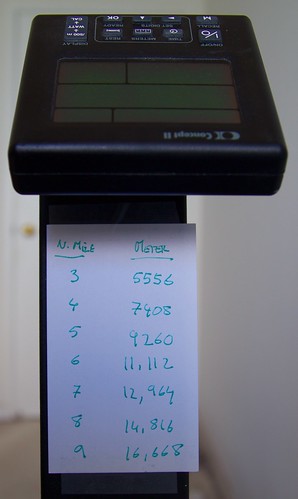
Some time ago I tweeted that I was going to row a number of nautical miles on my trusty old Concept IIc machine. As an engineer, I use SI units for everything --- except on the water, where I use traditional units: nautical miles and knots.

A couple of rowers I know asked me how I had hacked the controller on the Concept IIc to change the units. This was my answer:

How I "hacked the software" on the Concept IIc to use nautical miles. #genius

Many people miss the point, that the others were making a common mistake in problem-solving, a mistake that forecloses most creative solutions:

The mistake is working the solution instead of solving the problem.

Hidden in the question about the hack is an assumption: that the solution has to come from my programming skills (they know what I do, so it's not an unreasonable assumption). That assumption sets a path to a solution, which would include reprogramming the firmware inside the Concept IIc controller.

Having the ability to backtrack from that path into the beginning and to choose another path is the key process in the thinking process here. Too many people start on one path and can't get off it to pursue other possible paths to the solution.

By focussing on the problem, i.e. the question "what is to be achieved?", rather than the solution under consideration, changing the software, the mistake was avoided.

Yes, this is a trivial and obvious (after the fact) example, but often the difference between a non-working "solution" and a working solution is a matter of focus on the problem to be solved.

Alas, changing their focus is too hard for some would-be problem solvers.